A rising tide lifts all boats: How tech small caps gained from the AI boom in 3Q25


For small-cap stocks, late summer was a turning point. At Jackson Hole, Fed Chair Jerome Powell signaled that the tight monetary policy was nearing an end. For small caps, whose profitability is especially sensitive to borrowing costs, that implied a reset in expectations. Tech added fuel: a pickup in new contracts to build AI data centers and strong demand for products from leaders such as Nvidia, Oracle, and TSMC reinforced the idea that even smaller tech names can ride the ongoing AI boom.
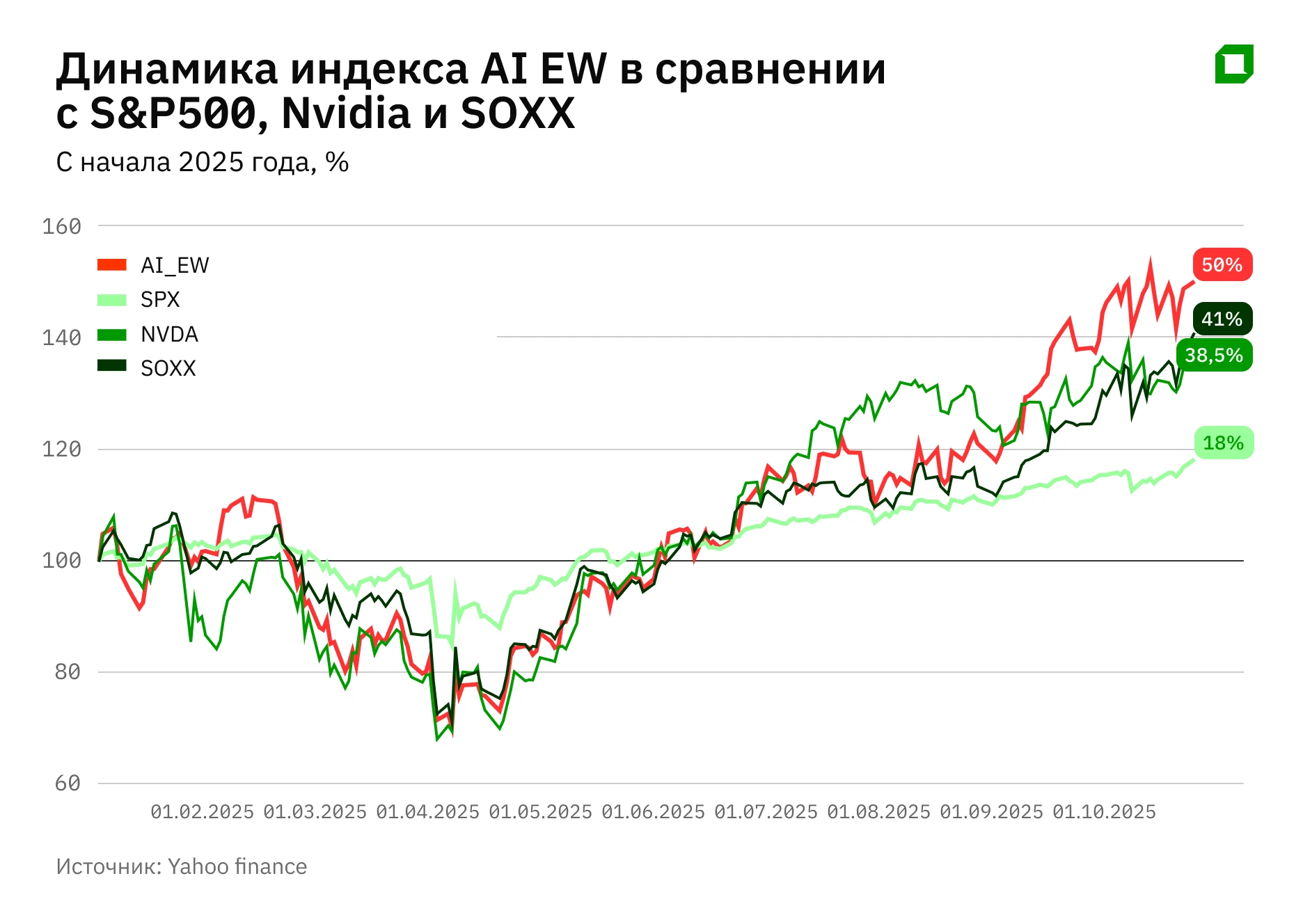
An index meant to measure them, the AI Small Cap Equal Weight Index, calculated for Oninvest by analyst Aldiyar Anuarbekov, rose 37% in the third quarter and is up 50% year to date. The index tracks 46 small-cap companies tied to AI infrastructure, sensors, robotics, and quantum computing.
In the third quarter, 39 of the 46 index members advanced. Notably, small-cap AI names outperformed Nvidia and the iShares Semiconductor ETF (SOXX), which are up 38.5% and 41.0% year to date, respectively.
Individual outperformers
Applied Digital
The top performer of the third quarter was Applied Digital – its shares jumped 135% last quarter and are up 194% year to date. The company builds data centers for AI computing. Investors cheered progress on key projects: Applied confirmed a new construction phase for CoreWeave capacity and said it is preparing deals with two additional, undisclosed cloud operators.
In October, Needham raised its target price from $21 per share to $41 per share, citing a clearer project pipeline and expected hyperscale deals. Craig-Hallum argues that momentum can support a continuous cycle of new sites and contracts into 2026. Twelve analysts cover the stock, according to MarketWatch data, all with “buy” or “overweight” ratings, and the consensus target price is $42.90 per share, for roughly 25% upside.
Absci Corporation
Absci is a generative-AI platform for biologics design, combining AI models with high-throughput wet-lab validation. The stock rose 13% in the third quarter, up 66% year to date, helped by strategic AI bioengineering alliances. In early November, Absci announced a partnership with Oracle Cloud and a strategic investment from AMD to accelerate its AI drug-creation platform. Those updates, alongside insider buying, supported sentiment. Nine analysts cover the stock, according to MarketWatch data, all with “buy” recommendations; the average target price of $8 per share implies the shares could nearly double.
Innodata
Innodata supplies “smart data” to help train third-party AI models. The shares gained 63% in the third quarter and 101% year to date after strong results and upgraded guidance. For the second quarter of 2025 (ended July 31), revenue rose 79%, and the management raised its full-year organic growth target to more than 45%. The explosive growth has convinced investors that demand will exceed expectations.
The autumn gains were amplified by Wedbush, which flagged Innodata as a prime AI acquisition candidate. Following that, the stock rose roughly 23% in the week of September 29-October 3 on that call. Wedbush analysts note that amid growing demand for resources and specialized teams in AI, Innodata is favorably positioned as a provider of key technologies in data engineering and training arrays. This makes the company a beneficiary of growing investment by major players in generative AI, Wedbush believes. Five analysts cover the stock, all with “buy” ratings at an $83.70 per share consensus target price, for about 8% upside.
Relay Therapeutics
Relay applies AI and computational design to drug development. The shares rose 48% in the third quarter and 72% year to date. In early September, Guggenheim initiated coverage with a “buy” rating and a $15 per share target price – nearly four times the then-market value – and named it a one of its top ideas, citing a promising breast cancer program (RLY-2608) and a cash balance roughly equal to its market capitalization.
For the second quarter, revenue was approximately $700,000 versus zero a year earlier, while the net loss per share narrowed nearly 41% to $0.40 per share. Guggenheim noted that the improved operating performance boosts the company's investment case, especially given the progress in the development of its key candidate. Of the 12 analysts covering the company, 10 rate the stock “buy” and two “hold,” with a $13.60 per share consensus target, implying nearly a doubling in value.
Outlook
Interest in AI infrastructure remains steady, with large technology companies increasing capital investments in data centers and cloud capacity for AI tasks, creating a "rising tide lifting all boats" effect for the small-cap segment.
Demand for AI infrastructure remains firm as large tech companies boost capital expenditures for data centers and cloud capacity, resulting in a rising-tide effect for small caps. Index constituents plug into this at multiple levels, from chips and sensors to data processing and model hosting. Global AI spending is projected to expand rapidly, with some forecasts pointing to a $1.68 trillion market by 2031, leaving room for niche players to capture share.
In the second half of this year, customer counts should grow: hyperscalers are outsourcing compute, pharma is funding AI discovery platforms, and industrials are adopting robotics. That supports further gains into 2026, assuming macro conditions remain favorable – cheaper money typically supports innovation sectors.
Risks
Concentration remains a vulnerability. Applied Digital’s trajectory depends on a few HPC tenants, and Absci’s on big-tech partnerships. The loss of a single contract or a pause in AI spending could dent results. In addition, Morgan Stanley warns that AI capex is concentrated among hyperscalers and Big Tech, which translates into overcapacity and demand-cooling risks.
Ultimately, the performance of the AI Small Cap Equal Weight Index will hinge on whether companies can validate the commercial potential of their technologies and whether capital continues to flow into AI infrastructure.
The AI translation of this story was reviewed by a human editor.