AI agent of special significance: why China banned Meta and Manus' $2 billion deal


China blocked the deal between Meta and Manus weeks before President Trump and Chairman Xi met. Photo: manus.im
Three young Chinese men founded a startup that, just 8 months after launching in March 2025, was bought by Meta for about $2 billion. A success story? Not exactly. On April 27, two days before Meta's quarterly earnings release, China said it was banning the deal for Mark Zuckerberg's company to buy popular AI agent Manus. Roman Kutuzov analyzes why the Chinese authorities won't give up this AI agent?
Butterfly effect
Manus was created by Xiao Hong, a Chinese serial entrepreneur and software engineer. In 2022, he launched Butterfly Effect ("Butterfly Effect"), a Beijing-based company that developed an AI plugin for Monica browsers.
The product was in demand and attracted more than a million users.
It was also in the bowels of Butterfly Effect that the Manus AI agent was born, which was later spun off into a separate company. In addition to Xiao Hong, its co-founder was Ji Yichao, a programming genius, who at the age of 19 was included in the "30 under 30" rating of Chinese Forbes - he held the position of chief scientist at Butterfly Effect. Ji leads the technical and infrastructure development of Manus.
Zhang Tao, head of product development at Manus, has also joined the founding team. According to Business Insider, he has experience at Chinese tech giants ByteDance and Tencent.
In March 2025, Ji Yichao introduced Manus to the public in a short video.
He showed how Manus performs complex multi-step tasks, analyzing summaries, real estate and stock markets, presenting information in the form of easy-to-use reports, tables and charts.
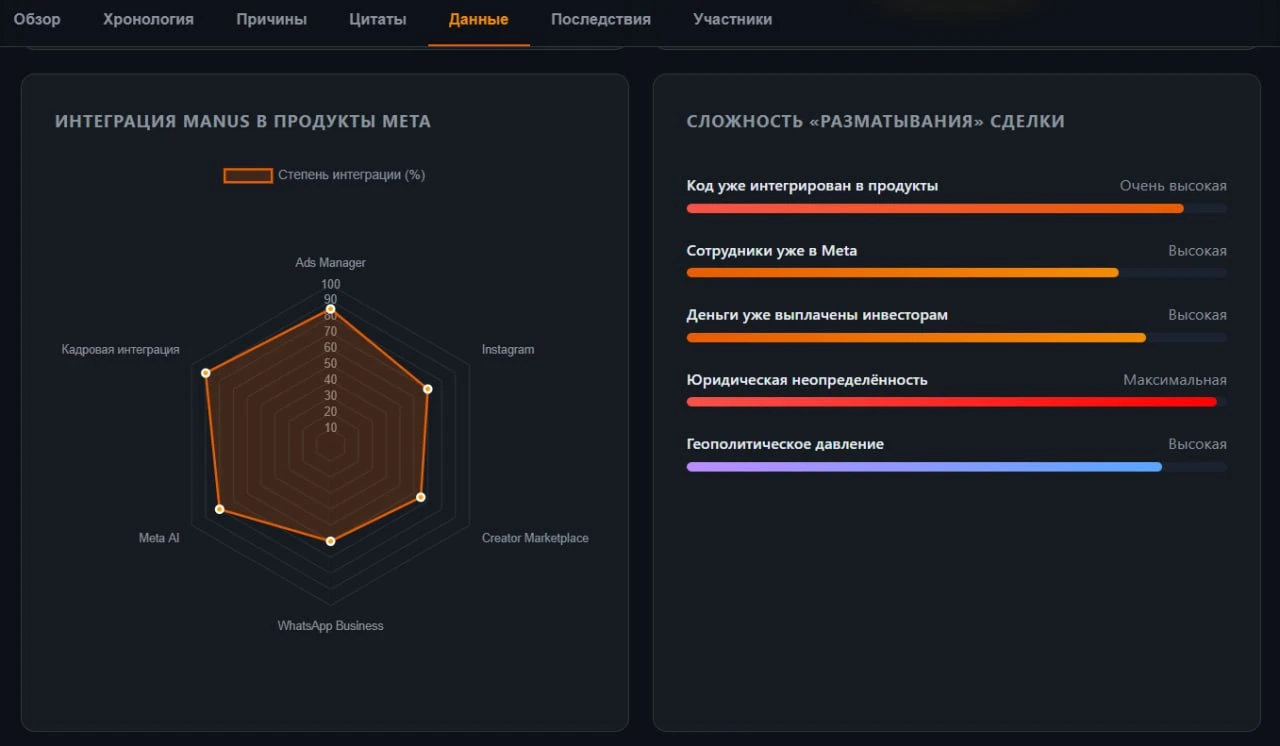
So Manus visualized the ban on its own deal with Meta by one simple query. And this is only a small part of the information he collected.
As I wrote earlier, an AI agent is the "harness" or "arms" that allow the AI to act. At the same time, the "brain" can be any large model. Manus works with both the Chinese Qwen and the American Claude.
Requests of each user he performs on a virtual computer in the cloud, which provides on the one hand security (no access to data on your personal computer), and on the other hand - continuity, you can give him a task and quietly leave the computer, he will work in the cloud and will report when he gets the result.
The announcement of one of the first true AI agents on the market caused a stir. Invitation codes granting early access to the product were resold in China and Silicon Valley for up to $15,000, and more than a million users signed up for the waiting list.
Adherents called it "thesecond DeepSeek", the new pride of Chinese IT, and critics called it just a "shell" without its proprietary technologies, writes the FT, but that's the essence of an AI agent. The question is how functional and convenient this shell is.
Exodus from China
Further events developed rapidly. Already in April, the American company Benchmark led a $75 million round, with Manus' total valuation at $500 million.
That's when the criticism came in: U.S. Senator John Cornyn wrote on the X network:
"".
Who thinks it's a good idea to have American investors subsidize our main AI adversary, only to have the CCP [Chinese Communist Party - Oninvest note] use the technology to economically and militarily oppose us? Certainly not me
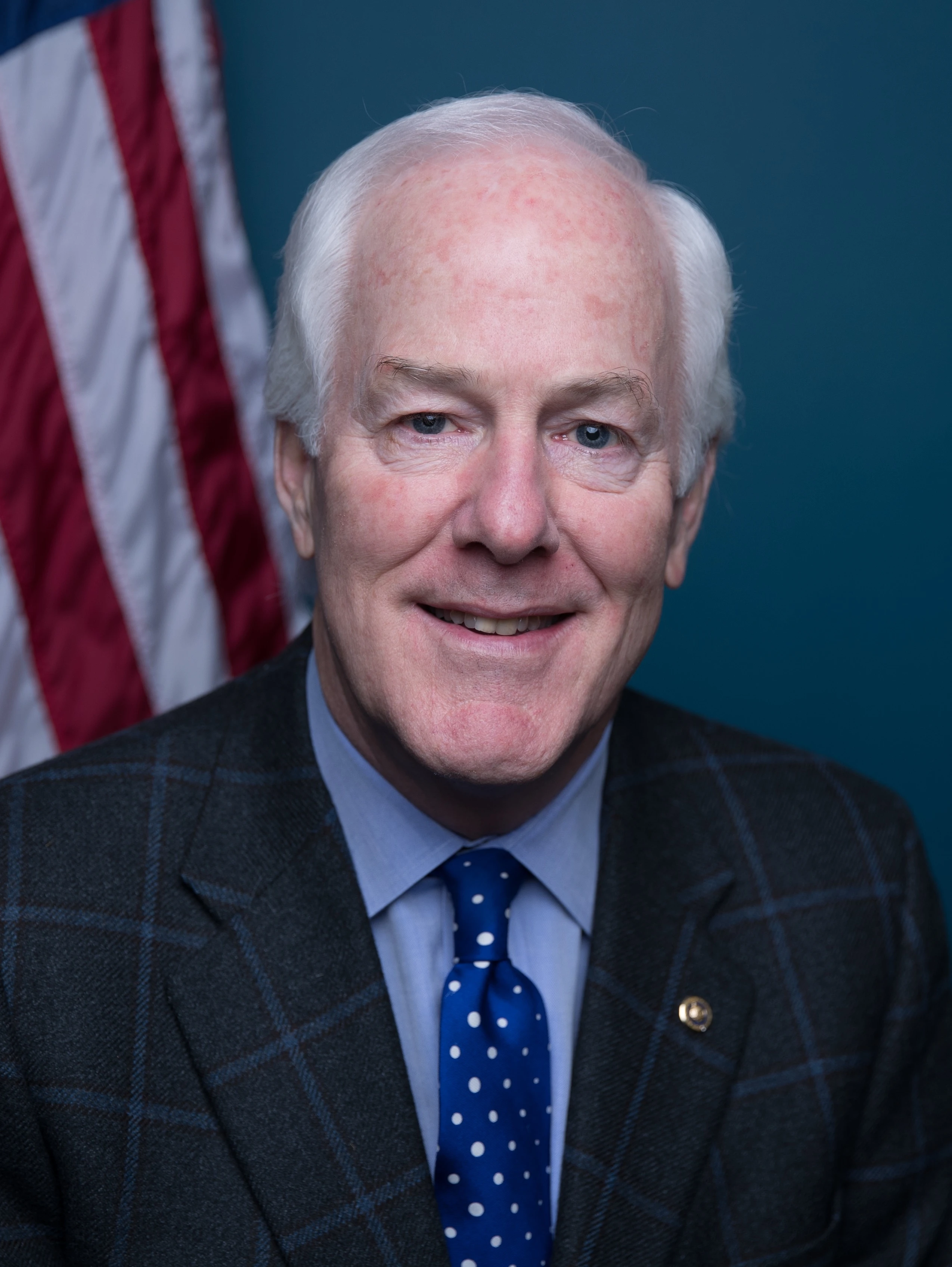
It was generally clear that if the company wanted to enter the US and European markets, it could not stay in China. To recall, for example, the fate of Bytedance, which was forced to sell control of the American part of Tik-Tok to a consortium of investors under threat of a complete ban - the Chinese retained only 19.9%.
In the summer of 2025, Manus moved its office to Singapore and laid off more than a hundred Chinese employees in Beijing. This is where Chinese criticism began: "Manus is leaving its home country, using cheap and highly skilled Chinese engineers to develop its product," the FT quoted a popular Weibo post as saying. However, officials in Beijing remained silent at the time.
In mid-December, Ji Yichao boasted in X that Manus had grown from zero to a business with recurring subscription revenue of $100 million in just 8 months.
One user wrote in response:
.
I was a beta tester. When I first saw Maus, I thought AGI was coming sooner than we thought it would
Finally, in late December, Meta announced that it was buying Manus for an estimated $2 billion or more. At the same time, Meta promised that there would be no Chinese owners left in the company, Manus and Monica's services in China would be discontinued, the remaining Chinese employees would be relocated to other countries, and Xiao Hong would become Meta's vice president. All in all, a complete break with China.
But it didn't.
Failed chuhai or what China didn't like
"In recent years, major Chinese technology companies and startups have been setting up overseas subsidiaries in a trend known as "chuhai," or "going offshore," taking their own innovations overseas. Beijing is therefore exploring ways to strengthen its position in cross-border deals involving domestic technology, data, talent or markets," China's South China Morning Post wrote.
The technique used by the founders of Manus is called Singapore-washing - bringing technology out of China through Singapore. It used to work perfectly well, but this time something went wrong.
According to the FT, the Chinese authorities' stance changed after the National Security Commission intervened. Its report, which characterized the deal as a "conspiracy," was circulated among top officials and prompted a broader multi-agency probe.
In March, two of the three founders, Xiao Hong and Ji Yichao, were summoned to Beijing to testify as part of a technology export control investigation into the sale of Manus. And banned them from leaving the country for an as yet unknown period of time. "The transaction was in full compliance with applicable laws. We await the proper resolution of the investigation," Ma said on the matter.
And they waited. On Monday, April 27, China's Foreign Investment Security Administration published its decision: foreign investment in Manus is prohibited and the deal must be terminated. That's it, no explanations, just the verdict.
The day after the ban, China's state-run Global Times published a story calling the government's decision "reasonable, legal and necessary." Although the startup was formally Singaporean at the time of the sale, it was built on Chinese soil, by Chinese engineers and on Chinese data, which means China has every right to ban the deal if it violates its interests, the newspaper argued in an unsigned editorial.
Manusgate
Of course, analysts are mostly discussing that this is a new round of the battle for supremacy in AI technology, and multinational companies will now have to assume that any technology with Chinese roots - regardless of where it is used - is subject to Beijing's veto, meaning it creates business risks.
But for Meta specifically, the situation is, to put it bluntly, dire. Money has already been paid to the former co-owners of Manus, its employees have become Meta employees, and the technology has already begun to be integrated into products. It will be very difficult to turn this stuffing back on. But it will also be difficult for the company to simply ignore the decision of the Chinese authorities, although Meta's social networks and messengers are banned in China.
First of all, Meta's current vice president, Xiao Hong, is actually being held hostage, and he must be rescued somehow. And secondly, despite all the bans, in 2024, the company received 11% of its advertising revenue - $18 billion - from Chinese customers (through reseller companies), CNBC recalls. More recent data was not disclosed, but it is likely that the Chinese government can cover up these schemes if it wants to.
According to The Wall Street Journal's sources, Meta is still leaning toward pulling out of the deal, and Chinese former Manus shareholders including Tencent, HSG and ZhenFund are willing to return Meta's money.
China has given several weeks to resolve the issue and otherwise threatens sanctions against Manus and Meta, WSJ writes.
Of course, for a company with global revenues of more than $200 billion in 2025, $2 billion is not a critical amount. Especially since it is very likely that they will be refunded in case of cancellation.
But the story itself riddled Zuckerberg's heroic efforts to get back into the AI race, which seemed to have just begun to bear fruit. How Meta's investors will react to this is not yet clear, but they are unlikely to be happy.
What will happen to Manus and its co-founders Xiao Hong and Ji Yichao is unclear. Will the product survive, and even if it does, will we see it outside of China?
This article was AI-translated and verified by a human editor