"Five-layer cake" AI, the bubble and jobs: what did the head of Nvidia talk about at Davos?

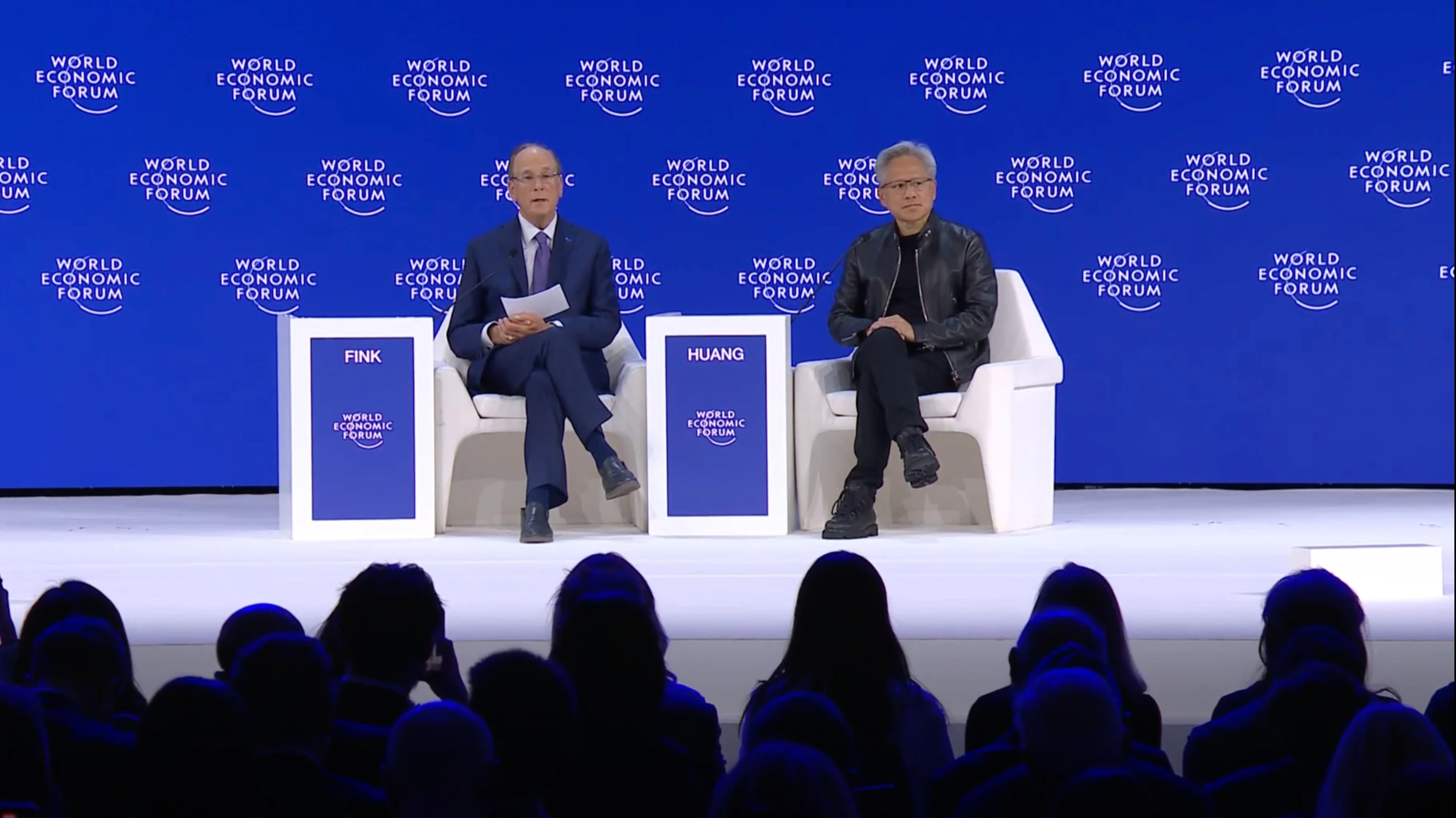
AI development creates demand for jobs, not threatens them, says Nvidia chief / Photo: screenshot of WEF broadcast
The development of artificial intelligence has triggered "the largest infrastructure deployment in human history" and this process is contributing to job creation, Nvidia CEO Jensen Huang said, speaking at the World Economic Forum in Davos. Oninvest has collected the main points from his speech.
Five layers of AI
According to Huang, artificial intelligence is a "five-layer cake." The bottom layer is the electricity needed to run the AI. The second layer - which is exactly where Nvidia is working - is the chips and computing infrastructure. The third layer is the cloud infrastructure for processing data. Next are the artificial intelligence models. "Most people think that's where AI is. But for these models to even exist, you need all the layers underneath," Huang added. The top layer, the most important one, he said, is the application layer. This is where AI can be integrated into financial services, healthcare or manufacturing.
"It is at this top layer where the economic benefit will ultimately be created. But it is important to realize that it requires all the underlying layers. And the process has already started - you can all see it right now: the largest infrastructure construction in human history has begun. We are investing billions of dollars in this."
AI and the workplace
This rapid development of AI does not threaten jobs, but, on the contrary, creates demand for qualified personnel, emphasized the head of Nvidia.
"This is the largest infrastructure build-out in human history, and it will create a huge number of jobs. And the wonderful thing is that they are related to craft trades. We're going to need plumbers and electricians, construction workers and metal workers, technicians, network specialists, and people who install and configure equipment. All of these working professions - and we're seeing this in the United States - are experiencing a very significant boom right now. Salaries have almost doubled; we're talking about six-figure incomes. Everyone should be able to make a decent living, and you don't have to have a Ph.D. in computer science to make that happen
Huang recalled that a decade ago, there was speculation that AI would destroy the radiography profession because computer vision could analyze medical images instead of humans. However, according to Huang, the opposite has happened: with AI, doctors can now process medical images faster and, as a result, see more patients who previously had to wait a long time to be examined. The Nvidia CEO sees a similar trend in the nursing profession.
The AI bubble
Huang said talk of a bubble is related to companies' huge investments in AI, but that spending alone is not a sign of a bubble.
"The investment is great because we need to build the infrastructure that is required for all layers of artificial intelligence. It's a really exceptional opportunity that needs to be seized. That's why the scale of investment is growing. The year 2025 was a record year for venture capital investment, with over $100 billion invested globally, and most of that money going into AI development companies. These AI companies are essentially building the top application layer, and they need the infrastructure, they need our investment to build the future"
What Huang regrets.
At the beginning of the conversation, Huang's interlocutor Larry Fink, head of investment company BlackRock, recalled that Nvidia became a public company in 1999. Huang, in turn, joked that he made one costly mistake at the time.
"My only regret is that after the IPO, I wanted to buy my parents something nice. So I sold Nvidia stock at the company's estimated value of $300 million, and I bought them a Mercedes S-Class. It's the most expensive car in the world
Nvidia's market capitalization now exceeds $4 trillion.
This article was AI-translated and verified by a human editor