Investors were not impressed with Klarna's first post-IPO report. Shares collapsed to the minimum
The company's market value is now a third less than it was at the close on the debut day of trading

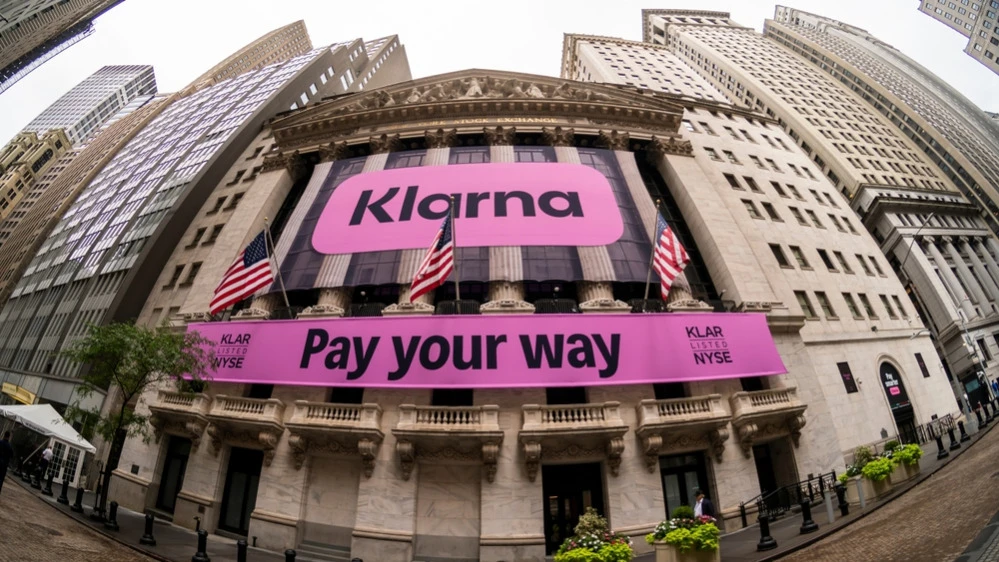
Klarna Group, a fintech company operating in the buy-now-pay-later quick loans segment, beat analysts' revenue expectations, but reported a loss instead of a profit in its first report since its September IPO. Klarna's stock plummeted almost 10% to its lowest level since its publication.
Details
Revenue of fintech company Klarna in the third quarter grew by 28% and exceeded Wall Street expectations: the company received $903 million, while analysts, according to FactSet, expected $885.5 million, writes Barron's. At the same time, the volume of gross merchandise turnover (GMV) in the U.S. increased by 43% to $32.7 billion. Under GMV Klarna understands the total value of all purchases made through its platform. Globally, the figure added 23%, up from 19% in the second quarter.
Klarna says more customers are "paying on time or even early" and realized losses have fallen to 0.44% of GMV, with the company reporting a loss of $95 million for the period; a year ago in the same quarter it reported a $12 million profit.
Investors were most disappointed by transaction margin dollars (TMD) - the difference between revenue and direct transaction costs, according to Barron's. TMD amounted to $281 million versus $316 million for the same quarter last year. The company explained that this "lag in profitability" was expected: like other U.S. lenders, it is required to make provisions for loan losses in advance. In the fourth quarter, Klarna expects to partially offset these losses, forecasting TMD of $390-400 million.
It was the decline in TMD, apparently, that caused Klarna's quotations to fall 9.3% after the report was published, Barron's notes. However, JPMorgan analysts pointed out that TMD as a percentage of transaction volume showed "encouraging" sequential growth in the third quarter, which is positive for the stock.
What else the company announced
According to Klarna, the revenue growth is attributed to the popularity of its fair financing product, which is an installment plan for large purchases with fixed monthly payments that, unlike interest-free options, are designed to last longer. Investors also welcomed the news of Klarna's two-year, $6.5 billion agreement with Elliott Investment Management to support the growth of fair financing in the U.S., Barron's said.
The company believes that one of the key drivers of the quarter was the success of the Klarna Card, a payment card that is becoming the core of the entire commercial fintech ecosystem. Since its launch in July, more than 4 million consumers have signed up for the card. The product combines the functions of a debit card for instant payments and a credit card, allowing purchases to be split into multiple installments. CEO Sebastian Siemiatkowski previously said the product responds to market interest in "a more honest and transparent way to pay."
What's going on with the stock
Since the IPO on September 10, investors' expectations from Klarna were high, recalls Barron's: on the first day of trading the securities rose by 15% against the offering price, closing at $45.8. However, investor enthusiasm has cooled considerably: by the close of trading on Tuesday, November 18, the market value of the company lost 31%.
Klarna shares continue to be pressured by concerns about rising loan delinquencies in the industry, the publication notes. In the first quarter, the company reported a $99 million loss, also due to increased loan losses.
Although the BNPL (buy now, pay later) business model remains popular, it is often criticized, Barron's explains. Players using it make money mainly from merchant commissions and interest payments, and - to a lesser extent - from late fees. The target audience for such products is mainly young people with low financial stability, which is what worries investors.
Other negative factors include rising borrowing costs and competitive pressure from fintech companies such as Affirm, as well as the broader banking sector, which Klarna is targeting, Barron's writes.
Wall Street analysts, however, are bullish on the company. Its securities are recommended to buy 13 analysts out of 19, shows MarketWatch. The remaining six hold a neutral stance.
This article was AI-translated and verified by a human editor