Made by Trump: what investors should know about the new projects of the US President's family

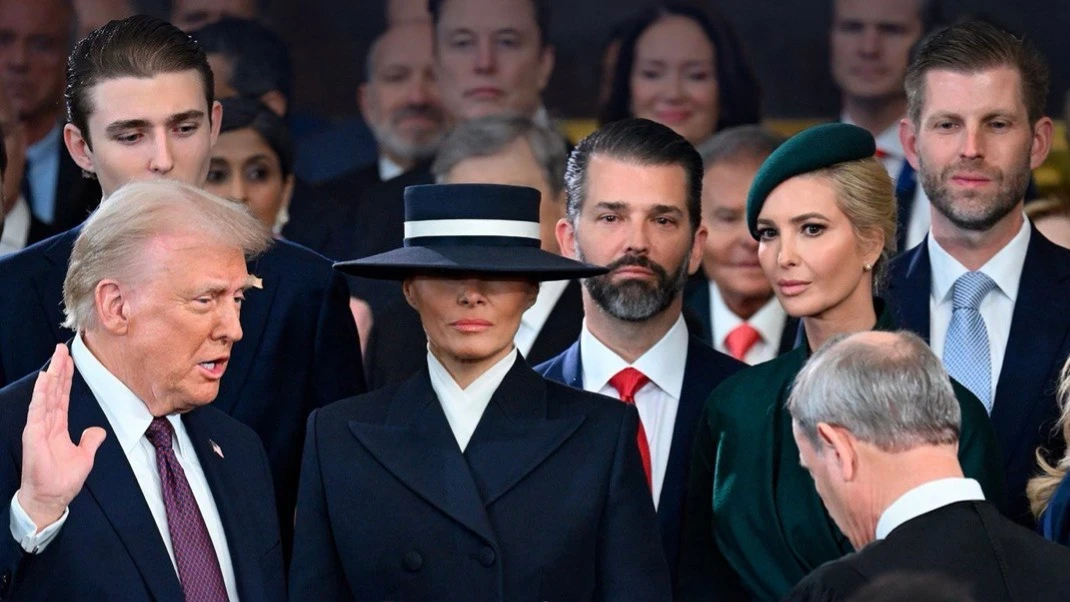
Last week, President Trump's family announced several projects at once - the creation of a mobile operator and the production of an "all-American" smartphone, as well as the launch of a cryptocurrency exchange fund. Do these projects have potential?
"We're going to provide a whole package of services so people can get telemedicine right on their phones, roadside assistance for cars, and unlimited texting to 100 countries around the world," said the president's eldest son Donald Trump Jr.
The Trump family's decision to enter the mobile carrier market has raised many questions. The U.S. mobile market is dominated by the top three - Verizon, AT&T and T-Mobile, which own 95% of the market, and it is not easy to take any significant piece of that pie;
"Mobile virtual network operators (MVNOs) have barely 3-4% of the U.S. market, and their customer churn rate is generally high," Michael Ashley Shulman, chief investment officer at Running Point Capital Advisors, told Reuters. - Unless Trump Mobile hits the one million subscriber mark - which is significantly higher than most successful MVNOs - the financial impact (of this business - ed.) will be minimal."
Trump Mobile immediately entered the market with an unsuccessful price offer compared to its competitors: the basic package of services costs $47.45 per month, which is on average $7 more expensive than similar packages from the top three and significantly worse than offers from smaller market players. That is, it does not so much correspond to the real market value, but serves as an additional reminder of the operator's connection with the owner of the White House - he is the 47th and 45th president of the USA. Such symbolism may please the pope, but hardly its potential customers, Digitrendz notes. "The tariff includes some unusual perks, but their real value is questionable. Ultimately, benefit-oriented consumers should stay away from Trump Mobile," the publication concludes.
The T1 smartphone has drawn even more criticism. Apple Insider directly accused the Trump family of cheating - no "made in USA" phone is even out of the question, according to journalists of this publication: "The smartphone, which the Trump Organization claims is made in the U.S., is actually a cheap Chinese Android device, which they triple the price on Amazon, cover with new plastic, and that's the end of it";
The Verge points to inconsistencies on the T1's official website. "The triple camera unit at first glance resembles the latest iPhone Pro models, but the lenses are oddly placed and the flash seems to be missing altogether. There are many errors on the page: the processor section doesn't contain information about the processor, RAM is confused with storage, and there's a proud mention of a '5,000mAh long-life camera', though it's obviously about the battery," listed The Verge.
There are also questions about the price of the future smartphone - it is stated at $499, with Trump's sons promising that the phone will be 100% made in the States.
"If the Trump Phone is really promising a $499 price point when manufactured in the U.S., then this claim seems like classic piffle," said Todd Weaver, CEO of Purism, to Reuters. That company, Reuters writes, is currently the only one making smartphones entirely in the States (minus the phone cases, which are made in China). The price for their phone Liberty is $1999.
For this initiative to grow into a profitable business, the Trump family will have to build a more realistic concept, and the idea of an all-American smartphone is likely to be the first to go under the knife. Another son of the American president, Eric Trump, has already recognized that at least the first few batches of the phone will not be made in the U.S.
That said, there is a demand in the U.S. market for less expensive smartphones, "simply because not only Apple but to some extent Samsung have made their devices too expensive at this point" without a significant increase in functionality, says Brian Mulberry, manager of client investment portfolios at Zacks Investment Management. "So if you can offer the same thing for half the price - there's definitely a market for that," Mulberry notes.
Trump's crypto empire
Far less ridicule and far more attention was generated by another piece of news from the Trump family. On June 16, Trump Media & Technology Group (TMTG) applied to launch an exchange-traded fund that will invest directly in bitcoin and ethereum. The new fund is called the Truth Social Bitcoin and Ethereum ETF. Before that, in June, Trump Media applied for another ETF - focusing only on bitcoin, Bloomberg recalls;
Economic Times summarizes: in this sector, the Trump family will face even tougher competition than in the mobile operator market. But Trump's future ETFs have an undeniable advantage - the White House chief executive's personal brand. "It's quite possible that these funds will be promoted directly to retail investors - and as a result could appeal to the same audience that, for example, buys Apple stock simply because they love their iPhone," accounts Sui Chang, CEO and chairman of CF Benchmarks.
The Trump family has been actively increasing its capital at the expense of cryptocurrencies for more than a year, showed the annual financial report of the president, which he filed with the Office of Ethics under the U.S. government (on June 14, it was analyzed by Reuters). At the end of last year, Donald Trump reported assets worth $1.6 billion. And he earned a total of $600 million - on cryptocurrency, golf clubs, licenses, development projects in Vietnam, India and Dubai, personal NFT and so on. On the tokens of the World Liberty Financial project alone, he was able to earn more than $57 million. Reuters on the occasion remembers other past business initiatives of the president's family: Trump Vodka, Trump Steaks, Trump Ice Cream, Trump University and even Trump mattresses.
"Although cryptocurrency was second to other sources of income last year, 2025 looks set to be the year that digital assets become a major source of the president's earnings. Since the end of the reporting period reflected in the declaration, Trump has received billions of dollars ... from various crypto projects, including expanded World Liberty initiatives and his own memcoin," decrypt.
The head of the White House owns almost 16 billion governance tokens issued by World Liberty Financial. Such tokens give the right to participate in the management of decisions of a decentralized network. The value of its package may be close to $1 billion (the token itself is not traded now), the Fortune Crypto edition shares its assessment. In addition, we should also take into account the $TRUMP memcoin issued two days before Trump's inauguration, which, according to Reuters, has already generated about $320 million in revenue on commissions alone (although it is not known how this money was distributed between Trump's company and partners);
With such scope, ambition and personal brand power, it seems that any crypto initiative of Trump's could bring millions to potential investors. Or not?
"Investors should stay away from not only Trump memcoins, but all other memcoins. They are unsecured pacifiers. And usually even the issuers of memcoins do not hide it, calling their tokens respectively FARTCOIN, SHITCOIN. There are no projects, no technology behind them. They just want to take money from gullible and/or gambling people with minimal effort - the scheme is very similar to a regular pyramid scheme," Rustam Botashev, investment director of Blockreign Fund, told Oninvest;
As for the future launch of the Trump family exchange-traded fund, Rustam Botashev noted that there is nothing breakthrough for investors - in his opinion, the fund will be just "one of many on the market, where dozens of bitcoin and etherium ETFs already exist and are traded";
Projects with "huge potential"
American lawyers and opponents of the politician believe that there is a huge potential for corruption in the president's crypto-activities. Now there are two investigations against Trump's crypto-activities underway - in Congress and in the Senate. Their goal is to prove that the president is using his status to manipulate the digital currency market for personal enrichment;
"Policy decisions are being made about certain sectors of the financial industry not for the benefit of the country, but for his own financial interests. It's hard to imagine that what he's doing is actually benefiting the nation," said Princeton University professor Julian Zelizer, a specialist in political history in an interview with the Guardian.
"Personal enrichment is exactly what the Founding Fathers feared most in a leader. That's why they included two separate prohibitions on personal gain in the U.S. Constitution," former federal prosecutor Paul Rosenzweig told the newspaper. - That Trump is profiting from his memcoin is a classic example of what the framers of the constitution sought to avoid."
"Anyone who follows what's going on even a little bit couldn't help but notice that President Trump views the office of chief executive as a tool to increase his family's wealth," commented Lawrence Lessig, a Harvard law professor, on what's going on.
As an example of possible abuse, the Guardian cites the story of Justin Sun, founder of the blockchain platform TRON: he bought $20 million worth of $TRUMP memcoins and invested another $75 million in World Liberty Financial. San was among two hundred invited memcoin investors Trump hosted a special dinner for the president. Justin Sun's three cryptocurrency companies, which were sued by the SEC for fraud in 2023, obtained a stay of the cases in February 2025 and are now awaiting a pre-trial settlement.