P&G is restructuring its business and cutting staff. What does this mean for investors?

In early June, Procter & Gamble announced the launch of a major two-year restructuring program in which it plans to cut up to 7,000 office staff. This is about 15% of the administrative staff not involved in production. P&G disclosed this at the Deutsche Bank Global Consumer Conference.
Over the next two years, the company plans to include restructuring charges of between $1 billion and $1.6 billion in its financial statements.
Since P&G announced its plans, its shares have fallen 3%, as of June 24. The company's securities are now almost 4% cheaper than they were at the beginning of the year. By comparison, the S&P 500 index is up nearly 2.5% over the same period.
Why P&G needs restructuring
The company's management explains its decision by the growing uncertainty in the market, partly caused by the U.S. trade war, it significantly affects the costs of manufacturers and the behavior of buyers.
Total losses to U.S. companies from the trade war are estimated at $34 billion in lost revenue and increased costs, according to data from Reuters.
P&G forecasts that in fiscal 2026, the negative impact of the current U.S. trade duties will result in losses of up to $600 million, in particular, annual earnings per share will decrease by about $0.48. At the same time, the company is ready to use all available "levers", including price increases and accelerated cost reductions, to mitigate the negative impact of duties, P&G CFO Andre Schulten told the conference.
"Our top priority is to deliver balanced growth and value creation, bringing satisfaction to consumers, customers, employees, communities and shareholders," said P&G in a statement.
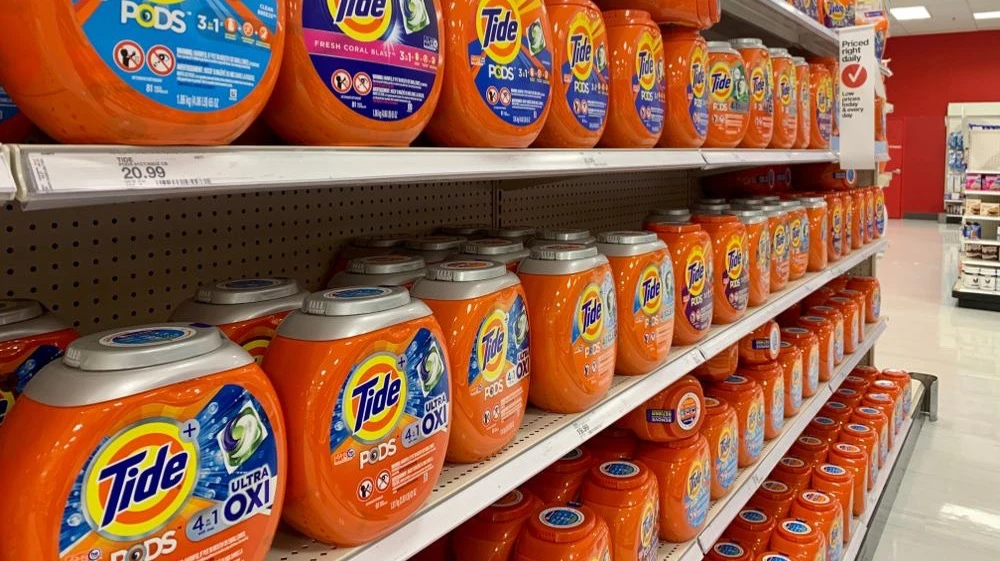
The goal of the restructuring is to speed up decision-making and improve operational efficiency. To this end, P&G plans to optimize its staff and withdraw from non-priority categories, reallocating resources to its flagship brands - Tide, Pampers and Old Spice.
At the same time, the specific names of brands to be sold or phased out were not disclosed - the company promised to tell about it at the end of the financial year in July. At the same time, P&G presented a list of brands it plans to focus on: Comet, Wella, Aussie, Ivory, Dreft, Sebastian Professional, Fixodent and Align are not on the list. P&G plans to maintain its strategic focus on priority categories where it is already a leader and in steady demand. These are primarily the health, beauty, home, hair care and baby segments.
In recent years, P&G has already left the Argentine market and rebuilt its business in Nigeria due to the volatile exchange rate and macroeconomic situation. The company also sold the Vidal Sassoon brand in China to Henkel and a number of local brands in Latin America and Europe in 2024;
How P&G's strategy has changed
Until 1982, P&G was focused on household products. However, in the same year, it acquired Norwich-Eaton Pharmaceuticals, the manufacturer of the over-the-counter drug used for digestive disorders Pepto-Bismol - it is still one of the company's largest brands. In 1995, the company opened a division, P&G Pharmaceuticals, to develop and manufacture prescription drugs.
Although the pharmaceuticals business was one of the company's fastest-growing areas - between 1997 and 2006, the prescription and over-the-counter segment's share of P&G's revenue grew from 8% to 17.3% - P&G Pharmaceuticals' margins remained low and synergies with the core business were lacking. In 2009, P&Gsold this division to Warner Chilcott for $3.1 billion, transferring with it manufacturing facilities in Puerto Rico and Germany and more than 2,300 employees.
P&G now only develops and manufactures over-the-counter drugs as the company focuses on sales through retailers such as Walmart. This is the company's main source of revenue in the consumer healthcare sector.
In 2018, P&Gacquired the consumer healthcare division from German pharma giant Merck for $4.2 billion. The acquisition allowed P&G to expand its portfolio with the brands Neurobion, Femibion, Nasivin, Seven Seas and strengthen its position in the OTC sector. Following the deal, this segment's share of the company's business grew from 11.8% to 14% in 2024, allowing it to diversify and increase revenues.
The current restructuring is part of a longer term trend. P&G also left the grocery business more than a decade ago to focus on core brands such as Pampers diapers and men's grooming line Old Spice. P&G's strategy has been effective: after a period of underperformance in the early 2010s, the company overtook its main rival Unilever. P&G has more than doubled over the past 10 years, while Unilever's shares have risen about 40% over the same period;
What now
For the third quarter of fiscal 2025 (January through March), P&G reported a 2% year-over-year decline in sales to $19.8 billion. Adjusted EPS rose 1% to $1.54, slightly beating market expectations. At the same time, the company lowered its fiscal 2025 EPS expectations to $6.72-$6.82 from the previous range of $6.91-$7.05 amid the trade war and a slowdown in U.S. consumption growth in March from 3% to 1%.
"Consumers are starting to unload their pantries and are in no rush to buy extra toothpaste or shower gel, especially amid this volatile external environment," said Colgate-Palmolive CEO Noel Wallace.
What's being said on Wall Street
- Analysts at JP Morgan maintained an "outperform" rating on shares of Procter & Gamble in a report on June 5 and increased their target price from $169 to $178 through December 2025. That means the stock could rise another 10.5% from its closing price on June 23.
According to the investment bank, restructuring and cost cutting is a standard approach of P&G: over the past eight years, P&G has saved about $1.8 billion a year. JP Morgan analysts see this as a positive development and note the relevance of the decisions against the backdrop of slow revenue recovery in China, global geopolitical instability and the negative impact of duties. Analysts believe that Procter & Gamble in the coming months will be able to not only maintain but also strengthen its market position.
JP Morgan emphasizes the company's strong brands and marketing advantage. According to analysts, even as consumer spending growth slows in key markets, demand for core categories remains resilient, allowing P&G to post solid revenue growth.
JP Morgan analysts forecast adjusted earnings per share to rise from $6.59 to $6.80 in 2025, to $7.13 in 2026, and expect continued growth to $7.63 in 2027. According to the investment bank, P&G remains one of the highest quality brands among the FMCG companies it tracks.
Among the main negative factors for P&G remain a slowdown in the Chinese market recovery, lower sales volumes with further price increases, increased competition, currency fluctuations and volatility in raw material and transportation costs, JP Morgan emphasized.
- Analysts at investment bank TD Cowen noted that food manufacturer General Mills, maker of breakfast cereal and snack brands such as Cheerios, Nature Valley and Betty Crocker, also announced a restructuring in early June. The company plans to spend about $130 million on the restructuring program, which includes cutting 4-6% of its workforce and selling some brands;
Analysts believe the company's decision also reflects pressure on the industry as a whole: sales growth is slowing and companies costs are rising. Similar initiatives may follow from other FMCG makers such as Clorox, Conagra, Kraft Heinz and PepsiCo as they come under pressure from rising costs and slowing organic growth, TD Cowen analysts emphasized in their report.
Among the ten companies in the consumer staples sector tracked by TD Cowen, the bank recommends buying only P&G shares. The target price is $175, which means the stock has a potential upside of about 8.7%.
- Evercore's report comes a few days ahead of P&G's announcement of a restructuring program. The investment bank raised its target price by almost 12% to $190 for the next 12 months. This suggests a potential upside of 18% for the securities.
Evercore analysts note the undervaluation of P&G securities: despite clear operational successes, the company's P/E ratio (price to projected earnings) remains at a twenty-year low compared to the SPDR Consumer Staples ETF (XLP), which tracks an index of consumer staples.
P&G is the most stable manufacturer in the U.S. household and personal care products sector, according to Evercore. Since the first quarter of last year, P&G's share of U.S. sales through the big three retailers - Walmart, Costco and Amazon - has grown from 50% to 52%, according to Evercore. It is these three companies that account for about 86% of P&G's sales growth, thanks to more efficient supply chains and large packages, as consumers in the U.S. prefer to buy goods in bulk.
Analysts especially emphasize the contribution of Walmart, whose share shows a stable annual growth of 0.5-1 percentage points. Since 2019, P&G has restructured its work with Walmart: the company's brand managers do not work through intermediaries, but communicate directly with Walmart's sales team, which helps to better promote products.
This article was AI-translated and verified by a human editor