Palantir chapter manifesto, a novel about a stock market crash, life with AI: the best books of 2025
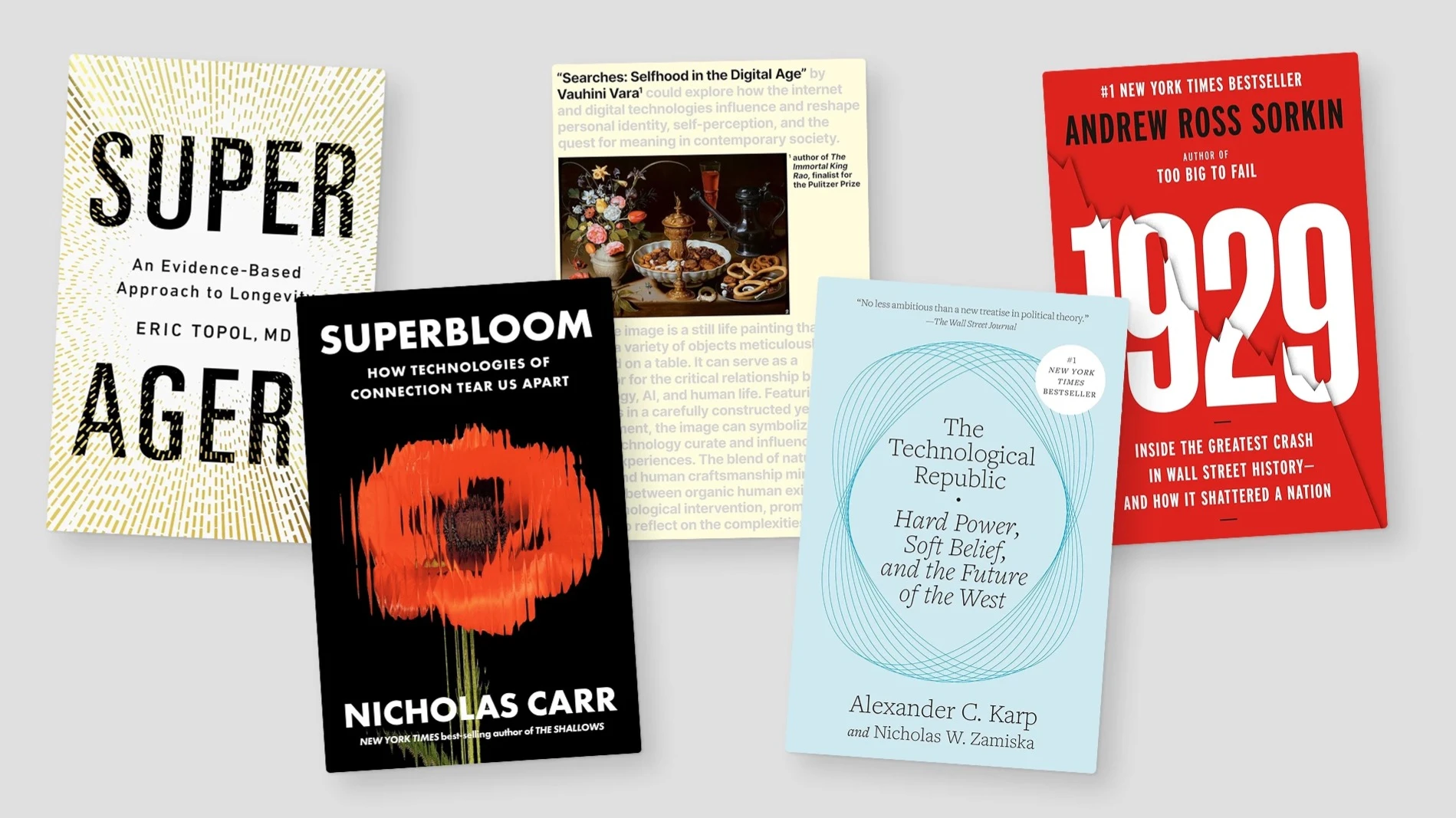
From a proclamation by Palantir head Alex Karp to the story of the 1929 stock market crash and an exploration of AI's impact on everyday life, journalist and author Maxim Semeliak has selected five of the most notable books published in 2025.
Alexander Karp The Technological Republic: Hard Power, Soft Belief, and the Future of the West
An essay by the billionaire and CEO of Palantir Technologies, a company that creates software for analyzing data - the kind that will be used to study the year 2025 with mixed, as they call it, emotions. The conservative-trampist and Dark Enlightenment-inspired alarmist manifesto fits perfectly with the rhetoric of time heroes like Elon Musk, who this year publicly believed in God.
So, the world's leading nations are engaged in a new arms race. The atomic age is already in the past, the new era will depend entirely on advances in software, and the main force will be AI. The main problem, according to Karp, is that the best minds of mankind (i.e. the inhabitants of Silicon Valley) are engaged in targeting advertising for social networks and other insignificant nonsense - instead of directing their breakthrough mental energy to the needs of medicine, education, and, most importantly, the military-industrial complex.
Karp insists that the entire technology industry must, if not directly join the war effort, at least realize the scope of the problem and contribute to national security. He accuses the inhabitants of the Valley of infantile thinking, oversensitivity and atrophy of reason. Karp's idea is to put active libertarianism at the service of a great idea - in this case, the triumph of America as the flagship of Western civilization.
Since the book was written, it has been clear that Karp is not throwing words into the wind. The calls (futile, though) to boycott the company intensified after Palantir signed a contract with the U.S. Immigration and Customs Enforcement, and now their software helps deport all undesirables.
Andrew Ross Sorkin 1929: Inside the Greatest Crash in Wall Street History - and How It Shattered a Nation
The author of the excellent book about the 2008 crisis Too Big to Fail continued to study the nature of financial cataclysms and wrote a book about the stock market crash of 1929, which started the Great Depression. According to Sorkin, after the first book he realized that the economy is not reduced to big data and dry numbers, behind everything there are specific people and their decisions.
This is probably the reason for the form of the new book - in meaning it is non-fiction, but in language and plot it is a real big novel, where human destinies and characters occupy more space than stock market reports, and Groucho Marks plays almost a bigger role than his namesake Carl.
Sorkin's new book reads like both Tom Wolfe's "Bonfires of Ambition" and his "Full Manhood". And at least it is a ready-made script for a TV series (Sorkin is one of the creators of "Billions") - for simplicity, the book even gives a list of actors with positions.
Here is the once great banker Charles Mitchell of National City Bank having breakfast at his home on Fifth Avenue, reading the newspaper, and in these minutes Wall Street is already flying into the abyss of a collapse in stocks, and the day comes, which would later be called the most destructive in the history of the New York stock market.
The story of October 1929 goes back in time and into the future. On the one hand, Sorkin explores the banking panic of 1907; on the other hand, he sees echoes of Black Thursday in the current speeches and decisions of US President Donald Trump and Elon Musk.
"1929" is all the more timely reading when you consider that it was the 1920s that laid the foundations for the careless consumer culture in which we still exist today: the principle of living on credit and the concentration of vast resources in the hands of a select few. It was then that businessmen began to turn into full-fledged stars akin to Hollywood stars, and optimism became a drug or a religion, or a combination of both, as Sorkin writes. There can be many reasons for financial collapses, while Sorkin prefers to describe the process itself with a dialog from Hemingway: "How did you go bankrupt? - In two ways, first gradually and then at once".
Nicholas Carr Superbloom: How Technologies of Connection Tear Us Apart
Another stone in the garden of techno-optimists was thrown this year by writer Nicholas Carr. The book is about the fact that the cult of ever-evolving communication has not led to good.
The content of the message is dying because classic media has lost out to total digitalization. Media technology decides everything for the consumer. In the pursuit of efficiency, people are trying to speed up the process of getting information as much as possible, for example, by choosing streaming over reading. As Jean Baudrillard's epigraph to one of the chapters says: "Words cannot keep up with their meanings. Social networks provoke uncontrolled self-expression, which leads to depression and burnout.
Communication has lost its human dimension. But people are not computers, they are united by values and interests, and they suffer, according to Carr, from the fact that the former diversity has been replaced by a generalized cyberspace populated by disoriented users. In short, Carr believes, humanity's great communicative utopia has failed. Don't look for any solutions in the book, but the diagnosis is convincing, and the author grumbles pleasantly and to the point.
Eric Topol Super Agers: An Evidence Based Approach to Longevity
Another book with the campaigning prefix "super" but, unlike Nicholas Carr's Superbloom, just as filled with practical advice. Cardiologist Eric Topol gives away the base and expands the scope of longevity, proclaiming the benchmark: 80 is the new 50. The means of achievement are more or less the same as before - Mediterranean diet, strengthening the immune system, not too short but also not too long sleep and more sauerkraut, kimchi, yogurt and kombucha for the gut microbiome.
Tests should not only be done for those covered by insurance - more personalized tests are needed and don't forget about the genome. Special attention should be paid to the gut-brain axis, i.e. the bilateral system of connections between the digestive and central nervous systems, as well as strengthening the vagus nerve - this is achieved by proper breathing as well as singing, laughter and gargling the throat. Great expectations are placed on AI. Your chatbot should become a direct food counselor and nutritionist, and it is recommended to ask as many Perplexity questions as possible about one or another of the scientific breakthroughs in the field of peptide hormones. In other words, AI combined with sauerkraut is the surest path to longevity today.
Vohini Vara Searches: Selfhood in the digital age
Another book on the topic of techno-capitalism, but this time of a more private nature, without global generalizations. "Searches" is rather an attempt to understand how artificial intelligence affects the personal space that we are now obliged to share with our neural network assistants.
The book is based partly on memories of the early days of the Internet, partly on current writing experiments - some texts are composed directly by the neural network. In particular, Vara asked GPT-3 to compose a text about her relationship with her deceased sister. The bot did it perfectly, it was more than touching, but the best lines turned out to be untrue, which did not cancel the artistic merits.
Interestingly, three years ago, Vara released a fantasy novel The Immortal King Rao, which dealt, among other things, with the power of algorithms. But since reality has since surpassed the most daring expectations, non-fiction based on her own experience has now seemed to her a much more adequate form of statement about artificial intelligence. This is how the circle closes - earlier people wrote fiction about AI, and now neural networks compose fiction about people. However, ChatGPT is not listed as a co-author of Searches for some reason. Is there no infringement of AI subjectivity in this?
This article was AI-translated and verified by a human editor