Swerving across a double solid: why everyone is talking about problems at Porsche
And why it's not as bad as it seems

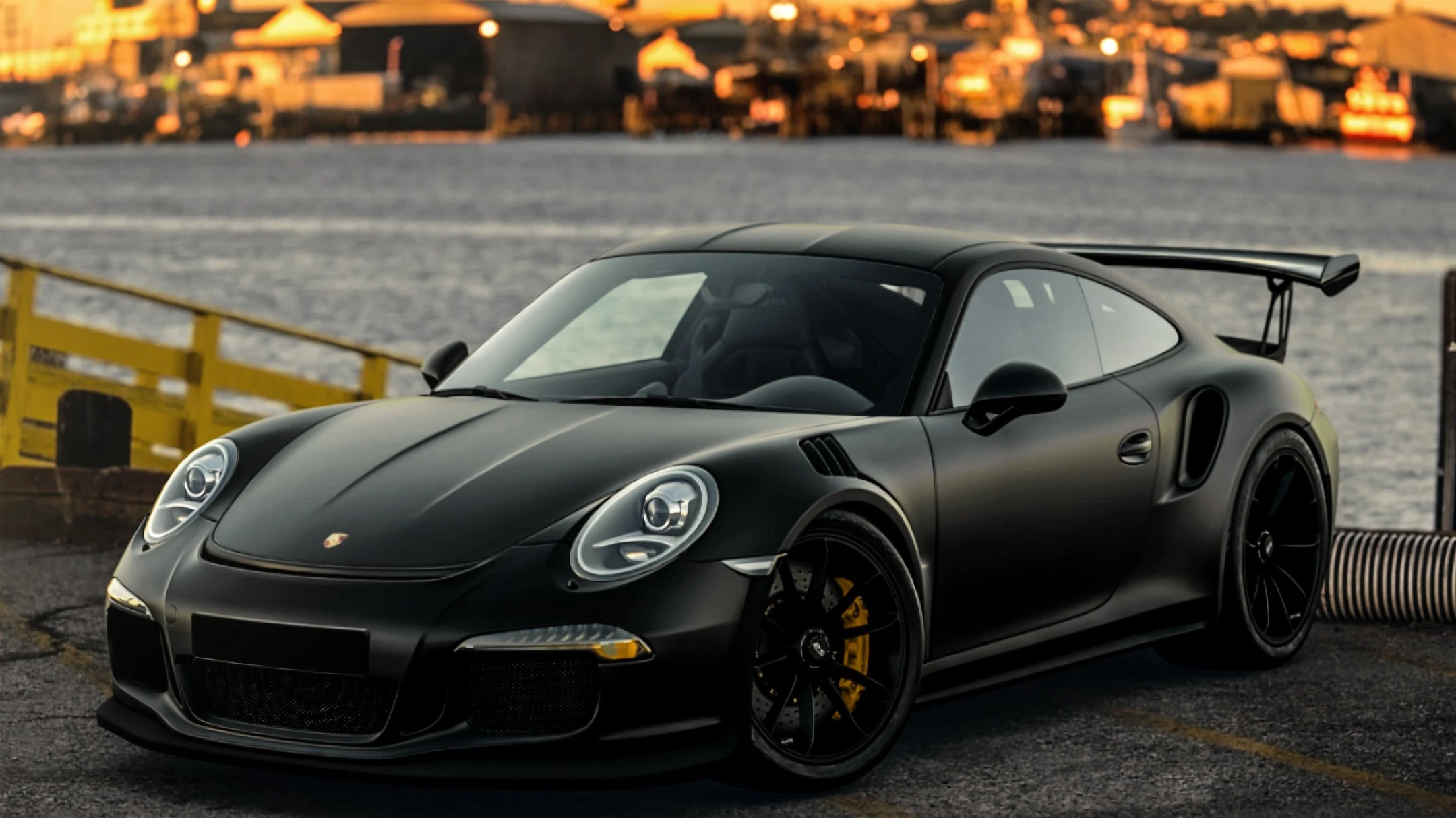
German company Porsche is changing its strategy, the next few years its business model will be put to the test / Photo: Josh Berquist / Unsplash.com
In April, German automobile company Porsche presented its report for the first quarter of 2026. Due to competition and the war in Iran, its operating profit in January-March decreased by 22% to €595 million. For those who have a soft spot for German cars or are interested in the fate of the European auto industry, such results became a reason for pessimistic forecasts. But the company itself has already deployed its strategy to maintain market share and profitability in the future.
They're coloring themselves
It seems that accountants understand the inner workings of Porsche better than analysts in the automotive industry. Yes, motorists from China are not loyal to the brand from Stuttgart, preferring cheaper Chinese alternatives, buyers in the Middle East are distracted by alerts about Iranian attacks and do not order new products at the same pace. As a result, auto shipments in the first quarter fell 15% year-over-year. U.S. import tariffs are also eroding profits.
On the outside, the Porsche crisis looks like a drop in sales. But on the inside, it looks like the destruction of the old profitability formula.
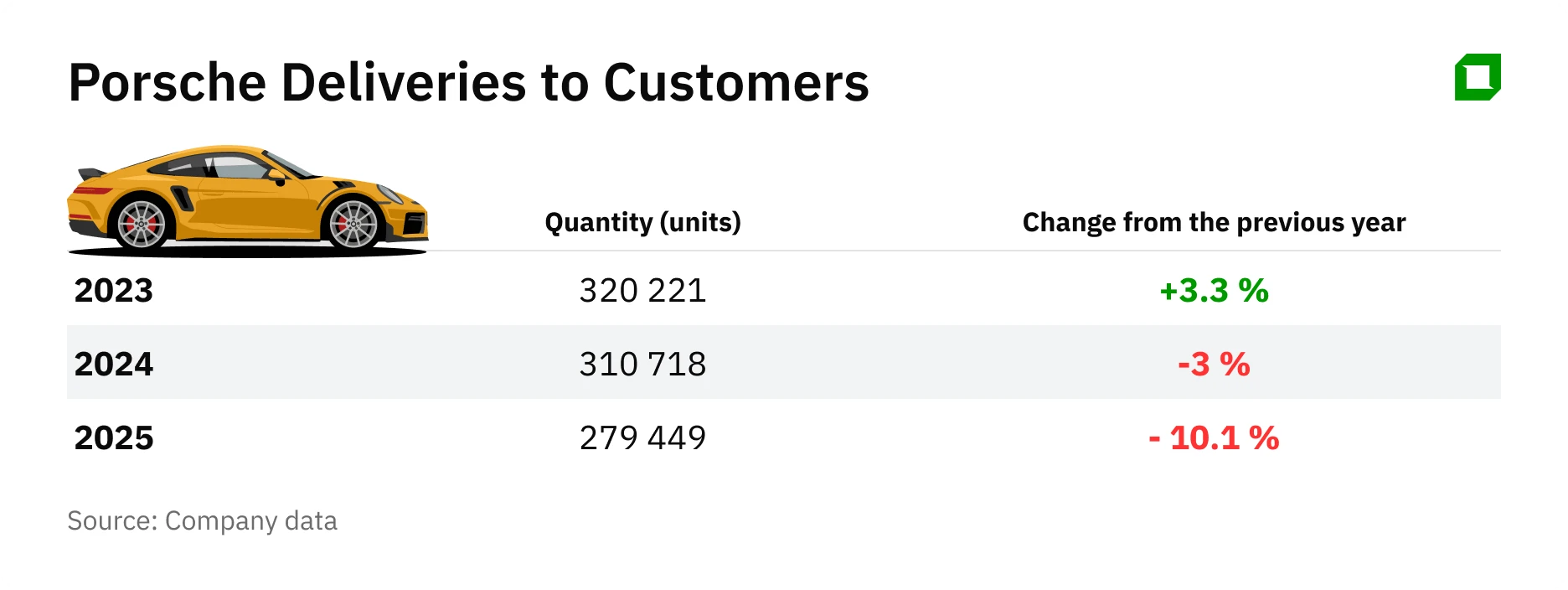
Porsche still delivered 320,221 vehicles to customers in 2023, then customer shipments fell about 12.7 percent over the two years.
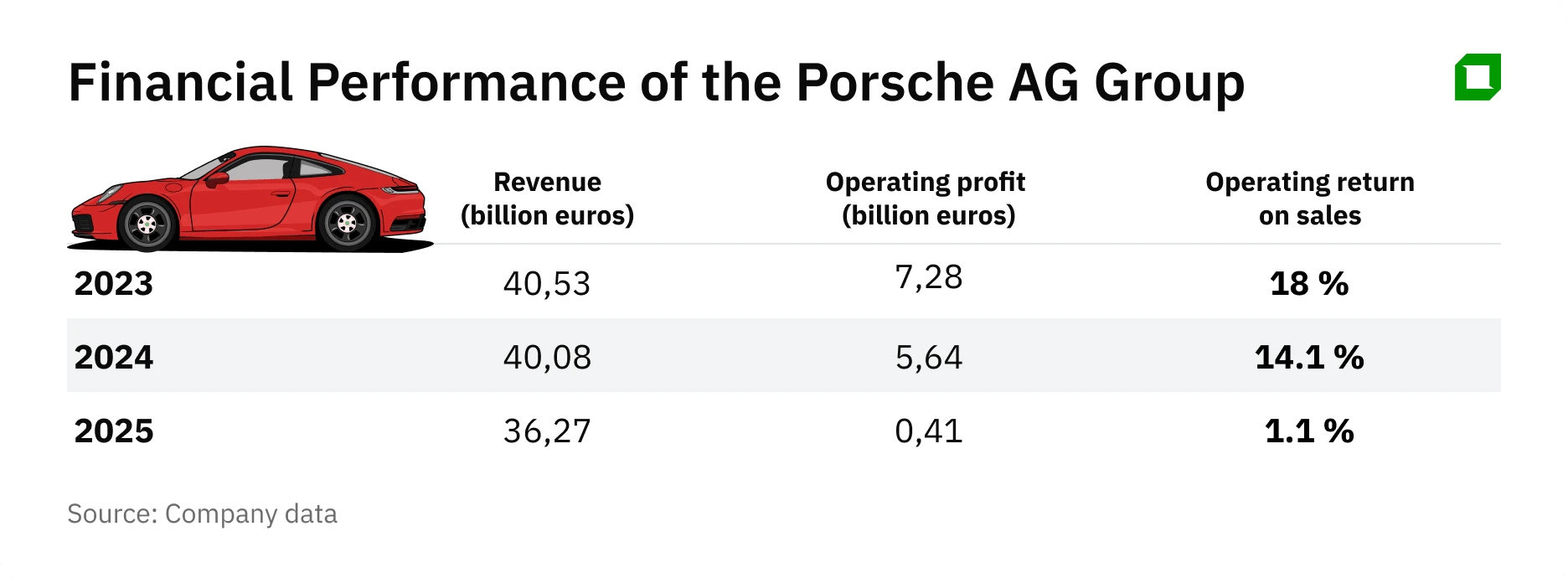
If we look at the financial indicators, the situation looks more serious. In 2023, Porsche had €40.53 billion in revenue and €7.28 billion in operating profit. In 2025, the problems worsened: revenue fell by more than 10% in two years, but operating profit fell by almost 95%. Last year's result takes into account, among other things, €3.9 billion of extraordinary expenses related to the revision of the product strategy and electric vehicles. Porsche announced a target in March 2022: by 2030, more than 80% of its new cars should be fully electric. The market, regulators and investors had been waiting for accelerated electrification, and the success of the Taycan model created a sense that luxury EVs would be a new source of growth. But that bet was abandoned in 2025.
The company found itself in a situation where the problems arose not on the quality or price side, but in marketing. The Mark's image is undermined by the discount policy in China, imposed by local manufacturers, and confusion in its own strategy.
For example, for several years the company prepared buyers for the fact that the popular Macan model in the new generation will be primarily an electric car, but last year, at the last moment, Porsche changed its mind and left the model on traditional fuel.
Chinese lesson
China has traditionally been a market where foreign premium brands "sold" status cars from Europe with history. But now it is increasingly difficult to do so, as buyers can choose between cars with status or with advanced software, screens, lower price and speed of product updates. German companies are losing this comparison race.
Porsche officially reported that in 2023, deliveries in China fell 15% to 79,283 cars, and the following year the decline accelerated - the figure fell another 28% year-on-year. At the end of last year, Porsche sales in China, including Hong Kong, fell 25.2% to 39,946 cars. This region accounted for 11.8% of all deliveries.
Reuters cited analysts as saying that Chinese consumers are turning away from Porsche in favor of cheaper local alternatives. For the German company, this is particularly dangerous: BMW or Audi can fight for sales volume, sacrificing part of their profits. Porsche can't do that. If it starts protecting Chinese sales with discounts, it risks destroying exactly what the customer pays for: rarity, status and high residual value.
An American lesson
Another important market for the German manufacturer is the USA. And here the situation looks better than in China. In 2025, retail deliveries in the States reached a new record of 76,219 cars. Sales of certified pre-owned Porsche were also at their peak: 48,092 cars, plus 11% by 2024. This is an important indicator of the quality of demand: the brand holds not only the primary market, but also residual values.
But in the U.S., the Trump factor is spoiling the reporting. The German company does not have a full-fledged production facility in this country, so the tariffs hit it harder than manufacturers with local assembly.
Reuters wrote about a €200 million tariff hit in the first quarter of 2026 alone. And on Ma 1, the US President announced a new increase in duties on European cars - from 15% to 25%.
"The imposition of additional duties will further weaken the position of German premium car makers," Matthias Schmidt, an analyst at Schmidt Automotive, commented to Reuters.
Sales in Europe cannot make up for the American losses. The North American market (excluding Mexico) is Porsche's largest market. In addition, shipments to customers in Europe without Germany are down 13% in 2025 and 16% in Germany.
Porsche attributed the drop, among other things, to the limited availability of the 718 (due to EU safety requirements for on-board electronics) and Macan models with an internal combustion engine, due to regulatory and modeling factors. At the same time, Europe has become a region with a high share of electrified Porsche: this pleases Euro bureaucrats, but for the company itself the production and sales of electric cars is less profitable compared to gasoline cars.
Changing steering wheels
Forecasts of Porsche's future are most often built through an assessment of the qualities and plans of its managers. Since this year the company has a new CEO - Michael Leiters, former head of McLaren and ex-technical director of Ferrari. Officially, Porsche filed this as a planned change, but the context is clear: the company needs a manager fully focused on restoring market positions in the world of luxury and sports cars.
Last year, Porsche also changed its CFO and sales director. Reuters attributed this decision to the weak dynamics of the company's performance indicators, deteriorating position in China and falling share price. Last year alone, its securities lost more than 20% in value.
New managers have canceled the optimistic scenario of electrification of Porsche models. Back in September 2025, the company announced that it would supplement the lineup of key models with versions with internal combustion engines and postpone the release of some all-electric models. For example, Porsche's upcoming new SUV in the class above the Cayenne was designed to be fully electric, but will first enter the market with conventional motors and plug-in hybrids.
Analysts' bets
The average target price for the company's shares is €41.11 with a "hold" recommendation. This roughly corresponds to the current quotations.
Analysts are betting that the coming years for Porsche will not be about "sales recovery" cars, but about validating a business model based on selling customers a legend. Leiters has to show that Porsche can return to high margins without actively conquering China and without betting only on electric cars.
For 2026, Porsche forecasts revenue to remain roughly at the same level as last year and a significant recovery in operating margin on sales to 5.5-7.5%. But this is still a long way from the previous 18%.
The company will need to keep the U.S. as a quality market without losing profits on import duties. The longer Trump's tariff pressure on EU imports persists, the more acute the question becomes: should Porsche localize part of its production there or "protect the Made in Germany mark" as part of its brand value to the last.
Adapting the model lineup to customer preferences will also be critical. Porsche now relies on a flexible portfolio: the 911, GT/Turbo/GTS, Cayenne and Panamera will remain with internal combustion engines and in plug-in hybrid versions, electric cars will only be available where customers are really willing to pay for them. The Panamera and Cayenne - both hybrids and models with conventional motors - will still be on the market in the 2030s.
The company also aims to save production costs. Leiters' recovery plan includes the reduction of almost 4,000 jobs, which was started by his predecessor.
Paradoxically, Porsche can benefit from the fact that it is not as large a manufacturer as Mercedes or BMW - it does not have to fight to the last for China or India as future markets. It can operate conservatively in the most profitable markets.
This article was AI-translated and verified by a human editor