Trump agreed to cut duties on imports from China from 57% to 47%
Nvidia's most powerful chips were not discussed at the meeting between the heads of the US and China, contrary to expectations

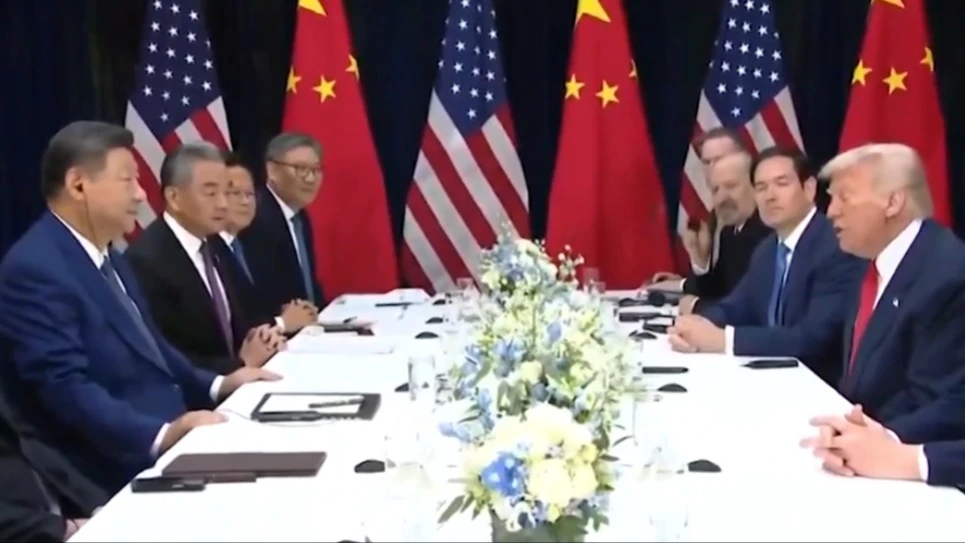
US President Donald Trump has halved the duty on Chinese goods imposed over fentanyl smuggling, bringing the overall duty rate on imports from the PRC down to 47%. The U.S. leader said he reached a one-year agreement with Chinese President Xi Jinping on supplies of rare earth metals. But the export of the latest Nvidia chips was not discussed at the meeting, contrary to Trump's announcement.
Details
Leaving South Korea, Trump told reporters aboard the presidential jetliner that the meeting with Xi Jinping was "terrific" and that "a lot of decisions were made," CNBC reported. "The issue of rare earth metals has been settled," the US president said, clarifying that the agreement reached to resume exports of these elements from China will be renegotiated annually.
Duties related to fentanyl will be immediately reduced from 20% to 10%, the U.S. leader promised. As a result, the overall customs rate on Chinese imports will decrease from 57% to 47%. According to Trump, Beijing will respond by "making every effort to stop [supplies of] fentanyl" and will also resume purchases of American soybeans and other agricultural products, the TV channel reported.
What's with the Nvidia chips
One of the most expected issues on the agenda of the talks between the two leaders was the supply of Nvidia products to China. The day before, Trump made it clear that he was ready to discuss the possibility of exporting the company's most powerful chip for artificial intelligence, Blackwell. However, after the meeting, the president said that the two sides talked about "many chips," but not the most advanced Blackwell.
He revealed that Beijing was going to negotiate with the US chipmakers. "I told [Xi] that this is a matter between him and Nvidia, and we are a kind of arbitrator or referee," Trump was quoted by Reuters as saying.
The head of the leading AI chip maker, Jensen Huang, has previously said that he did not even apply for a US export license to ship Blackwell to China because Chinese authorities "have made it clear that they don't want Nvidia's presence in the market right now." At the same time, Reuters sources reported that the company is working on a new chip based on the Blackwell architecture, weakened specifically for export to China to meet U.S. requirements.
What the analysts are saying
The U.S. decision to reduce duties related to fentanyl responds to "a key Chinese grievance" and demonstrates that "Beijing's efforts to curb exports of fentanyl precursors, long unrecognized by Washington, are finally being recognized," according to Han Shen Lin, China director at consulting firm The Asia Group.
According to Alfredo Montufar-Elu, managing director of Ankura Consulting, Trump's announcement of the interim results of his talks with Xi Jinping "exceeds expectations."
Charu Chanana, Chief Investment Strategist at Saxo Markets in Singapore, is more skeptical. She commented on the rise in gold prices on the back of progress in US-China talks: "This appears to be an attempt to reset the narrative on the US-China relationship - through the resumption of selective trade channels to restore confidence. Gold, however, is still picking up uncertainty - laying the price on soft Fed policy easing and lingering geopolitical risks."
Context
Trump's 2025 trade policy has clashed with China's hardline stance, escalating tensions between the two largest economies, affecting AI chips, rare earth metals, soybean supplies and TikTok. Despite the trade truce, Washington's relationship with Beijing has been particularly volatile over the past month, Nikkei Asia noted.
After China announced sweeping export restrictions on rare earth metals and other goods, Trump threatened to impose an additional 100 percent duty on Chinese shipments. The two sides have also levied new port fees on each other.
This article was AI-translated and verified by a human editor