Where to invest $10,000 when there's a war on? Three ideas for March

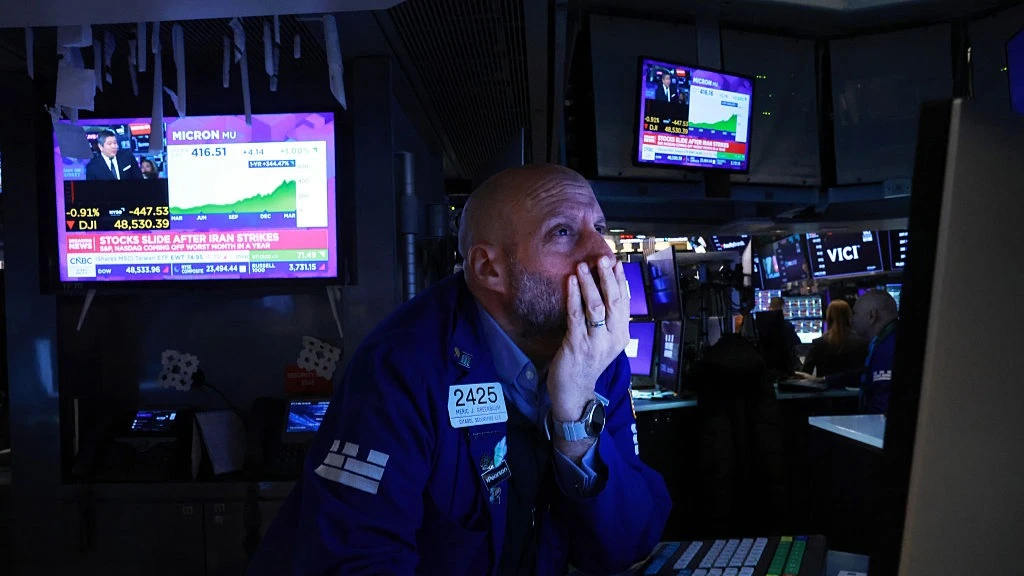
Stock markets plummet after the U.S. and Israel launch an operation against Iran. Photo: Spencer Platt/Getty Images
Spring began for markets around the world with a fall due to the war in the Middle East. Even shares of defense companies were falling. Oninvest asked Halyk Finance portfolio manager Igor Savchenko shortly before the start of the US-Israeli military operation against Iran where to invest $10,000 in March. In his opinion, the list of eternal values includes batteries, copper and cyber security.
Betting on batteries and energy transition
China's CATL is the world's leading manufacturer of lithium-ion batteries with a market share of about 38%. The company supplies batteries to virtually every major electric carmaker, from BMW and Mercedes to Ford and Porsche (with the exception of some vertically integrated players like BYD). Most recently, on February 2, CATL unveiled a car battery designed to last more than 1,000,000 miles that can be recharged in 12 minutes, and durability and fast charging are two of the biggest barriers to mass adoption of electric vehicles, experts say.
Igor Savchenko draws attention to this company for three reasons. First, the penetration of electric vehicles continues to increase, especially thanks to affordable Chinese models; more than a quarter of new cars purchased globally in 2026 will be electric, experts suggest. Second, CATL produces energy storage for solar panels:
This is an even more interesting segment. The problem with renewable energy is that generation and consumption do not coincide in time: solar energy is generated during the day, while consumption peaks in the evening. Batteries can store energy for 5-6 hours or more, smoothing out the imbalance. Companies buying such systems can purchase electricity during periods of surplus (and low prices) and use or sell it when demand peaks
Third, in addition to classic lithium-ion solutions, CATL is developing batteries using cobalt, and sodium-ion batteries, which are potentially cheaper and less dependent on rare metals. If sodium-ion battery technology becomes widely used, this could be an additional growth driver.
"CATL is a Chinese company, which automatically adds political risk," Savchenko points out. We are talking about possible tariffs, regulatory restrictions and sanctions mechanisms, which can affect the business even with strong fundamentals. In addition, in China the state is actively involved in strategic industries, which means that the rules of the game can change faster than in Western markets. All this does not cancel the investment attractiveness of the company, but increases volatility and requires careful allocation of stakes in the portfolio. However, in the US, the company uses a licensing model: it sells technology licenses, receiving royalties, without significant capital expenditures, which reduces operational and tariff risks. For example, CATL now has a license agreement with Ford, although it raises concerns with the U.S. authorities.
At the closing on March 4, CATL shares in Hong Kong fell by 1.6% amid a general decline in Asian trading floors. Since the beginning of the year the securities fell by 5.2%.
Copper and the new "supercycle" of metals
Freeport-McMoRan is one of the largest copper producers in the world. Approximately 80% of the business is copper, about 20% is gold, and one of the key assets is the Grasberg mine in Indonesia.
Copper is the base metal of the new economy. It is needed for data centers and AI development, electric cars, grid modernization, solar and wind farms, and chip manufacturing. Virtually any form of electrification requires copper. There is no alternative capable of replacing it on a large scale.
The copper market is now in a phase of structural scarcity: new deposits are difficult to discover, mines take years to build, exploration investment was inadequate in previous cycles, and demand is growing at an accelerated rate.
S&P analysts predict 50% growth in copper demand by 2040.
According to Savchenko, even if prices temporarily correct along with the general market, the fundamental balance remains in favor of growth. He believes that a new "metal supercycle" is forming, and copper may continue to move upward in the 12-month horizon.
At the close of March 3 trading in New York, the shares fell by 3.98% amid the general collapse of the U.S. markets due to the war in the Middle East. At the pre-market on March 4, the securities added about 2%. Since the beginning of the year the shares have grown by 29%.
Cybersecurity in the Age of AI Agents
In recent months, the software market has been experiencing a sell-off. The reason for this is the rapid development of AI and fears that new models will automate the work of entire industries, from legal services to accounting. Investors have massively reduced their positions in the technology sector, sometimes without deep analysis - even companies indirectly related to the topic have fallen.
Igor Savchenko believes that the market overestimated the risks for software, but underestimated the new demand for security:
AI agents gain access to corporate data, automate internal processes, and integrate with cloud services while increasing the risk of attacks on infrastructure and data.
Palo Alto Networks not only protects cloud solutions, operates in the enterprise security segment, and develops endpoint device protection, but also actively buys new technologies. Palo Alto Networks recently agreed to acquire Israeli startup Koi for about $400 million, integrating its technology into its protection platform to close security gaps created by autonomous AI agents and tools, the deal was announced Feb. 17.
Since the beginning of the year, the company's shares have shed more than 15% following a weak earnings forecast, which, according to Savchenko, creates a good entry point. Although risks remain in the form of high competition - including from Cloudflare and other players - and volatility in the technology sector. At the close in New York on March 3, the stock was up nearly 4% despite a massive drop on Wall Street.
How do you distribute $10,000?
Portfolio manager Halyk Finance suggests allocating 40% to Freeport-McMoRan (copper), which is a more "tangible" asset amid political and market turbulence, and 30% each to CATL and Palo Alto Networks. In terms of confidence level, the ideas are comparable, but the higher share of copper is explained by the current supply shortage and the protective nature of the commodity asset.
This combination provides diversification in terms of geography (China/US), asset type (raw materials/technology) and growth drivers.
Does not constitute an investment recommendation.
This article was AI-translated and verified by a human editor