After the Ayatollahs: How Iran's discovery could rewrite the map of Eurasia's risks and routes

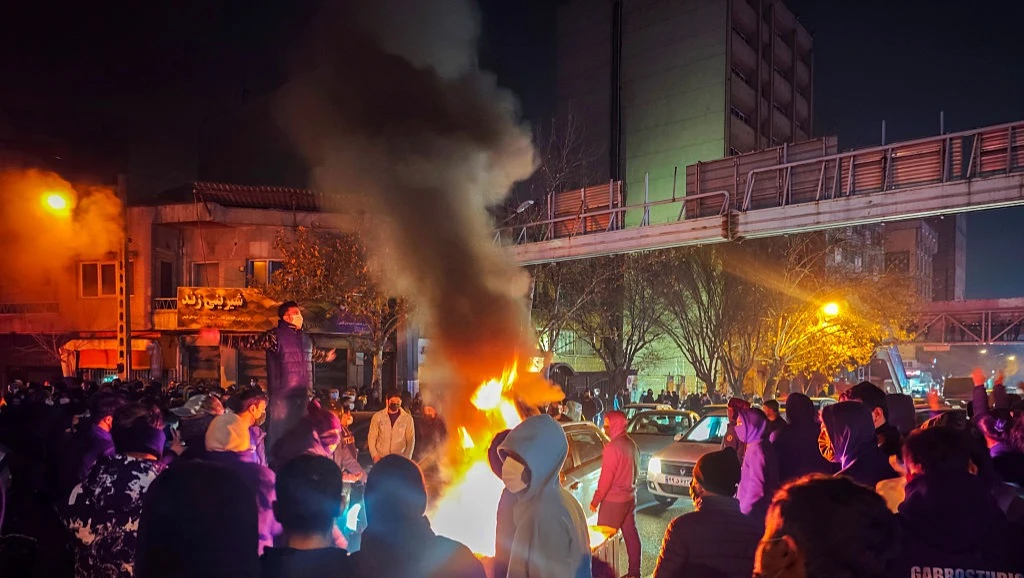
Iran International TV channel says at least 12,000 people have already been killed in the protests, Reuters government source says 2,000 people have died / Photo by Anonymous/Getty Images
To an outside observer, the potential fall of the ayatollah regime in Iran looks like an ideological fracture. For the capital manager, it is primarily an infrastructural and geopolitical shift that changes the logic of flows, the cost of risk, and the architecture of the entire region. The question here is not about moral assessments, but about who will be able to quickly and profitably integrate into the new configuration, EA Global Capital CEO Adilgerey Namazbayev writes on his Facebook page. We publish his post without bills.
From crisis management to business process: what changes the possible opening of Iran
The first and most practical effect is related to transit. Iran is turning from a chronic sanctions bottleneck into a normal transportation state. For Kazakhstan, this means not abstract access to the seas, but concrete, measurable economics of routes. The Caspian Sea is once again becoming a working axis rather than a geopolitical scenery, and the southern direction is no longer a hostage of foreign conflicts.
Against this background, the oil swap scheme through Port Nekka is of particular importance. Kazakh oil is delivered to the southern coast of the Caspian Sea, after which an equivalent volume of Iranian oil is shipped via Bandar Abbas in the Persian Gulf. The economics of this design are extremely sobering and therefore compelling. The total cost of such a transportation mechanism is on the order of two dollars per barrel. For comparison, exports via Novorossiysk are five dollars per barrel, Atasu Alashankou to China nine and Baku-Tbilisi-Ceyhan 15.
Iran is the cheapest and at the same time the most stable transportation route. Minimal political premium, no congested straits, high predictability. In the conditions of Iran's normalization, such a route ceases to be exotic and becomes a basic export infrastructure.
The second effect is less comfortable, but no less important. Iran's return to the global oil market increases supply and puts pressure on prices. For Kazakhstan, this means tighter short-term fiscal arithmetic. However, in the medium term, the gains outweigh. Volatility is reduced, geopolitical noise is gone, and there is an opportunity to plan exports and logistics as a business process rather than engage in crisis management. It is in such an environment that it is reasonable to accelerate processing and diversification, rather than postpone them until the next external shock.
The geopolitical aspect is not secondary, but fundamental. Iran in its current configuration has been a source of constant uncertainty for decades due to sharp turns in foreign policy. All this formed an additional risk premium, which was paid not only by the direct participants in the confrontation, but also by the countries of the second circle. The fall of the ideological regime and the transition to a more pragmatic model of power means a reduction in the probability of sharp and difficult to predict actions. For capital, this is expressed simply. Fewer tail risks. Cheaper financing.
This is especially important for Kazakhstan in terms of its multi-vector policy. The weakening of the anti-Western axis on Eurasia's southern flank reduces selection pressure and the costs of constant balancing between centers of power. In a calmer environment, multi-vector diplomacy once again becomes a tool for economic empowerment rather than threat management.
A normalized Iran also changes the balance in the Caspian region. It ceases to be an isolated player and becomes a full-fledged participant in trade and transportation chains. This reduces the monopolistic importance of individual routes, but at the same time increases the value of sustainable, institutionalized solutions. For Kazakhstan, this means a transition from the tactics of situational detours to a strategy of long-term integration.
Finally, investment. An open Iran will inevitably become a competitor for capital. The large market, the effect of pent-up demand, the scale of infrastructure needs. This is bad news for economies living off inertia and good news for those willing to compete on speed of decisions and quality of institutions. Swap via Nekka and exit via Bender Abbas are among the arguments that investors understand without further ado.
Ultimately, the geopolitical effect boils down to a simple formula. Less ideology, more predictability. Less conflict rents, more economic logic. For a money manager, these are not abstract categories, but a direct impact on the cost of risk. And it is here that space opens up for Kazakhstan to play a cold-blooded, calculated game, in which not the loudest, but the most organized and disciplined win.
This article was AI-translated and verified by a human editor