Downgrade Game 2: Michael Burry vs. Artificial Intelligence

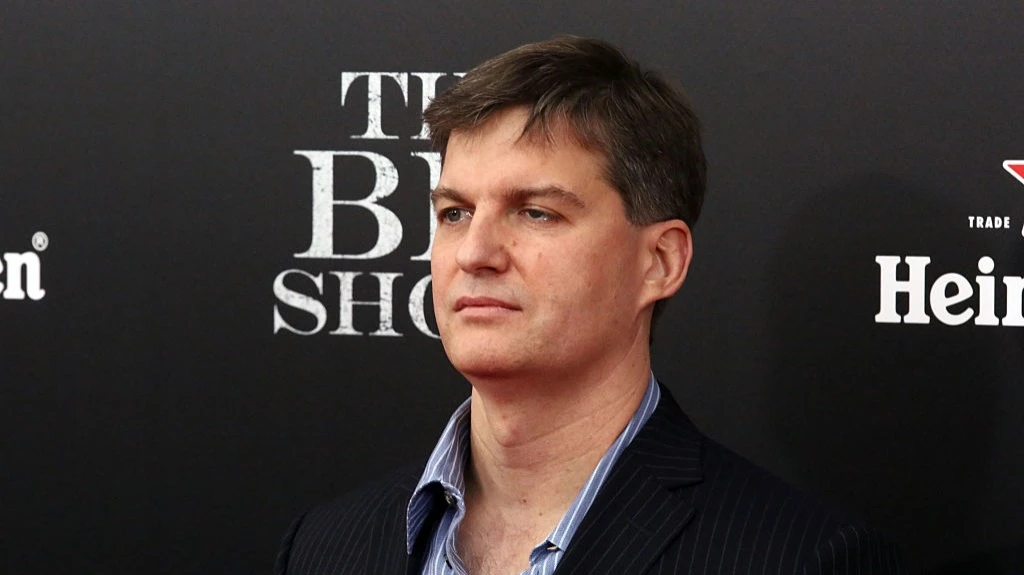
On October 31, 2025, for the first time in two and a half years, Michael Burry unexpectedly returned to X and published a single post, "Sometimes we see 'bubbles'. Sometimes we do something about it. Sometimes the only winning strategy is not to engage." The post was the preface to a series of moves that Burry used over two weeks to effectively declare a new down play - this time against the AI boom. Burry's insight is legendary - is he right now?
When curiosity replaces a diploma
Born June 19, 1971 in San Jose, California, Burry lost his left eye as a child due to retinoblastomaand has worn a glass prosthesis his entire life. Which hasn't stopped him from seeing perfectly what others can't. Like Elon Musk, Burry says he has Asperger's syndrome - people with this disorder are not prone to social rituals but are highly intelligent.
Burry has no background in finance. He studied economics and medicine at several universities. During a summer internship at the Rehabilitation Institute of Chicago, he became interested in why the rehabilitation branch of medicine was more successful than others and stumbled upon a correlation between government policy and private sector overreactions that he would later see in the mortgage lending market.
In the second half of the '90s, Burry started a blog and wrote about how the Fed's actions were contributing to bubbles like the dot-com bubble. In 2000, he retired from medicine and started his own hedge fund, Scion Capital, in which he invested his own money and that of his family: his Ma gave $20,000 and his three brothers gave $10,000 each. Also Joel Greenblatt, founder of Gotham Capital put in $1,000,000 and Jack Byrne of White Mountains put in $600, 000. As Burry recalled:
"I left medicine with $145,000 dollars in debt and no assets under management, so it certainly only got better from there."
The first time Burry earned big on the dot-com bubble, says Valery Emelyanov, an analyst at Movcchan' s Group, an investment management company:
Burry successfully shorted dotcom stocks from 2000-2006 and made over 130% on it.
By the end of 2004, Michael Burry was managing $600 million. Michael Burry admits that he has never given investors much transparency about what he is doing:
To be honest, I suspected from the beginning that it might have scared them unnecessarily.
The birth of a legend
The growing role of the housing sector made Burry wary: the scale and structure of borrowing, the almost religious belief that real estate prices would inevitably rise, and the total involvement of society seemed like a dangerous mix. It was then, he says, that the image of impending financial Armageddon, with the housing market as the trigger, first became clear to him.
He articulated a simple pattern: when credit becomes more available than income and prices rise faster than the ability to service it, the system sooner or later breaks down. By the early 2000s, rates had fallen to multi-year lows, so had borrower requirements, and the volume of poorly repaid mortgages was growing explosively. That's when Burry decided to play against the market.
In 2004, he started buying credit default swaps on the weakest mortgage bonds - effectively insuring their collapse. Banks didn't understand why he wanted the instrument; investors didn't understand why he was spending their money. The move was unusual: Burry called various Wall Street banks, trying to convince them to trade with him in this market, but there were no takers. Anticipating the scale of the crisis, he did not work with, for example, Lehman Brothers, realizing that they would not have enough money to cover their liabilities when the market collapsed. In the end, Deutsche Bank and 8 other banks agreed to work with Burry.
When he refused to close positions and "lock in profits" too early, clients demanded refunds and threatened lawsuits. He cut costs, closed offices, sold off other positions, but held on to the core idea. His strategy remained unpopular even as the signs of crisis began to show.
When the market crashed, Scion Capital made about $700 million and Burry personally made $100 million. From 2000 to 2008 , his fund returned 489% with the S&P 500 rising just over 3%. To focus on his family - by then he had two sons, Nicholas and Michael - and personal investments he closed the fund for the first time.
In 2010, Michael Lewis described Burry in his book "The Great Game of Downsizing," and then Adam McKay turned that analytical story into a movie - "The Game of Downsizing " won an Oscar and $133.4 million at the worldwide box office.
Burry, played by Christian Bale, went beyond Wall Street and became a global legend - the Man Who Predicted the Mortgage Crisis.
Cassandra Liberated: a new prediction.
In the fall of 2025, Burry began his second big downside play - against AI companies. Scion Asset Management's 13F filing showed put options on 5 million shares of Palantir and 1 million shares of Nvidia, representing about 80% of the portfolio as of Sept. 30. Initially, the media indicated that these were shorts for almost $1.1 billion, but later Burry clarified: the face value of the contracts is not their value, the real purchase price of the puts is $9.2 million. On the day of publication of the report, shares of Palantir fell by almost 8%, and Nvidia - by 1.8%. Burry himself published graphs of slowing cloud revenues and rising capex of hyperscalers.
Private investor Yuri Mayorov says there is not much that can be said about this rate with certainty:
Neither the term of the options, nor their strike, nor the date of purchase are disclosed, so we don't know how much Burri spent on them. If the strike is very low and the term is short, the bet could be close to zero. Also, how much the Nvidia puts were worth is unknown, but from his words, their strike is $110 (the stock is now worth $180.26) and the expiration is December 2027. If Burry's tweet is to be believed, the bet isn't that big in the context of the fund he managed until recently. And the fund had about $150 million in assets.
Burry doesn't have much time to test his prediction, argues Valery Emelyanov of Movchan's Group:
Unlike CDSs, which could be held for years, put options have a clear expiration date of a few months. And if NVIDIA and Palantir don't drop dramatically in price before the expiration date, his idea simply won't work out
On Nov. 10, Burry deregistered his fund for the second time. Official registration is mandatory for funds with more than $100 million in assets, and its termination means that Scion no longer needs to file reports with the SEC, which are published in the public domain and which investors and journalists usually study to understand what deals the fund is making.
I am pleased to be free of the regulatory burden and massive misinterpretations generated by my reporting. Scion Asset Management is not closing as this entity also serves me to manage other investments. It is no longer a registered investment adviser (RIA) and no longer manages funds for external investors
After publishing a series of high-profile posts in X about hyperscalers and AI, Burry announced the launch of his own paid newsletter. 20 years later, he is playing down again, but this time he is not alone in this game, believes Emelyanov.
A lot of people are waiting for a hard correction. It has been too long since the market had a good systemic crisis
Burry doesn't consider his retirement as a blogger. He says he was simply freeing himself from a management role in which regulatory restrictions, reporting and compliance requirements prevented him from saying what he really thought.
Burry called his blog Cassandra Unchained: "Cassandra," Buffett called me when he spoke to Congress about the crisis, "is finally no longer connected"
This article was AI-translated and verified by a human editor