Eco-friendly shoe brand Allbirds is closing stores, yet Wall Street sees 170% upside

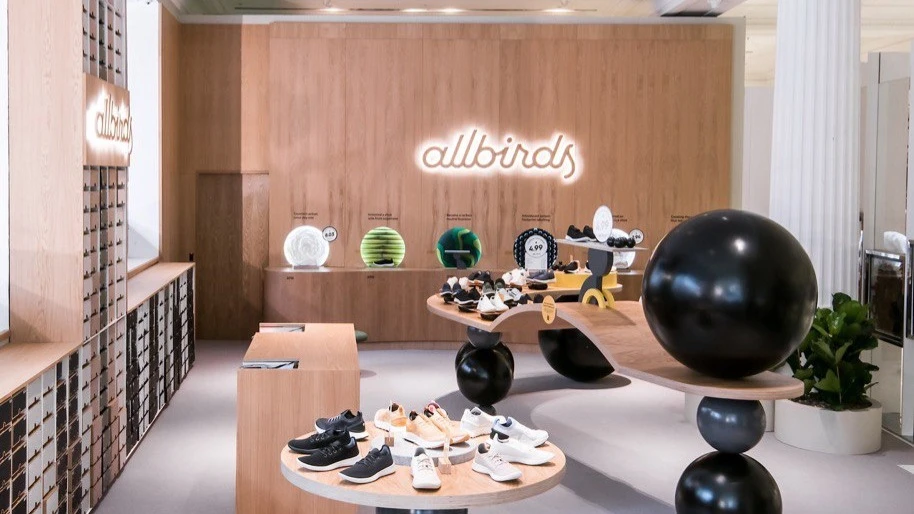
Allbirds will focus on online sales and partner distribution programs / Photo: Facebook / Allbirds
Jennifer Lopez, Lady Gaga, and Sarah Jessica Parker – the list of celebrities spotted wearing Allbirds’ eco-friendly sneakers could rival a Hollywood guest list. Popularity with stars, however, has not translated into financial stability for the company, which continues to operate at a loss. Allbirds stock now trades at about $3.00 per share – just a fifth of the IPO price. At the same time, Allbirds is pushing ahead with a reset strategy: expanding its footwear lineup, introducing new eco-materials, and shifting toward online sales while closing full-price retail locations. Wall Street analysts believe the stock offers substantial upside of 170% over the long term.
Beginnings and growth
Footwear and apparel manufacturer Allbirds, with a market capitalization of roughly $25 million, is headquartered in San Francisco, though the brand’s story began in New Zealand. The company was cofounded by former professional soccer player Tim Brown, now a member of the board. During his playing career, he became frustrated with conventional sneakers and set out to create something simpler and more sustainable. From its outset in 2014, the concept centered on natural materials – especially wool, a hallmark of New Zealand. The brand name itself references the country’s famed diversity of birds. Allbirds released its first sneaker model in 2016.
The minimalist wool shoes quickly became part of Silicon Valley’s informal dress code. Business Insider wrote that the footwear gained traction among tech founders and venture capitalists, while the New York Times reported that Google cofounder Larry Page and former Twitter chief Dick Costolo were among those wearing them. The brand also benefited from celebrity and cultural visibility. Actor Stanley Tucci said he had “been a fan of Allbirds for years,” while environmental advocate and investor Leonardo DiCaprio backed the company in 2018, announcing: “Allbirds is on the forefront of developing new materials that will serve as a model for the footwear industry… I am proud to join the company as an investor.”
Minimalist design, eucalyptus fiber, sugar-cane-based materials, and a focus on responsible sourcing helped position the brand at the intersection of sustainability and comfort. On the wave of that popularity, Allbirds expanded its product line, moving beyond sneakers into apparel categories such as jackets and underwear made from wool and plant-based fibers.
The company raised about $255 million in multiple venture funding rounds. In November 2021, Allbirds went public, selling more than 23.2 million shares at $15.00 apiece. The stock is now down roughly 80% from that level, trading near $3.00 per share.
Financial troubles
Despite expansion and scaling, Allbirds’ revenue began declining in 2022. Meanwhile, for the third quarter of 2022, the company reported a net loss of $25.2 million, that number having grown 82% from the same quarter a year earlier. Forbes wrote that the brand faced pressure associated with public-market expectations for consistent growth, while simultaneously opening dozens of retail stores and expanding into apparel categories that did not resonate with customers. Allbirds tried to turn the situation around. In late 2022, the company announced it was discontinuing an entire product line, and in March 2024 it updated its strategic plan.
The company has acknowledged its financial challenges. “We have incurred significant net losses since inception and anticipate that we will continue to incur losses for the foreseeable future,” Allbirds stated at end-2024.
Losses have remained substantial, though narrowing. In 2024, the net loss declined 39% year over year to $93.3 million. The company cautioned that even if it reaches profitability, sustaining or expanding it may prove challenging. As Allbirds stated in its filings, “our focus on using sustainable, high-quality materials and environmentally friendly manufacturing processes and supply chain practices may increase our cost of revenue and hinder our revenue growth.” Being environmentally friendly and maintaining a low carbon footprint comes with higher costs – and those costs are borne by the company's investors.
Allbirds reported a net loss of $20.3 million for the third quarter of 2025 versus minus $21.2 million a year earlier. The company warned that revenue will be pressured by structural changes, including the transition to a distributorship model in certain international markets and the closure of some U.S. stores, with an expected impact of about $23-25 million. The management announced in late January that it is refocusing on online sales and partner distribution programs as part of the reset strategy. Only two Allbirds outlet stores will remain in the U.S., as well as two shops in London.
What analysts say
Maxim Group analyst Tom Forte wrote in a November report seen by Oninvest that third-quarter results were in line with management and Maxim expectations and that margins came in slightly above market consensus. Despite a 23.3% year-over-year revenue decline, Forte noted that new product launches are beating sales expectations and supporting the brand’s recovery momentum.
Maxim Group lowered its 2026 revenue forecast for Allbirds by 3.2% and expects the company to focus on revitalizing wholesale channels. Forte says the company is executing a multiyear restructuring program to create a business model capable of delivering sustainable, profitable growth amid a strong brand. The firm’s target price is $14 per share, implying nearly fivefold upside.
In a November report seen by Oninvest, Morgan Stanley initiated coverage on Allbirds with a “hold” rating at a target price of $8 per share. Analyst Alex Straton said that despite progress on the transformation strategy, the company's fundamentals remain weak and volatile, pointing to repeated downward revisions to sales forecasts during 2025 and the risk of another sales dip in the fourth quarter.
Morgan Stanley’s valuation assumes average annual revenue growth of about 5% and positive adjusted EBITDA by 2029.
According to MarketWatch data, Allbirds currently has three analyst ratings, all “hold.” The average target price is $8 per share, implying upside of about 170% versus the closing price on Friday, February 13.