Europe has a $13 trillion "weapon" against Trump, could it be activated?
EU leaders will hold an emergency summit on Jan. 22 to discuss responses to threats of new duties from the White House

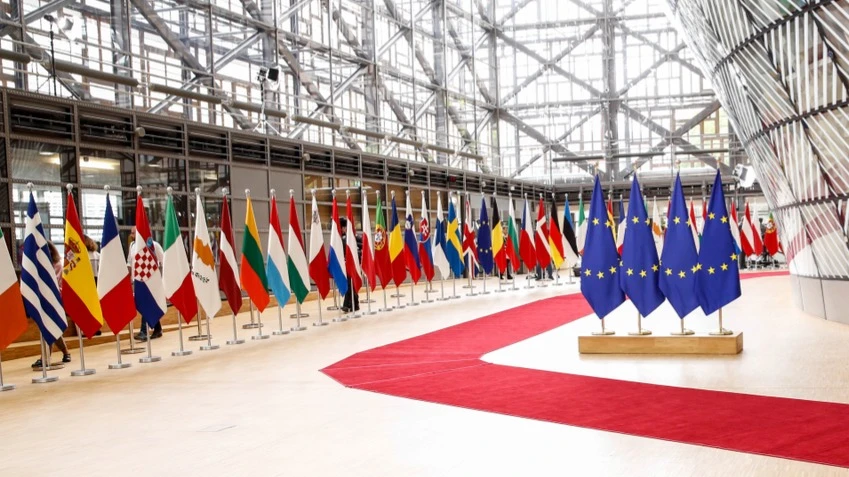
Brussels may for the first time use the so-called "trade bazooka" against Washington - this tool allows blocking access to markets in whose trade the U.S. has a surplus / Photo: Shutterstock.com
European countries own trillions of dollars worth of U.S. bonds and stocks, provoking discussions about a possible sell-off of these assets in a new round of escalation with the U.S. over claims to Greenland. Will Europe be able to turn the securities it owns into leverage against Donald Trump's administration?
Details
"The United States has one key weakness: it relies on others to pay its bills through huge external deficits. Europe, on the other hand, is America's biggest creditor: European NATO countries own $8 trillion worth of US bonds and stocks - almost twice as much as the rest of the world," said Deutsche Bank chief currency strategist George Saravelos, quoted by the Financial Times.- At a time when the geo-economic stability of the Western alliance is under existential threat, it is not clear why Europeans should be willing to continue to play this role". Taking into account the assets of non-European investors in investment funds and custodians in Europe, the amount rises to $12.6 trillion, the FT calculated.
According to Saravelos, the key point in the coming days will be whether the EU decides to invoke measures affecting capital markets as a countermeasure. "With the US net international investment position at record negative levels, the mutual dependence between the financial markets of Europe and the United States has never been higher. It is the use of capital rather than trade flows as a weapon that will be most destructive for markets," the strategist emphasized.
Why there may not be a sale
It is not so easy to organize the sale of American securities in Europe: the main part of these assets belongs to a lot of private funds, not controlled by governments, states Bloomberg. In addition, such a sell-off would also hit European companies, so most investment strategists believe that its probability is low, the agency notes.
"It's possible European public-sector investors will stop ramping up investments in U.S. assets or start selling them, but more aggravation is probably needed before they damage their investment returns for political purposes," Bloomberg quoted Societe Generale chief currency strategist Keith Jaks as saying.
ING said that while Europe theoretically has leverage thanks to U.S. assets, it may have to take a softer approach. "There is little the EU can do to force European private investors to sell dollar assets. It can only try to encourage investment in euro-denominated assets," the Netherlands' largest banking group said.
U.S. Treasury Secretary Bessent dismissed as a "false narrative" the idea that Europe would sell off bonds and other U.S. assets in retaliation for Greenland-related duty threats. "There is no such talk in Europe," he said in Davos. - It defies all logic, and I strongly disagree with it."
The idea of Europe using $12.6 trillion in U.S. securities as leverage against the U.S. seems implausible for three reasons, according to FT columnists Robin Wigglesworth and Toby Nangle. First, the fact that the lion's share of these assets are not owned by governments rules out the possibility of a quick forced sale. Second, there are simply no buyers for such a volume of securities outside the United States, as Asian markets are too small. Third, a massive dumping of U.S. bonds would result in "mutual assured destruction": the value of the portfolios of the Europeans themselves would collapse, while the return of capital would lead to a sharp strengthening of the euro and hit the EU economy, they warned.
Context
On the night of January 18, Trump announced on the social network Truth Social that imports from eight NATO member countries would be subject to increasing duties in the United States "until a deal is reached on the full and final purchase of Greenland." According to the US leader's statement, the tariff rate will be set at 10% on February 1 and will rise to 25% on June 1.
EU leaders will hold an emergency summit on January 22 to discuss retaliatory measures. According to Reuters, Brussels is considering imposing mirror duties on U.S. imports worth €93 billion - the EU developed this package last year, but postponed it until February 6.
Another option is the never-before-used "Anti-Coercion Instrument" (ACI), a mechanism known as the "trade bazooka" to block access to state tenders, investment and services markets in which the US has a trade surplus. French President Emmanuel Macron, who is coordinating the European response to the tariff threats, has already confirmed his readiness to push for the activation of ACI if Trump does impose duties, BBC reports.
This article was AI-translated and verified by a human editor