How is the fate of Lukoil's foreign assets being decided?
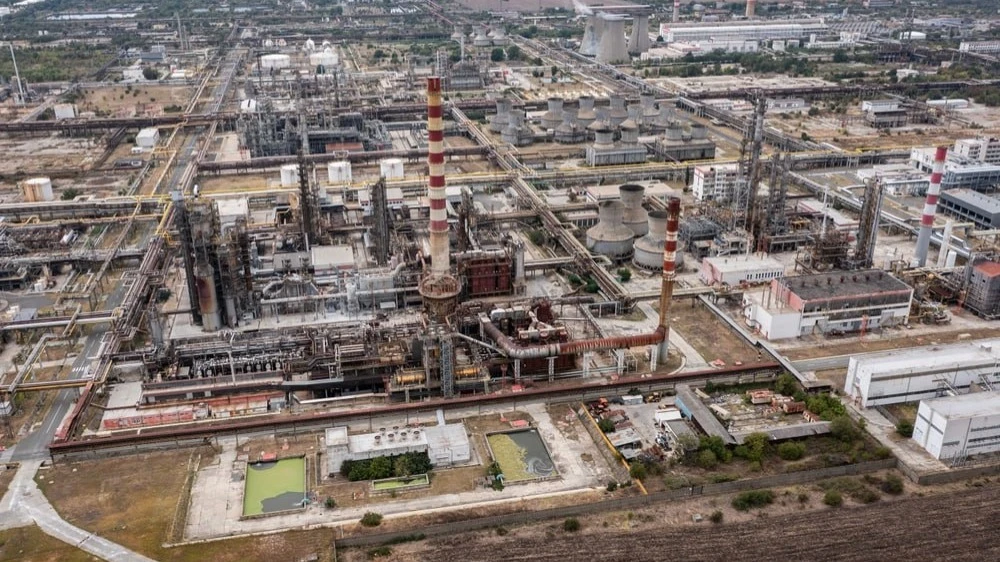
In October 2025, the US imposed blocking sanctions on Rosneft and Lukoil. This raised questions about the fate of their foreign assets, especially in the case of Lukoil, which is traditionally focused on international expansion. What scenarios and contenders for this company's foreign assets are currently being discussed?
What happened to the Russian oil industry?
On October 22, the Office of Foreign Assets Control of the US Department of the Treasury (OFAC) imposed sanctions against the two largest companies by production volumes in Russia - Rosneft and Lukoil, as well as against 34 of their subsidiaries. They provide about half of Russia's oil and condensate exports, with Rosneft producing about 5.2 million barrels of oil equivalent per day in 2024 and Lukoil producing 2.2 barrels.
Companies and their subsidiaries have been placed on the SDN List. This means a complete ban for American citizens and businesses on economic relations with those on the list and the blocking of their assets in the United States. For businesses from other countries, cooperation with sanctioned companies risks secondary sanctions.
Currently, any transaction with sub-sanctioned companies will require special permission from the U.S. Ministry of Finance - a general license. In addition, the agency allowed Lukoil to sell its foreign assets until December 13, 2025, and then extended the permission until January 17, 2026. Until then, the Russian company must decide their fate.
The sanctions were primarily aimed at reducing Russian hydrocarbon exports to India and China, increasing the discount on Russian oil and reducing the country's budget revenues, according to Alexei Belogoriev, director of research and development at the Institute of Energy and Finance.
The first fruits of the restrictions have already been felt in Russia. The threat of secondary sanctions forced companies in India and China to reduce their imports of Russian oil. In November, Russian exports fell by 420,000 barrels to 6.86 million barrels per day, the cost of the Urals export grade fell by $8.2 to $43.52 per barrel, and oil and gas revenues collapsed to their lowest level since the beginning of 2022, according to the International Energy Agency. The Russian Ministry of Finance reported a 22.4% year-on-year decline in oil and gas budget revenues in January-November, mainly due to the fall in the average oil price.
What is the situation with foreign assets of Russian companies?
Rosneft's situation is somewhat simpler. Its core business is in Russia, and its key foreign projects are already under sanctions. For example, the German authorities, where Rosneft has stakes in three refineries, have imposed external management on them starting from 2022. The Nayara Energie refinery in India has been under EU sanctions since the summer of 2025, and the UK sanctions since October. Indian authorities supported Nayara Energie by facilitating the refinery's access to container rail transportation and temporarily providing Nayara Energie with several shadow fleet vessels, Reuters writes. The company is now working with the Reserve Bank of India and local banks to help the refinery pay its counterparties in rupees, Bloomberg's source said.
The only questionable issues are Rosneft's retention of its stake in the offshore projects in Mozambique, where the Russian company has only 20% and the main shareholder is the American Exxon Mobil with a 40% stake, and in the project in Egypt, where the Italian Eni owns a 50% stake and Rosneft has 30%.
"Lukoil has been striving to become an international company since the 1990s, both through production in Asian countries and through refining and marketing in Europe, says Alexei Golubovich, managing director of Arbat Capital.
Sberbank CIB estimates Lukoil's international assets' contribution to its EBITDA at 20%. Their fair value is estimated by analysts of Sberbank and Finam at $12 bln, and by BKS Investment World at $10 bln.
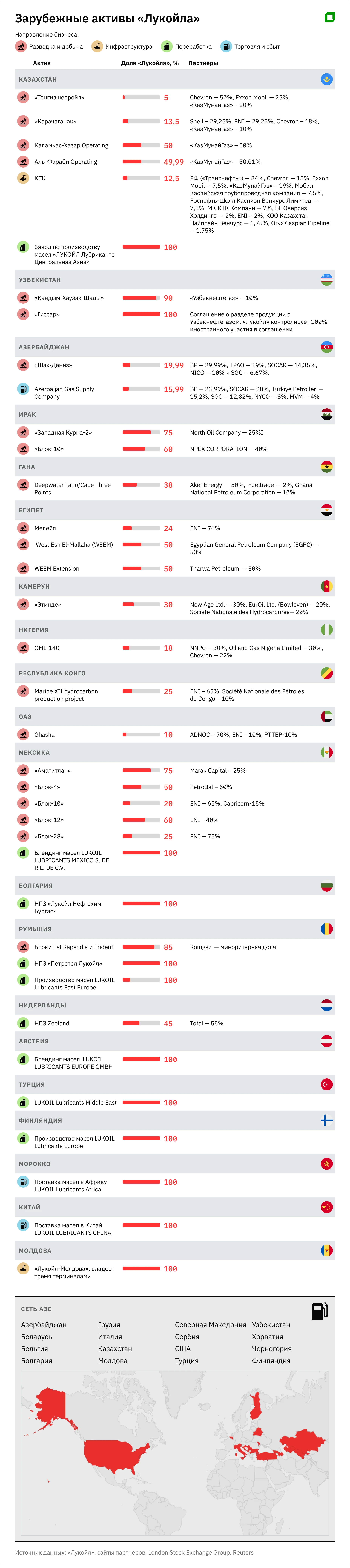
The company now has interests in fields in Iraq, Kazakhstan, Azerbaijan, Uzbekistan, Mexico, UAE, Egypt, Ghana, Cameroon and Congo. It also has refineries in Bulgaria, Romania, the Netherlands and a network of filling stations in the EU and the US, as well as oil production and storage facilities in several countries.
"Lukoil did not seek to get rid of its overseas portfolio after 2022; the Russian company sold only one asset in 2023 - Italy's largest refinery, ISAB in Sicily, after EU sanctions cut it off from Russian oil supplies, Golubovich recalls."
"Perhaps the company hoped for a change in the geopolitical situation or simply did not find a buyer who could simultaneously accept the risks associated with Russia and not demand a significant discount for it," he speculates.
Which projects are under attack?
Lukoil's projects in many countries have already felt the impact of sanctions. For example, in Azerbaijan, the company faced the risk of failing to fulfill the obligation of cash call (coverage of expenses by shareholders, stipulated by the contract) at the gas condensate field "Shah Deniz" (Lukoil has 19.99% in it) because of the ban on settlements in dollars, Azerbaijani media wrote. Lukoil had to declare force majeure at West Qurna-2, as Iraq stopped payments to it in cash and oil due to sanctions.
As the experience of Gazprom Neft (under US sanctions since January 2025) in Iraq shows, the sanction status does not make it impossible to continue work, but it makes interaction with contractors and suppliers much more difficult, explains Sergey Vakulenko, Senior Fellow at Carnegie Politika.
The point is the concept of "the long arm of American law" - it applies to any activity that uses anything American. For example, the dollar as a means of payment - for the oil itself, for freight, or even for the delivery of food to the tanker carrying the oil, Vakulenko writes. This is enough for a U.S. court to impose interim measures and demand cooperation from foreign countries that prefer not to quarrel with the United States.
Under such conditions, some countries started direct negotiations with Washington on the fate of Lukoil's projects on their territory. Kazakhstan has agreed with the U.S. Treasury Department to obtain a general license for the operation of the Tengizchevroil fields, where Lukoil's share is only 5%, and Karachaganak (13.5%), as well as for oilfield services and other services at these projects. A similar authorization was obtained for the Caspian Pipeline Consortium (Lukoil has 12.5%), through which Kazakh oil is delivered to world markets. The issue of redemption or redistribution of shares in the projects of Lukoil and KazMunaiGas is now being worked out with international consultants, said in late October, Vice-Minister of Energy of Kazakhstan Sanzhar Zharkeshov. In early December, the company was still conducting a comprehensive assessment of the projects.
And Uzbekistan, together with the U.S., is still looking for options for gas fields and has asked Washington for a delay.
Other countries are urgently changing national legislation to avoid a fuel crisis and not to violate the U.S. sanctions regime. For example, Bulgaria passed a law allowing for the introduction of external management at critical infrastructure facilities, for which the parliament had to override a presidential veto. Now the country's largest refinery, Lukoil-Neftochim Burgas, is managed by the National Revenue Agency. A similar legislative framework is being prepared in Romania.
And Moldova, for example, announced an "emergency solution": the Chisinau airport received a fuel terminal from Lukoil-Moldova for free use and agreed on fuel supplies from Romania. Earlier, Moldovan Energy Minister Dorin Jungietu talked about plans to buy the assets of Lukoil's subsidiary - a network of gas stations and three oil product storage facilities. However, on December 15, Prime Minister Dorin Munteanu announced the decision to seize the fuel terminal at the airport from Lukoil as state property, as well as an upcoming investigation into the transfer of ownership of the terminal in favor of Lukoil.
The Iraqi Oil Ministry transferred two Iraqi projects of Lukoil to the state-owned companies Basra Oil and Missan Oil for external management. After that, Iraq has already applied to American companies with a proposal to become the new owners of West Qurna-2 instead of Lukoil. The new owner of the world's largest oilfield will be chosen at a tender. According to Bloomberg sources, the U.S. authorities supported this idea.
"Lukoil did not respond to Oninvest's request.
What scenarios are "on the table" right now?
In a month and a half it has not been possible to conclude any deals with Lukoil's foreign assets. The process of searching for optimal options and their coordination with the U.S. Ministry of Finance may stretch for the whole year 2026, Belogoriev believes.
The first bidder for Lukoil's foreign assets was Swiss oil trader Gunvor, whose co-owner until 2014 was Russian billionaire and friend of Russian President Vladimir Putin Gennady Timchenko. Gunvor wanted to buy Lukoil's foreign portfolio in a single lot, the terms of the future deal were not disclosed. But the U.S. Treasury Department did not approve the deal, calling Gunvor a "Kremlin puppet that will never get a license" from OFAC. After that, Gunvor CEO Torbjorn Tornqvist announced his resignation from the company and the sale of his stake (85%) in it.
The Swiss trader is unlikely to try its luck again with the U.S. Ministry of Finance. First, the US authorities still have concerns that Lukoil and Gunvor could theoretically provide for a buyback option, Alexei Golubovich suggests.
Secondly, there are many contenders for the purchase of Lukoil's assets in parts, and among them there are American companies, recalls Sergey Kaufman, analyst of Fink FG. According to Reuters sources, Exxon Mobil is the main contender for "West Qurna-2", and Chevron is considering increasing stakes in joint projects with Lukoil in Kazakhstan and Nigeria. Another potential buyer for Lukoil's portfolio is the U.S. fund Carlyle.
The media also named another bidder from Saudi Arabia - Midad Energy - and two from the UAE: state-owned Abu Dhabi National Oil Co and IHC Holding. A consortium of Azerbaijani Socar and Turkish Cengiz Holding and Hungarian MOL are evaluating the possibility of buying Bulgarian and Romanian refineries. In addition, the Austrian businessman and former owner of Pornhub Bernd Bergmayr announced his interest in Lukoil's assets. Finally, the most exotic option was voiced by the American investment bank Xtellus, which offered the U.S. Ministry of Finance to conduct a cashless exchange of Lukoil securities owned by U.S. investors for the company's foreign assets. The U.S. Ministry of Finance rejected this idea.
According to Alexei Belogoriev, there are only two realistic scenarios now.
The first one is the sale of Lukoil in parts, where the most "tasty pieces" in Iraq and possibly in African projects will go to the Americans, and the rest (gas stations, oil refining, trading, minority stakes) will be distributed among other interested parties. The second option is to sell the assets in a single package, where a large fund like Carlyle will be the buyer. It will be able to buy the package at a discount and resell it piecemeal at market value. This scenario is less likely, as it is unprofitable for Exxon Mobil and Chevron, Belogoriev believes.
Sberbank CIB estimates that, given the urgency of the deals and sanctions, the discount for Lukoil's foreign assets may amount to 60-80% of the fair price, while Finam estimates it at 20-30%.
The main intrigue now is whether Lukoil will receive money for its foreign assets in principle, recalls Kirill Bakhtin, analyst at BKS Investment World. OFAC points out that they should go to the blocked account, where they will be kept until the sanctions are lifted from Lukoil. Thus, the company will have no motives to negotiate with buyers, concludes Bakhtin.
It is unlikely that Lukoil will be able to negotiate directly with OFAC to change its position: this can only be achieved through negotiations between the Russian government and the White House, believes Alexei Golubovich. So far there is no public information about such negotiations.
Oninvest sent inquiries to Lukoil's major partners: Royal Dutch Shell declined to comment, Total, Chevron, Exxon Mobil, BP, Eni, as well as Lukoil's national partners in Egypt, Ghana, Cameroon, Congo and Nigeria did not respond to the inquiry.
Difficulties of nationalization
All Oninvest's interlocutors named the introduction of external management as another possible option. The authorities of Germany, Bulgaria and Romania are already following this path. Andrey Gusev, senior partner at Nordic Star law firm, believes that this is not ideal for Lukoil, but it is a milder option compared to direct nationalization or "fire" sale.
Irina Chebotareva, head of the international practice of the law firm K&P Group, says that the advantages of the external management scenario are in the future reversibility of the decision. The minuses are that it is only an interim option until an optimal solution is found, reminds Artem Kasumyan, senior lawyer at Delcredere Bar Association.
Nationalization will be interpreted by the countries' authorities as protection of security, but expropriation without real compensation is unacceptable from the point of view of national and international law, Kasumyan argues.
In addition, nationalization is virtually impossible in the Middle East and Central Asia - these countries have historically close economic ties with Russia, and the authorities here will seek compromise solutions, Kirill Bakhtin believes.
The likelihood of full nationalization of Lukoil's assets in Europe and the United States also remains questionable, as it would require strong legal grounds and payment of fair compensation, or changes in legislation, Chebotareva said.
In case of nationalization, Lukoil has chances to appeal the decision in international courts. In any case, there are already such cases. In 2021, the arbitration at the Permanent Court of Arbitration in The Hague ruled in favor of Iranian banks Melli and Saderat, which were included in the SDN List, and awarded them compensation for assets seized in Bahrain, Kasumyan recalls. And the U.S. company ConocoPhillips sought in court $8.7 billion in compensation from PDVSA for the nationalization of its assets in Venezuela.
This article was AI-translated and verified by a human editor