JPMorgan warned of a new threat to the global oil market due to the US war with Iran
The loss of a key oil export terminal could prompt Tehran to step up attacks on its neighbors' energy infrastructure

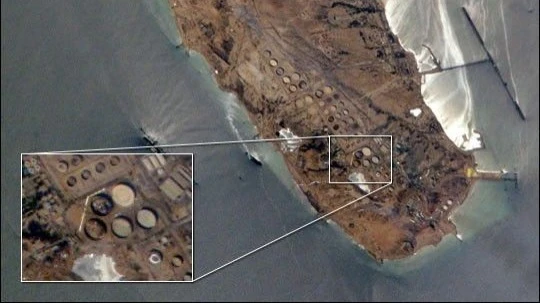
90% of Iran's oil exports pass through the terminal on Kharq Island / Photo: NASA
The shock to the global oil market could intensify if the US and Israel decide to seize Iran's port on Kharq Island, through which 90% of Iran's oil exports pass, JPMorgan has warned. Axios wrote that Washington was discussing the option of attacking the island. In this case, Iranian oil supplies could virtually stop, its production would be halved, and Tehran could respond with strikes on the energy infrastructure in the region, JPMorgan said.
Details
A direct strike on Kharq would "immediately halt the bulk of Iran's oil exports," likely leading to "serious retaliation" in the crucial Strait of Hormuz, which Iran controls, or against Gulf energy infrastructure. This is according to a JPMorgan note quoted by Reuters.
Kharq Island in the northern Persian Gulf remains one of Iran's most strategically important yet vulnerable targets. According to the Financial Times, about nine out of ten barrels of oil the country exports abroad passes through this small coral island.
"Without [the island], [Iran's] economy will hit rock bottom," the Financial Times quoted former US deputy special envoy for Iran Richard Nephew as saying. But an attack on Kharg would be a significant escalation of the conflict, he believes. "The US and Israel realize: if you strike, there is a risk that Iran will actually start attacking the oil infrastructure of the Gulf states, and if regime change is successful, it will extremely weaken the [possible] new government," he said. - That doesn't mean it won't be the target of an attack, but it explains why it hasn't happened yet."
Iran is OPEC's third-largest oil producer: the country produces about 3.3 million barrels of crude oil per day, about 4.5% of global supplies, Reuters notes. The terminal on Hark Island is connected by underwater pipelines to the country's largest fields. The island has dozens of oil storage tanks and long berths for loading supertankers, the Financial Times notes.
Storage capacity on the island is estimated at about 30 million barrels. About 18 million barrels are now stored there - the equivalent of about 10-12 days of exports at normal volumes, according to data from the analytical company Kpler cited by Reuters.
An additional factor in the importance of the island remains China: most of Iran's oil exports go there, the FT notes.
Before the US-Israeli strikes, Iran sharply increased oil exports from Kharqa. According to JPMorgan Chase, between February 15 and February 20, shipments exceeded 3 million barrels per day - almost triple the usual level of 1.3-1.6 million barrels.
Context
Despite its strategic importance, Hark has not yet been attacked. According to the Financial Times, the terminal continues to operate, and tanker tracking platforms show that several supertankers have loaded there in the past week.
JPMorgan analysts remind us that historically the U.S. has avoided strikes on the island. During the 1979 hostage crisis, President Jimmy Carter imposed sanctions on Iran but did not attack Hark. Later, Ronald Reagan during the "tanker war" of the 1980s (one episode of the Iran-Iraq War) also focused on protecting shipping without striking the terminal.
This article was AI-translated and verified by a human editor