Liberation Day, Buffett's departure, and fears of a bubble: what will investors remember about 2025?


In 2025, political instability and geopolitical risks increased market volatility, while rapid technological progress gave stocks new momentum for growth. Donald Trump's return to the White House heightened the risks of trade wars and geopolitical fragmentation, investors began to talk more frequently about a possible bubble in the artificial intelligence sector, and Warren Buffett's retirement symbolically marked the end of an era. In this article, we look back at the key events of 2025 that shaped the risks and opportunities for investors around the world.
Trump 2.0
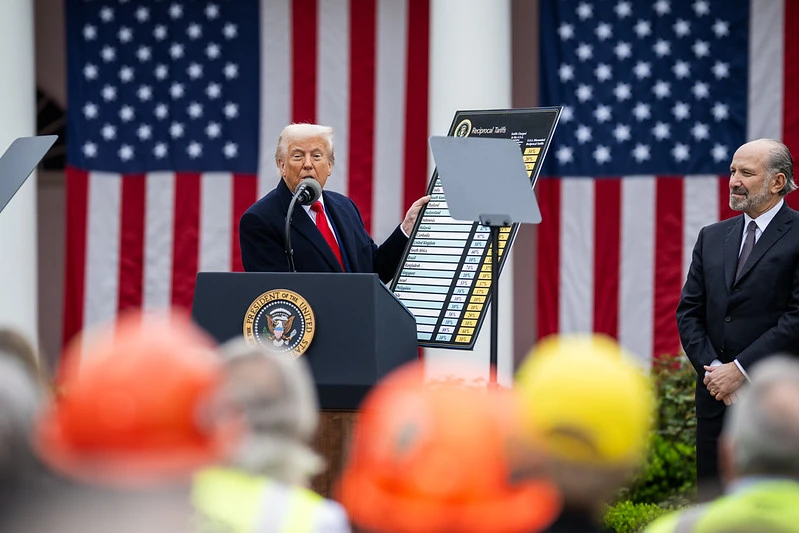
Donald Trump returned to the White House with his old slogan, "America First." He quickly began implementing his trade policy, which culminated in the so-called Independence Day (America's independence from import dependence). The tariffs he announced turned out to be much more extensive than expected: stocks reacted with their sharpest decline since 2020, the Wall Street fear index soared, and economists predicted a recession. Amid market panic, Trump suspended most of the tariffs, giving rise to the phrase "Trump Always Chickens Out" (TACO). A global trade war was avoided: the US negotiated deals with other countries and even concluded a fragile "truce" with China. In early 2026, the Supreme Court is expected to decide whether Trump could have imposed such tariffs in the first place.
At the end of the year, Trump also credited himself with "resolving eight wars." This is clearly an exaggeration, but the US president did receive recognition for his role in the settlement between Israel and Hamas. The US 20-point peace plan ended the war and secured the return of Israeli hostages, although implementation of the program stalled after that — and some analysts argue that this was to be expected, but Trump was in a hurry to close the deal. As for Russia and Ukraine, the US president, who promised to achieve peace in 24 hours, has so far failed to achieve even a temporary ceasefire. There are still significant differences in the peace plan currently under discussion, and Washington is already preparing new sanctions against Moscow in case the negotiations fail.
What happened in the market: The S&P 500 lost 12% in a week after Trump declared "Liberation Day."
The crisis in US-European relations
The arrival of the new administration in the White House also marked a change in US policy toward Europe. In February, Trump's right-hand man, Vice President Jay Vance, shocked the Munich Security Conference by accusing Europe of deviating from "universal democratic values." Trump demanded that NATO allies increase their security spending: "If [they] don't pay, I won't defend them." In its new national security strategy, Washington officially called on Europe to take "primary responsibility for its own defense." In response to the pressure, European NATO members have made an unprecedented commitment since the end of the Cold War to strengthen their defense capabilities. According to the European Defense Agency (EDA), the EU has allocated a record €392 billion to defense this year.
What's on the market: The Stoxx Europe Aerospace and Defense index has risen more than 50% this year, outperforming the broader European stock market threefold.
What to read: Witnesses to the accident: what will change after US Vice President Jim D. Vance's speech in Munich
$1 trillion panic over "Chinese ChatGPT"
On January 27, in just one day, the US stock market lost more than $1 trillion in capitalization, and Nvidia's market value plummeted by a record $600 billion. The panic was caused by the release of the Chinese chatbot DeepSeek R1, which, according to its creators, outperformed ChatGPT in tests and cost only a small fraction of the funds invested in Western megaprojects. This made investors wonder whether OpenAI, Meta, and other tech giants would be able to continue to justify their colossal capital expenditures, which had contributed to the influx of money into stocks over the past two years.
DeepSeek's success has also sparked increased interest in Chinese technological developments. Since the beginning of the year, Hong Kong's Hang Seng Tech Index has risen by more than 20%, while tech giants Baidu and Alibaba have gained around 60-70%.
How the market reacted: The NASDAQ Composite Index lost more than 3% in a single day due to the release of DeepSeek.
The End of Buffett's Era
The news of Warren Buffett's departure from his position as CEO of Berkshire Hathaway, which he had held for 60 years, could have been expected: after all, he turned 95 this year. Nevertheless, the "Oracle of Omaha" caused a sensation in May at the annual shareholders' meeting — the so-called Woodstock for capitalists — when he announced the transfer of power to his deputy Greg Abel.
"The end of an era for the man many consider the greatest investor of all time," Bloomberg described it. Buffett himself explained his retirement simply: "When you start getting old, it's irreversible." He said he has no intention of sitting at home watching TV series in retirement: his interests will not change after he steps down.
How the market reacted: since May, Berkshire Hathaway shares have fallen by almost 7%, losing the so-called Buffett premium — shareholders' willingness to pay extra for the legendary investor's expertise.
What to read: The hero of"investment Woodstock": what Warren Buffett taught investors
Musk in politics
Elon Musk's brief stint in the White House has caused serious damage to Tesla, even a long-time fan of the company, Wedbush Securities analyst Dan Ives, admits. The richest man in the world set out to cut government spending by $2 trillion a year through layoffs and the closure of certain programs, but achieved only a small fraction of what he promised. Nevertheless, his actions sparked a series of protests at Tesla dealerships and acts of vandalism against cars. Visible Alpha forecasts that global sales of Tesla cars will decline by 7% this year, while Musk himself told shareholders a year ago that they would grow by 20-30%. Now shareholders are expecting him to perform a "miracle" — and are willing to pay $1 trillion for his motivation.
How the market reacted: after a slump in the first half of the year, Tesla shares ended 2025 up more than 10%.
What to read: "Alien vs. Predator": what economists and political scientists are saying about the feud between Trump and Musk
The US and the dollar are losing their exclusivity
"You would have to be downright unlucky to pick a market that has underperformed the US this year," wrote The Wall Street Journal. In 2025, stocks in Korea, Greece, and Spain rose by 70-90%, while US stocks rose by only 17%. By actively investing in foreign securities, investors tried to hedge against the volatility of the US market caused by the chaotic introduction of tariffs and sought cheaper alternatives to the S&P 500 index. The weakening of the US currency also improved the returns on foreign assets, with the DXY dollar index falling by almost 10% this year. Bank of America strategist Michael Hartnett, who advised investors to look at foreign securities back in 2024, expects that after the first half of the decade, which was marked by "American exceptionalism," investors will increasingly shift capital to global markets over the next five years.
What's on the market: The MSCI ACWI Ex-USA Index, which includes large- and mid-cap companies outside the US, has risen nearly 30% this year.
What to read: The Greek miracle: how Athens emerged from the crisis and brought investors a 70% return
Crypto burnout
Until recently, it seemed that nothing could stop Bitcoin's growth. This year, Trump declared cryptocurrencies a national priority, the US Congress passed landmark legislation on stablecoins, and Bitcoin exchange-traded funds (ETFs) attracted billions of dollars. Therefore, the sharp decline in cryptocurrency after soaring to a record high above $126,000 has puzzled crypto traders, writes Bloomberg. Bitcoin is ending the year in the red for the fourth time in history. In addition, it is no longer moving in sync with stocks: the Nasdaq 100 index has risen 21% since the beginning of the year.
What's on the market: Bitcoin is now about 5% cheaper than at the beginning of 2025.
Laboub mania
A toy monster with a broad smile has taken the world by storm: in the first half of 2025, revenue for Chinese company Pop Mart, which produces Labubus, soared by more than 200% despite the broader economic downturn in China. However, the hype seems to be fading as quickly as it flared up. Prices for Laboboo on the secondary market are falling, Pop Mart's revenue growth in the US is slowing, and the number of bets on a decline in shares has tripled since November, according to Bloomberg. Goldman Sachs estimates that the craze for collectible toys typically lasts about two to three years, with only a few items, such as certain Barbie dolls, managing to remain popular for longer.
How the market reacted: Pop Mart shares fell more than 40% from their peak in August. Even despite the decline, they brought investors nearly 110% in 2025.
Fear of a bubble has returned to the market
By the end of the year, the market was focused on one question: would the artificial intelligence boom turn out to be a new bubble, whose collapse would be comparable to the dot-com crash? Never before had so much been spent so quickly on a technology with a business model that had not yet been fully proven. Big tech companies are competing with each other in terms of the scale of their investments in data centers, and the largest AI startups are partially financing their expenses through complex deals that are criticized for their "circular" nature.
At the same time, forecasts indicate a significant gap between the future revenues and expenses of AI companies. According to Bain & Co estimates, by 2030, the sector will need $2 trillion in total annual revenue to finance computing power. However, actual revenue is likely to be $800 billion less. "There is a very real possibility that investors will lose a tremendous amount of capital during this cycle," David Einhorn, CEO and founder of Greenlight Capital, told Bloomberg.
What's on the market: Nvidia shares have lost 9% since the beginning of November amid growing fears of a bubble bursting.
What to read: "The market is facing several difficult years": highlights from an interview with Burry, author of The Big Short
This article was AI-translated and verified by a human editor