Micron nearly tripled revenue, but stock fell sharply after the report. What's wrong?
Micron ramps up investment in manufacturing to keep up with demand

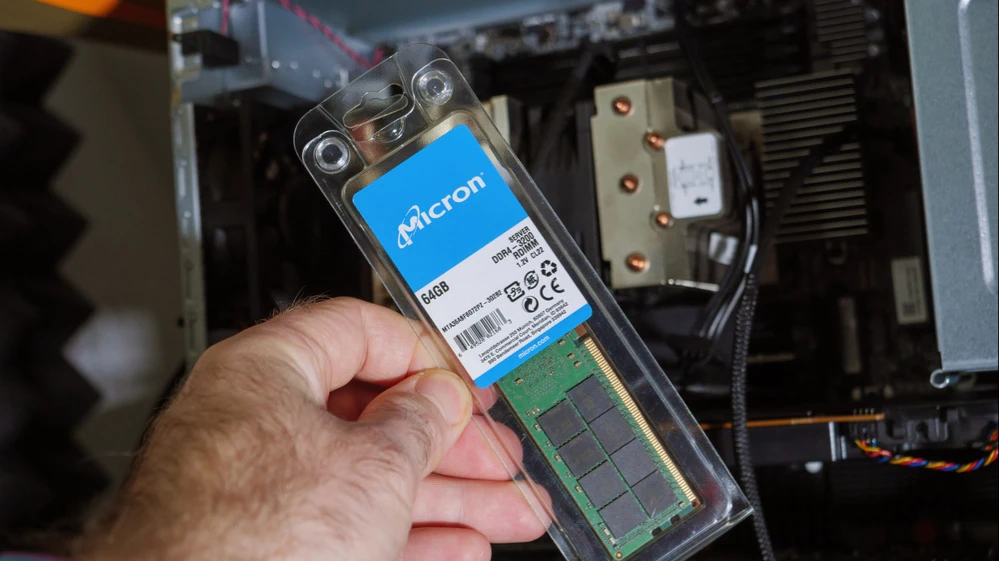
Revenue at memory chip maker Micron Technology nearly tripled last quarter, beating analysts' forecasts. However, the chipmaker warned that it will have to significantly increase production costs to meet the rapidly growing demand. That somewhat overshadowed the company's generally optimistic outlook for the current quarter, Bloomberg notes. In the postmarket after the publication of the reports, Micron shares were cheaper by more than 5%.
Details
Micron's revenue in the second fiscal quarter of fiscal 2026, ending Feb. 26, rose 196% to $23.86 billion compared to the same quarter last year. Analysts, according to LSEG, expected $20.07 billion, CNBC writes. Adjusted earnings per share totaled $12.2 versus expectations of $9.31.
Micron reported a huge demand for memory chips due to the AI boom. To meet this market need, the chipmaker needs to expand production. In this regard, capital expenditures in the current fiscal year, which ends in August, will exceed $25 billion, the company said. Analysts were expecting $22.4 billion, Bloomberg writes. Micron also added that in fiscal 2027, spending will increase by more than $10 billion compared to the current year.
Micron's revenue in the current quarter, according to the company, will be about $33.5 billion - 40% more than last quarter. The average forecast of analysts was at $23.7 billion, Bloomberg writes.
Despite the expected growth in revenue, investors took the report with restraint: the shares on the post-market on Wednesday fell in price by more than 5%. In the main trading on March 18, before the report was published, they set a new record for the entire time of circulation on the stock exchange, although at the end of the day they added an insignificant 0.01%.
Demand for memory
Computer memory prices are skyrocketing due to shortages caused by demand from the AI sector. Memory is critical for data transfer in training and running artificial intelligence models. This has forced manufacturers to reallocate capacity in favor of higher margin orders, which has reduced the supply of other types of memory and caused prices to spike.
Micron's cloud computing memory segment revenue grew more than 160% to $7.75 billion, while its mobile and PC segment showed even stronger growth, up 244% to $7.71 billion.
Micron shares were up 62% YTD by the time the report was published, becoming the best performing stock in the Philadelphia Semiconductor Index.
Micron and other memory makers are benefiting from the unprecedented expansion of data center infrastructure. The market is actually controlled by three players - Micron, Samsung Electronics and SK Hynix, and demand is expected to remain high for many years, emphasizes Bloomberg. According to the head of SK Group Choi Tae-won, the global deficit may persist for another 4-5 years due to structural constraints in semiconductor production, the agency writes.
Micron is building two large production complexes in Idaho and New York to expand capacity in the US. Production at the Idaho site is expected to begin by mid-2027, while silicon wafer production in New York is expected to start in the second half of 2028, CNBC writes.
What analysts recommend
Most on Wall Street recommend buying Micron stock: it has 44 Buy and Overweight ratings versus four Hold (advice to hold) and two Sell (sell), MarketWatch shows.
Meanwhile, the average target price of $443.67 is 4% lower than the current price.
This article was AI-translated and verified by a human editor