Musk warned of an "excruciatingly slow" start to Cybercab and Optimus production
Progress on robotaxi and humanoid robot projects is crucial to Tesla's share price

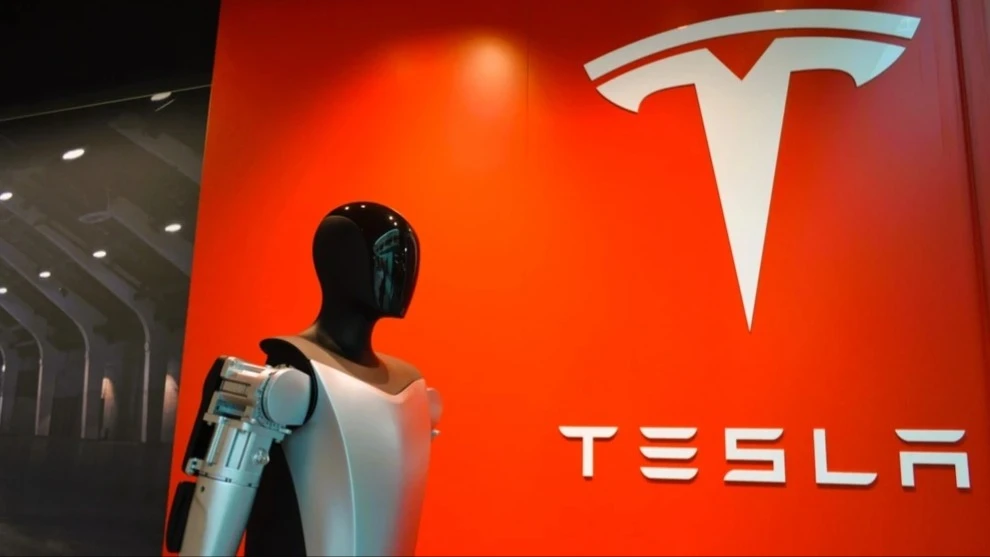
Tesla plans to start producing Optimus robots by the end of 2026 / Photo: Around the World Photos/Shutterstock.com
The early production pace of the Cybercab robotaxi and Optimus humanoid robot will be "excruciatingly slow" before accelerating over time, Tesla CEO Elon Musk has warned. Much of Tesla's share price is built on investor hopes for Cybercab and Optimus, although the company still derives its main revenue from electric car sales.
Details
Musk's clarification followed Tesla investor and Influencer Sawyer Merritt's announcement at X that Cybercab production will begin in less than 100 days using a new assembly method. Merritt added that eventually one Cybercab will be able to roll off the assembly line in less than 10 seconds, compared to 34 seconds for the Model Y.
In response to the post, Musk reminded us that new product launches always start slowly: "The speed of ramping up production is inversely proportional to the number of new parts and process steps." In the case of Cybercab and the humanoid robot Optimus, virtually all components are new, which will make production "excruciatingly slow" at first, though eventually it will become "insanely fast," he wrote.
At Tesla's November 2025 AGM, Musk said the company plans to begin mass production of the Cybercab in April 2026. He "hopes" to begin production of Optimus near the end of this year.
Why it's important
Tesla is positioning Cybercab as the centerpiece of its expansion into autonomous driving, robotics and artificial intelligence, notes a publication on Stocktwits, a platform for investors and traders. The company began testing robotaxis in Austin, Texas, in June 2025, launching a small fleet of Model Y electric cars with Full Self-Driving technology. At first, they took to the routes with a safety operator in the front seat. In December, Musk said Tesla in Texas had begun testing a fully autonomous robotaxi.
Musk called the humanoid robot project a key element of Tesla's long-term strategy, saying it could eventually surpass the company's car business. He argued that robots could create enormous economic value by taking on a wide range of tasks that humans are unwilling to do, Reuters recalls.
The market is increasingly seeing Tesla as an AI story: investors are betting on autopilot and robotics, causing the company's stock to trade at an extremely high multiple of about 200 to expected annual earnings. Nvidia, the main beneficiary of the AI boom, has only a 25, Barron's writes. To justify such a valuation, Tesla is critical to demonstrate progress in its AI projects in 2026, the publication emphasizes.
What's going on with the stock
On January 20, after a long weekend, Tesla shares fell along with the broad market in New York. The electric car maker's shares fell 4.2% to $419.25, while the S&P 500 and Dow Jones Industrial Average indexes fell 2.1% and 1.8%, respectively. Quotes on Wall Street collapsed amid investors' concerns about President Donald Trump's threats to impose duties on NATO partners if they do not allow the United States to acquire Greenland. On January 21, Tesla shares grow by about 1% in over-the-counter trading in the United States.
On Wall Street there is no consensus on Tesla: 20 recommendations to buy (Buy and Overweight ratings) with 18 neutral ratings (Hold) and 11 recommendations to sell the stock (Sell and Underweight) form a wait-and-see "hold" consensus (Hold). Current quotations even after the collapse on January 20 remain above the average annual target of analysts ($415.59) - a sign that the fundamental growth potential of Tesla securities is not seen at the moment.
This article was AI-translated and verified by a human editor