'Shock is inevitable': US stocks heading for longest series of declines in a year


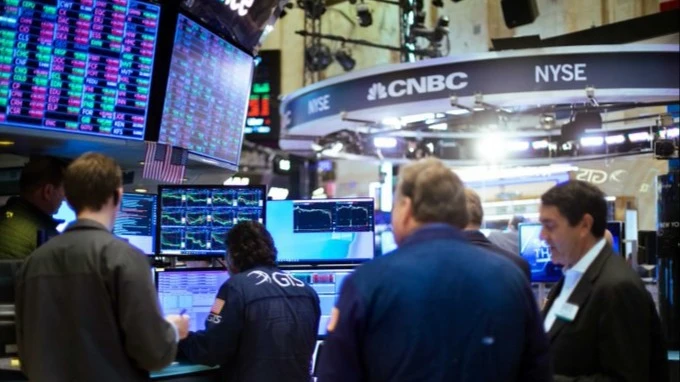
Photo: X / NYSE
Major U.S. stock indices opened March 20 in the negative zone and are heading for a fourth consecutive week of decline, writes CNBC. Bloomberg notes that for the U.S. stock markets this may become the longest series of declines for the year. Oil prices resumed growth after a brief decline.
Details
Broad index of U.S. stocks S&P 500 in the first minutes of trading on Friday fell by 0.48%, technology Nasdaq Composite lost immediately 0.8%, the index of "blue chips" Dow Jones in the minus 0.3%. Half an hour after the start of trading S&P 500 accelerated the decline to minus 0.77%, the Nasdaq Composite fell by 1.28%, the Dow Jones is still losing about 0.3%.
Brent crude oil, after a short decline in early and mid-trading on March 20, has reduced the rate of decline: at the time of publication it is trading at $108.44 per barrel (this is still slightly below the closing level of March 19, but more than the intraday low of $105). Meanwhile, April WTI futures resumed growth: they are trading at $96.28 per barrel, 0.15% more expensive than the previous day's closing level.
The VIX Volatility Index, also known as the "Wall Street Fear Index," adds 4.2% to 25 points (any value above 20 indicates volatility in the market).
Context
Amid escalating conflict in the Middle East, the market on March 20 should also be prepared for increased volatility as about$5.7 trillion worth of options tied to U.S. stocks, indexes and exchange-traded funds expire on Friday, Bloomberg writes. It's a quarterly event that traders call the "triple whammy" - it tends to cause unexpected swings in asset prices as large volumes of derivatives positions leave the market.
What the market is saying
- "Even if the U.S. withdraws from the conflict, Israel may not end it, and [therefore] strikes [against tankers and infrastructure in the Gulf] could still continue," said Alicia Garcia-Herrero, Natixis' chief Asia-Pacific economist. "This means that the Gulf will still be under pressure ... so oil prices will not go back to $60 a barrel [as they did before the escalation of the conflict in the Middle East], they will probably stay at $90 at least until the end of the year. So the shock is already inevitable," she believes (quoted by Reuters).
- "I think the market is now starting to realize the reality that high energy prices are going to persist longer than expected," Bloomberg quoted Siebert Financial chief investment officer Mark Malek as saying. - Clearly, the Iranian regime has moved on to the last point of its strategy: 'Mutually Assured Destruction'."
- "We believe that the Fed keeping interest rates unchanged remains the most prudent course of action," said Deborah Cunningham, chief investment officer at Federated Hermes. "The current conflict with Iran is in no way comparable to the turmoil seen during COVID-19 or the 2008 global financial crisis, so there is no reason to cut rates by hundreds of basis points," Bloomberg quoted Cunningham as saying.
- Although the S&P 500 index remains about 5% below its all-time high, Unlimited CEO Bob Elliott believes the market is still overly optimistic about the war's impact on corporate earnings and the U.S. economy, CNBC writes.
- "All short-term developments are dependent on the opening of the [Strait of Hormuz]," Scott Wren, senior global market strategist at Wells Fargo Investment Institute, agrees. "If you compare stocks and bonds, markets have been pricing in stronger gains since this conflict began. It doesn't make any sense," he told CNBC . "Essentially, households are being robbed of 1% to 2% of their real purchasing power, even if this conflict resolves tomorrow," he added.
This article was AI-translated and verified by a human editor