Structure shares double after 'near-homerun' obesity pill data
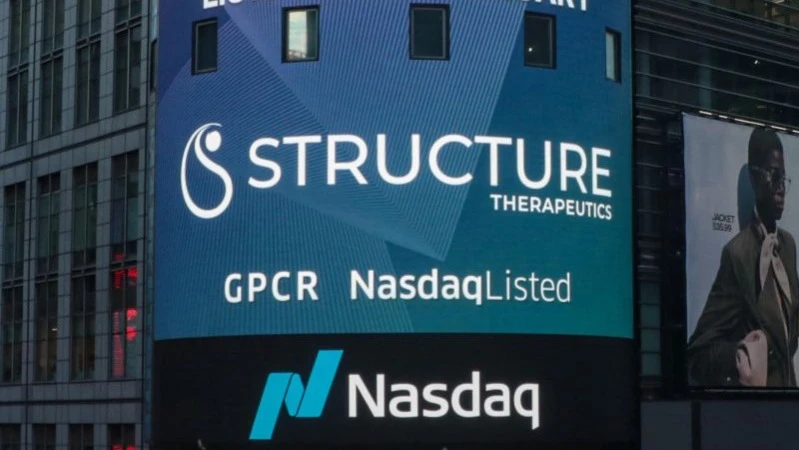
Shares of Structure Therapeutics more than doubled on Monday, December 8, closing near $70 apiece, with the company’s market capitalization rocketing above $4.2 billion. This followed mid-stage trial results for its experimental oral obesity drug, aleniglipron, which delivered greater weight loss than a competing pill under development by Eli Lilly. Analysts say the stock may have further upside, particularly if a major player moves to acquire the company.
Company history
Structure Therapeutics was founded in 2016 as ShouTi. Three years later, it adopted its current name and shifted its jurisdiction from Delaware to the Cayman Islands. The company’s founders include CEO Raymond Stevens and biotech software firm Schrödinger.
Stevens is a structural biologist with extensive experience in small-molecule drug development and company building. He previously contributed to the discovery of a therapy for an inherited metabolic disorder and founded Receptos, which developed a multiple sclerosis treatment. Schrödinger, meanwhile, provides the computational platform Structure uses to accelerate and refine small-molecule design, the company wrote in its 2024 10-K. Note that Schrödinger’s stock did not react to Structure’s trial results.
Structure financed its early operations primarily through private placements, before in February 2023 conducting an IPO on the Nasdaq, selling more than 12.3 million American depositary receipts at $15 per ADR (with 1 ADR representing 3 ordinary shares). Since the IPO, the stock has risen more than 4.7 times. On Monday, Structure also announced plans to raise as much as $500 million through a new ADR and warrant offering.
Structure today
From the outset, Structure has focused on therapies for chronic diseases. Its lead candidate is aleniglipron, an oral small-molecule GLP-1 receptor agonist for obesity. It was for aleniglipron that the company released phase II data on Monday.
The trials evaluated weight-loss outcomes across several dose levels. The lowest dose led to an 8.2% placebo-adjusted reduction in body weight, while the highest dose produced a 15.3% reduction.
For comparison, Eli Lilly’s orforglipron pill achieved a 12.4% reduction at its highest dose, but at a later stage of testing.
The results demonstrated that aleniglipron is among the strongest oral candidates in its class, said Ilya Zubkov, senior healthcare analyst at Freedom Finance Global. BMO Capital Markets analyst Evan Seigerman called them a “near-homerun scenario,” Bloomberg reported.
According to Stevens, the CEO, the data support progression into phase III trials, which are expected to begin around mid-2026. That stage will determine whether Structure can surpass the efficacy benchmark set by Lilly, reckons Zubkov of Freedom. Structure plans to evaluate higher target doses and aims to show average weight loss of about 15%, which would meaningfully strengthen its competitive position in a rapidly evolving segment of the market.
Impact
"In my entire life, I never dreamed that we would be talking about medicines that are providing hope for people like me who have struggled for years with being overweight or with obesity," famous TV host Oprah Winfrey told People magazine.
The growth of the weight-loss drug market, particularly GLP-1 agonists, is rightly considered a "silent revolution," says Boris Tolkachev, Zubkov's colleague at Freedom Finance Global. He compares it to the meteoric rise from the late 1980s of statins, which became a standard treatment for millions of heart disease and atherosclerosis patients. In terms of their impact on popular culture and consumer expectations, today’s weight loss drugs rival Viagra, Tolkachev adds.
Denmark's Novo Nordisk launched the first major obesity drug in this class, Wegovy, based on semaglutide. The FT named Novo Nordisk CEO Lars Jørgensen its person of the year in 2023, recognizing the company's obesity treatments for having a "profound impact on healthcare, society, and our relationship with food." Hot on its track, Eli Lilly registered its Zepbound drug, based on tirzepatide, which acts on both GLP-1 and GIP receptors.
Today, semaglutide and tirzepatide account for about 95% of the global obesity-drug market, but both are injectable therapies that require refrigeration and self-administration. They are also expensive, Structure wrote in its filings. As a result, adherence is low: roughly 65% of patients discontinue treatment within a year and as many as 85% within two years, according to the company. Without sustained use, patients typically regain weight and remain at risk for type 2 diabetes, cardiovascular disease, and sleep apnea.
“Plain and simple, patients are waiting for better options,” Stevens was quoted by Bloomberg as saying.
Switching from injections to tablets would improve convenience and adherence, Tolkachev reckons. He noted that the semaglutide-tirzepatide duopoly is unlikely to last. Morningstar estimated last year that as many as 16 new obesity drugs could reach the market within five years, potentially capturing a third of the market by 2031, which is projected to reach $200 billion by then.
Takeaways for investors
All 14 Wall Street recommendations tracked by MarketWatch are “buy,” with an average target price of $78.40 per share. That implies upside of nearly 17.5% relative to the December 9 close.
The primary catalysts for the stock are clinical-trial updates. That was the case in late 2023, when Structure reported phase I data, and again now, Zubkov points out. The next major catalyst will likely be the release of phase III results, expected no earlier than 2027.
Given this timeline, the performance of Structure shares in 2026 is likely to be subdued, Zubkov said. He does not expect meaningful gains in the short term.
"If our drawdown expectations for 2026 prove correct, we would revisit Structure ADRs as a potential 'buy,'" the analyst said. He pointed to the company’s appeal as an acquisition target, citing the recent bidding war in which Pfizer ultimately acquired Metsera for $10 billion, twice the original offer.
“We continue to talk with just about everybody that’s out there,” Stevens says. “Given that this is the biggest drug class in history, we continue to see a lot of interest.”
Freedom also highlights Viking Therapeutics, another developer of oral therapies for obesity. Canaccord Genuity has called Viking “one of the leading biotech companies in the obesity drug development space.” But concerns about discontinuations tied to high-dose side effects have weighed on its stock, Zubkov explains. If the company resolves those issues, he believes its candidate still has a viable path to market.