Wall Street is raising earnings forecasts for the S&P 500. What's unusual about that?


Analysts raise earnings per share forecasts for S&P 500 companies for 2026 and 2027. Photo: fabio Spano / Unsplash.com
JPMorgan on Tuesday, April 21, raised its forecast for the S&P 500 index for the end of 2026 to 7,600 points, explaining it by the growth of profits of companies associated with AI and technology. This comes just weeks after the bank, on the contrary, lowered its forecast for the index from 7,500 to 7,200 points, Reuters writes. The new target suggests a potential upside of about 6.9% relative to Monday's closing level.
The bank also raised its annual earnings per share (EPS) forecast for the index from $315 to $330 for 2026 and from $355 to $385 for 2027.
JPMorgan isn't the only one. Consensus earnings forecasts for S&P 500 companies for 2026 and 2027 are now 4% above January levels, notes Goldman Sachs strategist Ben Snyder. The energy and information technology sectors accounted for almost all of the increase.
What is special about this revision, investor Vladimir Tsuprov writes in his Telegram channel VTs. Oninvest publishes it with minor edits and an addition.
Why U.S. stocks are cheap
War is war, but the capitalists' profits are on a schedule.
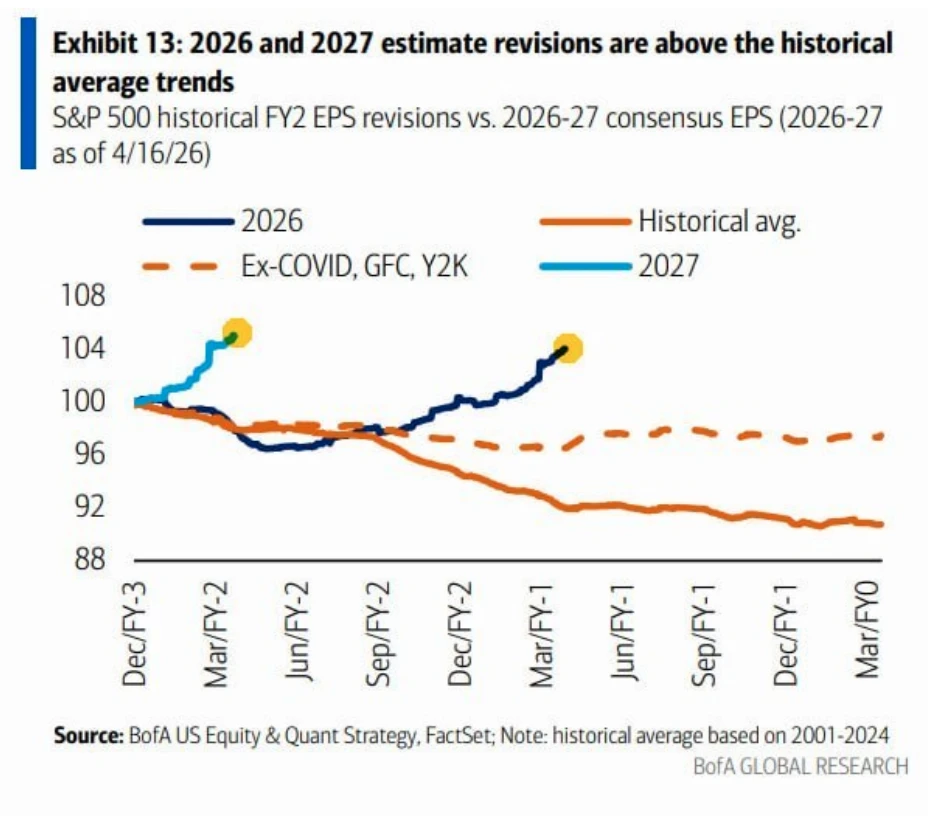
You may have seen this Bank of America chart. But I don't think everyone understands what the lines are. I explain because I see the same thing when I analyze individual stock reports (a recent example is my analysis of Nvidia).
The stock market lives by expectations, and market valuations are based on forecasts. So, now we are witnessing a situation of record upward revision of earnings forecasts.
One of the main drivers of growth is investment in AI, which entails large-scale infrastructure construction. A huge number of companies are increasing their revenue forecasts. Not all, but most (especially suppliers of sensitive equipment such as chips) are also increasing their margins.
The blue line is something I noticed myself. It shows how the market has projected the EPS of US companies for 2027. The recording of these forecasts started recently, essentially December 2025, so the blue line is short.
But the 2026 earnings forecast began in December 2024. We see a slump in forecasts last spring, when Trump unleashed tariff wars and the first speculation about a bubble in the AI market began. But investments in data centers and artificial intelligence supported both the U.S. economy and businesses, and analysts began to actively raise forecasts.
✌Lest you think the market is like that and forecasts always go up over time, BofA has provided the average forecast trend - the brown line. It turns out that forecasts usually go down.
It turns out that we live in a unique time, fellow capitalists! If you believe the Wall Street analysts - mortgage your apartment, buy the S&P 500 and you will be fabulously rich.
This article was AI-translated and verified by a human editor