'We're headed for incredible abundance': 'Davos' hitmaker Elon Musk spoke at WEF for the first time

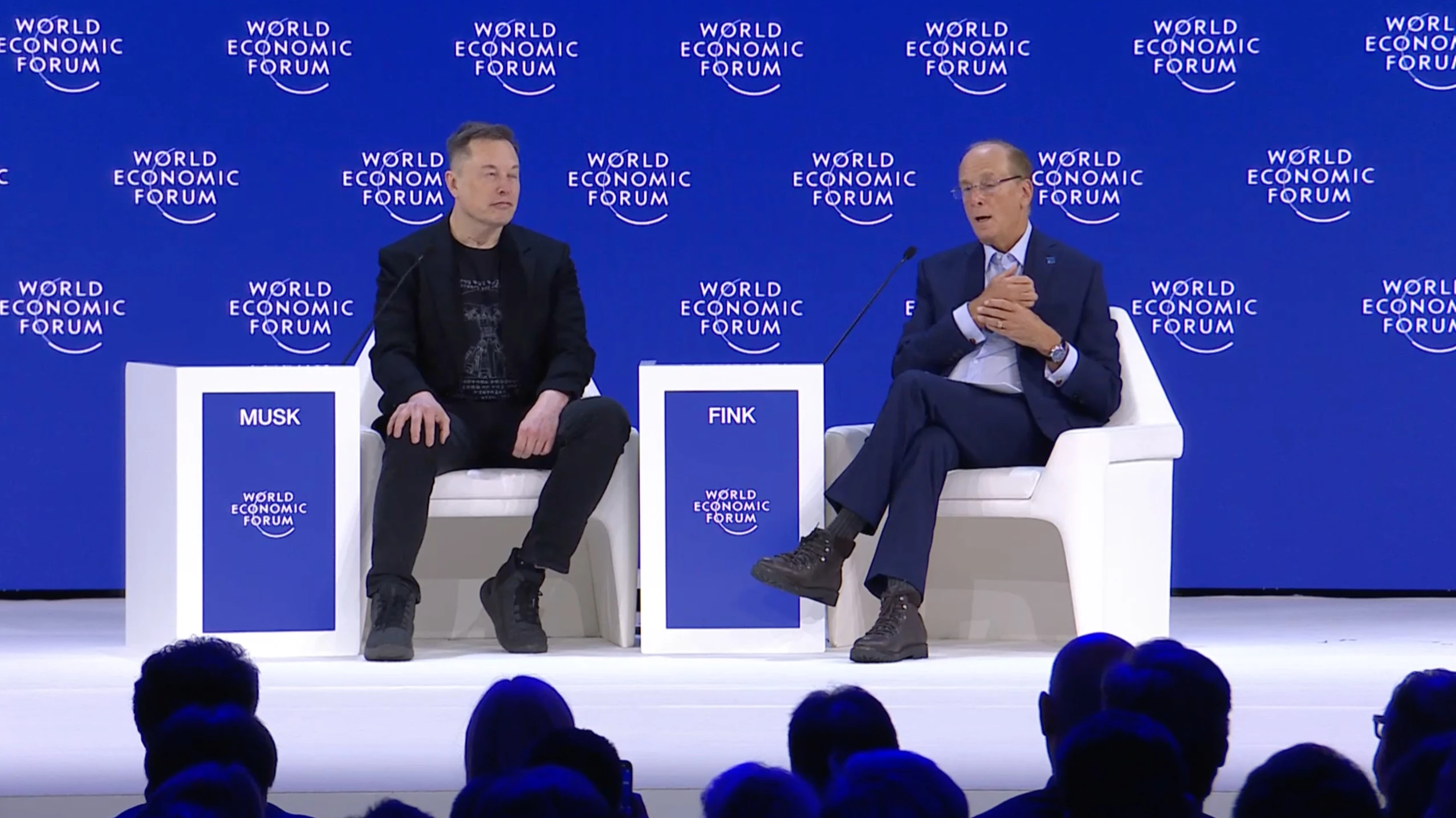
Elon Musk, the richest man in the world, took part in the World Economic Forum for the first time. In a conversation with Larry Fink, head of the world's largest investment company BlackRock, the billionaire told about his vision of a future without poverty and old age, plans for the development of Tesla robot cabs and the prospects of a flight to Mars. Oninvest quotes his statements with abbreviations.
About the SpaceX mission
The overall goal of my companies is to maximize the future of civilization. Essentially, maximize the probability that civilization has a great future, and expand the existence of intelligence beyond death. For example, SpaceX aims to develop rocket technology to the point where we can extend life and intelligence from Earth to Ma and then to other star systems.
I believe that the mind as we know it should be treated as something fragile and vulnerable. We don't know if it exists anywhere else. I am often asked, "Are there aliens among us?" And I answer that there is one - that's me. I'm not believed, of course. But if aliens were really among us, we would know about it. We must assume that perhaps we are the only ones who exist. And if that's the case, then we have a responsibility to make sure that this light - the light of reason - is not extinguished.
In my view, the mind is a small candle in the vast darkness, which can easily go out. That is why it is so important to create a multi-planet system, so that in case of a natural or man-made disaster on Earth, the mind will continue to exist.
On the plans of Tesla and SpaceX
We [at Tesla] already have Optimus test robots doing simple tasks in the factory, and later this year we will probably start doing more complex things in an industrial environment. We'll probably start selling humanoid robots to the general public next year - when we've achieved confidence in their high reliability, safety, and range of functions.
I consider unmanned cars to be an essentially solved problem. Tesla is bringing its robotaxi service to the roads in several cities, and by the end of this year it will have spread widely across the United States. Next month, we hope to get approval for controlled autonomous driving in Europe, and then perhaps some time later in China.
For SpaceX, the major breakthrough it hopes to achieve this year will be full reusability of rockets. Perhaps Starship, which SpaceX intends to use to fly to Mars and the Moon and launch satellites, will achieve full reusability. This would revolutionize the way space travel is done because the cost of access to space would drop by a factor of about 100.
On the pace of AI development
My prediction is that by the end of this year, we could have an AI that is superior to any human being. And by 2030 or 2031, that is, in five years, AI will be smarter than all of humanity combined.
About the plan to go to Mars
I've been asked a couple times if I want to die on Mars. My answer is yes, but not by colliding with it.
On robots and the fight against poverty
If we talk about solving the problem of global poverty, about making sure that everyone has a very high standard of living, I think the only way to do that is through AI and robotics. It's not that they don't have problems - we need to be very careful with AI and robotics. We don't want to end up in "Terminator," do we? But if we have ubiquitous and essentially free AI and robots, we will have an explosive growth in the global economy that will truly surpass all precedents.
My prediction is that in the future, robots will create so many robots with artificial intelligence that they will fulfill every human need. At some point, you won't even be able to think of what to ask a robot to do.
I think everyone realizes that everyone will eventually have a robot like this. Because that's the kind of robot you want: a very safe robot that can look after children or pets. If you have elderly parents - and a lot of my friends have elderly parents - you realize that they need complex care. There just aren't enough people to do the job. So having a robot that could take care of elderly parents would be great.
I think it's going to happen. I'm very optimistic about the future. I think we're headed for a future of incredible abundance. We are certainly living in the most interesting time in history.
About aging and death
I think this is a solvable problem. When we understand what causes aging, it turns out that it is not a complex, hidden process at all. Because virtually all cells in the body age at about the same rate. I've never seen a person with an old left hand and a young right hand. Tim, there must be a mechanism, a kind of "clock" that synchronizes all the cells in the body.
And, by the way, death has certain benefits. There is a reason why we do not have a very long life expectancy: if people live too long, I think there is a risk of "ossification" of society, when everything becomes stagnant and lacks dynamics.
But still on the subject, will we find a way to extend life and reverse aging? It seems to me that it is extremely likely.
Context
It is not quite clear why Musk came to Davos, writes Business Insider. In 30 minutes of his speech, he said almost nothing new. The event with Musk at the WEF was not originally in the program - it was announced at the last moment. The Tesla founder is known as "Davos' most prominent cheater" and has never attended the forum until now, Bloomberg notes. In the past, Musk has called the annual summit of the world's elite "boring" and claimed the WEF is turning into "a government that no one elected." Three years ago, a WEF spokesman said Musk had not been invited to Davos since 2015. Relations between the entrepreneur and the WEF began to improve last year - the organizers invited Musk to the forum along with newly elected US President Donald Trump.
This article was AI-translated and verified by a human editor