Wealthy Americans are going to discount stores. Who has already profited from this?

In early December, several US fixed-price and discount retail chains reported growth in quarterly sales.
The Dollar Tree chain is one of the largest players in the fixed-price store segment in the United States. For Dollar Tree, the third quarter was one of the strongest in recent years, and the 2025 Halloween season was a record-breaking one.
The company's net sales grew 9.4% year-on-year to $4.7 billion in the third quarter, with comparable sales up more than 4%, mainly due to a 4.5% increase in average check size and a 0.3% decline in traffic. Operating profit rose 3.8% year-on-year to $343 million.
The company also raised its adjusted earnings per share (EPS) forecast for 2025 to $5.6–5.8 (the previous forecast was $5.32–5.72).
Since the beginning of the year, Dollar Tree shares have risen 65%.
American discounter Dollar General's net sales in the third quarter grew by 4.6% year-on-year to $10.6 billion, with same-store sales increasing by 2.5% due to a 2.5% increase in foot traffic. The average check remained unchanged.
Operating profit rose 31.5% to $425.9 million. Earnings per share jumped 43.8% to $1.28.
The company has raised its sales forecast for this year and now expects them to increase by 4.7–4.9% compared to 4.3–4.8% in the previous estimate. Comparable sales growth is expected to be 2.5–2.7% instead of the previously forecast 2.1–2.6%. The new EPS forecast is $6.3–6.5, compared to the previous forecast of $5.8–6.3.
Its shares have risen by more than 80% since the beginning of the year.
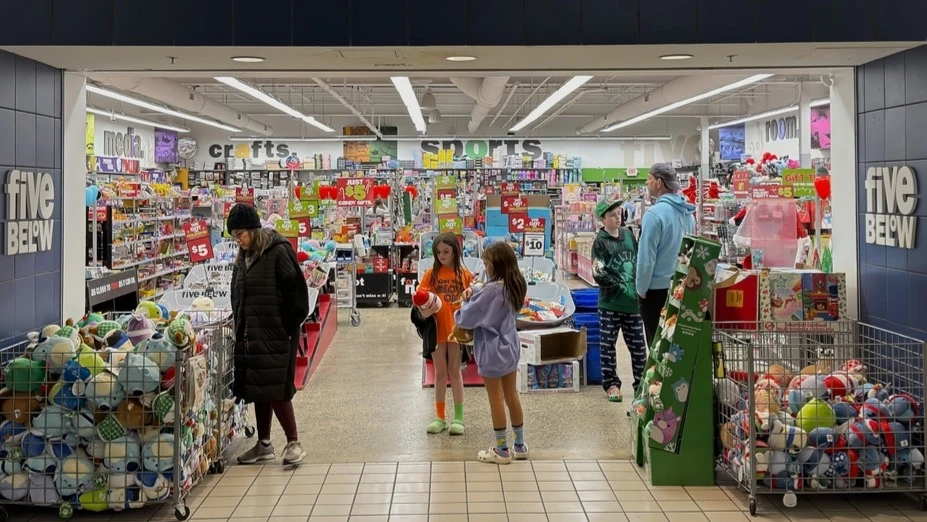
Another discounter, Five Below, saw net sales in the third quarter grow by 23% to $1.038 billion year-on-year, with comparable sales jumping 14.3%. The chain's operating profit for the quarter was $43.3 million, compared to an operating loss of $600,000 a year earlier.
The company also raised its 2025 sales forecast to $4.62 billion–$4.65 billion (previously $4.44 billion–$4.52 billion) and its earnings per share forecast to $5.51–$5.69 from $4.56–$4.96, respectively.
Its shares have risen by more than 80% since the beginning of the year.
Saving is for the long term
Hard discounters are managing to show sales growth thanks to widespread savings. Due to inflation and the rising cost of living, Americans are looking to get more goods for the same money, GlobalData Retail analyst Neil Saunders told Axios.
Official inflation in the US was 2.7% in November. Over the past five years, food prices have risen by more than 25%, according to Barron's, and prices for household goods, utilities, and transportation have also increased. Since 2017, annual expenses for two small children have increased by 40%, rent by 50%, and housing prices by 80%. At the same time, average income has grown by 38%, according to the Urban Institute.
Interestingly, sales at discount stores are now largely driven by affluent families. According to Axios, citing Dollar Tree CEO Michael Creedon, about 60% of Dollar Tree shoppers have an annual income of more than $100,000, while another 30% earn between $60,000 and $100,000. The rest are low-income consumers earning less than $60,000. Todd Vasos, CEO of Dollar General, told investors on a call following the third quarter results about the "disproportionately high growth" in the number of higher-income customers.
This is a long-term trend linked to a profound shift in consumer behavior, according to Alena Nikolaeva, portfolio manager at Astero Falcon. Americans have started buying more often out of necessity, optimizing their shopping carts and consciously choosing cheaper formats. This is a radical change in habits, she said in an interview with Oninvest.
Changes are coming: what companies will face in 2026
In 2026, the market will shift to competition based on high-quality execution of all processes: those who better control costs and product range will win.
The main challenges after the holidays are the need to maintain traffic when shoppers have already spent significantly and are becoming more cautious. For chains with a high proportion of essential goods, such as Dollar General, the decline is usually milder. For Dollar Tree and especially Five Below, this is a more sensitive period.
Dollar Tree experienced a downturn due to numerous operational and financial problems, including the unsuccessful acquisition of the Family Dollar chain in 2015. On July 5, 2025, it closed the deal to sell the chain to Brigade and Macellum, receiving $800 million.
Dollar Tree is currently undergoing a transformation: moving away from a rigid "everything for a dollar" scheme to a more flexible pricing model. If this transition continues to improve the perception of the product range, there is potential in 2026.
Dollar General is betting on essential goods and convenience, says Nikolaeva: the chain has been able to show how growth can be achieved through customer traffic rather than price increases.
Goldman Sachs, citing the company, writes that Dollar General has recorded sales growth in all categories for the third consecutive quarter, from consumer goods to home goods and clothing. In 2025, the chain plans to open about 575 new stores in the US and up to 15 in Mexico, as well as renovate about 4,250 stores. Goldman Sachs writes that renovated stores increase comparable sales by approximately 3-6%. After the publication of the latest quarterly report, the investment bank maintained a neutral rating for Dollar General shares and raised the target price from $126 to $129. On December 26, trading in its securities closed at $137.84.
The key challenge for the company in the near future will be competition with Walmart in the everyday goods segment: this retail chain is drawing away some of the discounters' customers with its promotions, and it is precisely the frequency of weekly visits that underpins Dollar General's business model, according to Nikolaeva.
Five Below not only managed to significantly increase sales in the last reporting quarter, but also raised its forecast for 2025 for two consecutive quarters. All this is thanks to an update of the management team and a change in marketing strategy, wrote the WSJ. According to Five Below CEO Vinny Park, quoted by the publication, the company tracks trends among Gen Alpha, Zoomers, and Millennials in order to target these groups with specific products. The company has also simplified its pricing structure, making low-priced items more visible and raising prices on select items. "The benefit is not just $5 and under. It's important that the shopper feels value in $7, $10, $15 and above," Park said.
Due to this focus on trends, Five Below is more sensitive to audience sentiment, and it is important for the company to maintain interest in its product range even when growth slows, Nikolaeva believes.
Walmart vs. discount stores
In the long term, the entire discount sector will grow, and not only because this segment is perceived as a safe haven during inflation. Chains will have to constantly fight for customers, says Nikolaeva.
Walmart remains the main beneficiary of "saving without giving up consumption" and, at the same time, the most serious competitor for hard discounters such as Dollar Tree, she believes.
Such chains are unlikely to fully replace supermarkets and hypermarkets, but they can become a convenient and, most importantly, accessible addition to everyday shopping. That is why Dollar General, for example, is actively developing its fresh produce segment and basic product line.
To understand who is winning this battle, investors should focus not only and not so much on the chains' revenues in the next two to three quarters. The key indicators to focus on are traffic and average check, frequency of visits, loss and margin dynamics, as well as the ability of chains to retain customers without aggressive promotions.
If Walmart continues to lure customers away from discounters, they will have to convince people that they not only offer cheaper goods, but also create value because they can be there when needed, says Nikolaeva.
This article was AI-translated and verified by a human editor