Who sets the Urals price in India - and what does Rosneft have to do with it?

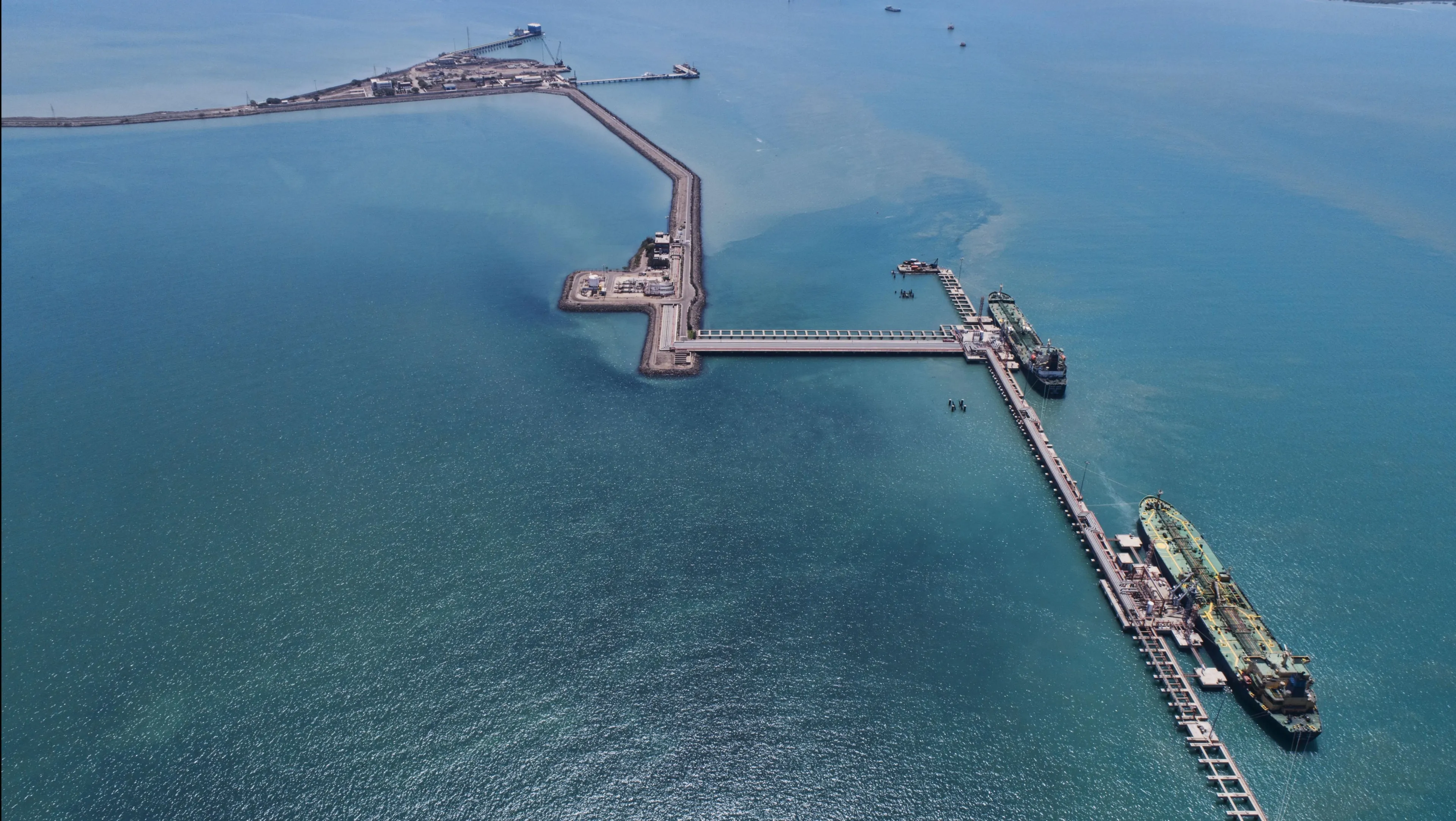
Polymarket puts the probability of a US strike on Iran before March 15 at 50%. Photo: Wikimedia.com
Oil prices jumped 3% on Wednesday amid heightened tensions between the United States and Iran and the abrupt end of Russian-Ukrainian talks in Geneva just two hours after they began, Reuters reported. Iran has temporarily blocked part of the Strait of Hormuz, a critical oil supply route - according to the official version, because of the Islamic Revolutionary Guard Corps exercises. On Thursday, February 19, Iran and Russia will conduct joint exercises in the Sea of Oman and the northern part of the Indian Ocean. While the market is pricing in the risk of a closure of the Strait of Hormuz and a new wave of escalation, India - one of the biggest buyers of Russian oil - is cutting its imports to their lowest levels since 2022 and turning back to Middle Eastern suppliers, Reuters sources said. Against the backdrop of these shifts, an uncomfortable question arises: how marketable the Urals price and its discount to Brent remains, if the largest buyer of this oil is linked to its seller. Oil industry expert Sergey Vakulenko wrote a great breakdown on his Facebook page, we publish it in full here
How is the price of Russian oil determined and where do the figures of discounts to Brent, which are flying around the Telegram channels, come from?
Russian producers sell oil to India under several types of contracts. The key differences are the point of sale (port in India or port in Russia) and whether it is a one-off transaction or part of a long-term contract.
At one extreme, oil is sold in a Russian port in a one-off transaction. This is a spot sale, the price is determined in the process of bargaining between buyer and seller, the buyer provides export and organizes freight.
The next option is that the seller (a Russian company) arranges to sell at an Indian port, but also in a one-off transaction and organizes delivery.
Finally, there are sales under a long-term contract (term contract). Usually such contracts are concluded for a year, the approximate volumes to be taken by the buyer are specified (however, often there is no penalty for not taking the volume, but there is an obligation to inform a reasonable period of time, say 2 months in advance, how much the buyer intends to take in each month), the price is determined by a more or less complex formula, which usually includes the price of a widely traded grade, such as Brent or Dubai, may include some other components, such as an exchange index for freight, discounts or premiums associated with the difference in the composition of the supplied oil from the marker grade. Usually, however, the formula is very simple - a marker grade plus or minus a premium or discount.
Large oil producers and refineries tend to operate under long-term contracts, and spot trading is what traders do, although standard practice for oil producers and refiners is to sell and buy stable base volume long-term and variable volume on the spot.
Now, how the price is determined. More specifically, how the price appears on newswires, Bloomberg and LSEG screens, and from there on websites and TV screens, and eventually in the calculation of taxes on the oil industry.
There are two main market information agencies, Argus or Platts. They regularly contact market participants, ask them how much oil was sold and bought on any given day, and summarize this data into daily quotes. But by the nature of this process, only the results of spot transactions are included in the quotes. For deep and liquid markets like Dated Brent or WTI this is normal. But in the case of Urals, the question arises as to what share of the Urals market is visible to external observers through the mechanisms provided by the agencies, and what share is invisible.
The spot is like a showcase
In the case of a calm and stable market (as it was with the same Urals until 2022), this is almost irrelevant. The formulas in the contracts will on average lead to approximately the same as what is realized on the spot market, and as soon as a noticeable difference appears, arbitrage traders eliminate it.
But for a market with a limited number of participants, where there are barriers in the form of sanctions risks, reluctance to shine, difficulties in organizing freight, especially in firefighting, arbitration often does not work.
In principle, Argus and Platts publish two prices - in Russian ports and in India. The gap between them is significant, but is explained by three elements:
- Freight cost (in early 2025 it was $4-$6 per barrel for shipments from Novorossiysk and Primorsk, and may reach $12 in February 2026)
- the cost of capital (if a trader buys oil and pays on the spot in a Russian port, from which it takes 5 weeks to go to India, i.e. to the point where the trader will get the money again, the capital is frozen).
- the effect of the forward curve on the marker grade (if the market is in backwardation, the futures price of Dubai crude, which determines the price level for the Indian market, is lower than the current one, the buyer assumes that when he brings the crude to the point of sale, the prices there will decrease and puts this risk into the price he offers at the Russian port a month before).
"The bridge" from the price in Russia to the price in India, taking into account the cost of freight and other components, is well built, leaving virtually no gaps of unclear nature.
$6 difference: terminal vs. customs
However, all this applies only to transactions and supply chains in which oil was bought on a spot in Novorossiysk or Primorsk, transported on a tanker chartered just before shipment on the open market and sold on a spot in India.
But how truly representative are spot prices in India and Russia?
On the spot, especially on the spot in Russian ports in the current circumstances of the sanctions wars, oil is sold not regularly, but involuntarily - when a deal fell through, a buyer refused, there were problems with organized logistics and so on. Even small sellers, whose oil is not enough for one tanker and whose volumes are not interesting to large traders, rather sell their oil back in Russia, up to FOB (Free on Board) basis, to consolidation traders, who have their own well-established process. In principle, the same is true for selling Russian oil on a DAP (Delivered-at-Place) basis in India. Taking oil to India speculatively, relying on chance, not knowing to whom and how you will sell it, is quite a risky business now. In other words, the situation is most likely true for DAP sales as well, as most of the oil volumes that are sold this way are volumes that for some reason have been rejected by a regular buyer with whom there was a preliminary agreement.
On the other hand, we can always find out the average official price of Russian oil sales to India from Indian customs statistics. This is exactly the average price, but it is interesting to compare it with the "exchange" price reported by the market agency. Apparently, import registration in India is somewhat delayed, so when comparing exchange prices with customs prices, it is better to shift these graphs by one month and compare, say, October exchange quotations with customs data for November.
A lot of interesting things come to light. For example, the customs price of Russian crude goes up and down in the same way as oil from other major suppliers to India (Iraq, UAE and Saudi Arabia), almost in parallel. Second, this customs price is very close to the previous month's prices of marker grades. Thirdly, the "exchange" price in India correlates very closely with the "exchange" price in Russian ports, but is quite far from the price registered by customs, which is somewhat surprising. At times this difference is small, but recently it has become significant - about $6 per barrel.
What does this have to do with Rosneft
Russian-Indian oil trade has another interesting aspect. The largest buyer of Russian oil in India is the Vadinar refinery, owned by Nayara Energy, half owned directly by Rosneft and the other half by a consortium in which half is owned by United Capital Partners, a small investment bank very close to Rosneft, and the other half, formerly owned by Trafigura, a trader who at one time worked extensively with Rosneft, was bought in 2023 by Italian-Monaco businessman Filippo Ghirelli for $169 million. Let me remind you that in 2017 Rosneft paid $12.9 bln. for its stake, and in 2025 discussed the sale of part of the stake it owns directly to the Indian company Reliance Energy based on the valuation of its entire stake at $20 bln. The deal, however, fell through. Apparently, Trafigura "bought" its stake almost entirely with borrowed funds and sold it to Mr. Ghirelli together with the debt. Most likely, UCP also bought with borrowed funds, and one can only guess who could have financed a multi-billion dollar deal for a small Russian bank and a little-known entrepreneur.
Under such circumstances, it is somewhat difficult to consider the sale of oil from Rosneft to this refinery as a market sale. At the same time, this tandem of the Russian owner - oil supplier and the Indian refinery - buyer, benefits from showing a low sale price to the Russian authorities (which benefits not only Rosneft, but also the entire Russian oil industry) and a high purchase price to the Indian authorities.
The main determinant of the quotation for Urals in the Baltic and Black Sea is the Indian market. A comparison of the two charts shows an interesting dependence. From the moment the DAP India quotation appeared in April 2023 until December 2024, it moved synchronously with Urals quotations in Russian ports. And since January 2025, the schedule of quotations in Russian ports looks like a very accurate reflection of the DAP India schedule with a one-month delay, which, if you think about it, is surprising - the determinant of the spot price of batch A oil in a Russian port, say, in March will be the price of batch B oil sold in an Indian port in February, while batch A oil will reach an Indian port in April or even in May.
As long as the Russian Ministry of Finance has not changed the way it calculates taxes on the oil industry, the price of Russian oil published by Argus is perfectly realistic - at least for this purpose. This price corresponds to market realities - but apparently to the realities of the least shadowy segment of the Russian oil market, the size of which is difficult to judge. In India, oil discounts recorded by price information agencies have begun to rise, but this is not evident in customs data. Freight rates have also started to grow and noticeably, they are pushing down prices in Russian ports to a greater extent, but this probably applies to those tankers that provide their services relatively white.
How relations in the darker segment, between Russian companies and formal shipowners who bought older tankers, most likely with money originating in one way or another from Russia, are structured, is much harder to say. Judging by the Russian oil companies' reporting, their revenue recorded in Russia corresponds to sales at FOB prices, but this means that again, as in 2022, much of the cash flow from Russian oil sales has become opaque. As it has been said several times already, Indian refineries do not get much from this flow, they certainly benefit from working with Russian crude, but there is no extra $15 per barrel, rather we are talking about $5.
This article was AI-translated and verified by a human editor