Winemakers against cataclysms: how they protect their business

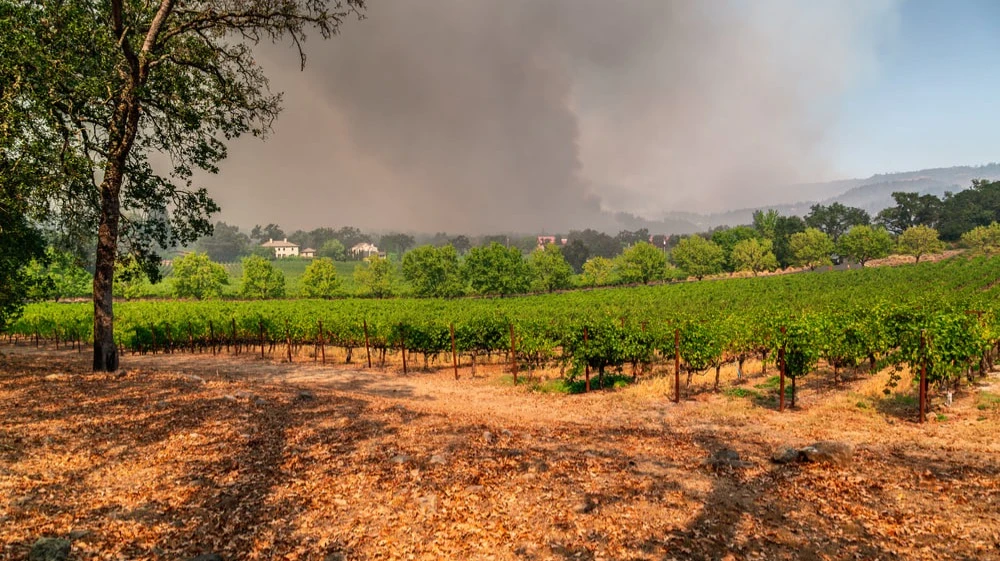
In a recent article, I mentioned the July fires in Cyprus, which took a huge toll on the entire island. Whole villages were affected, the agricultural sector was severely damaged, including the island's wine industry, which has begun its rise to the world stage.
A vineyard is one of the most vulnerable crops. One frost in spring is enough to destroy the whole year's harvest, one hailstorm in summer to destroy not only berries but also shoots, and drought or fire can leave a farm without harvest for several seasons in a row. Unfortunately, there are many examples of this.
For example, in France in April 2021, frosts destroyed up to a third of the grape harvest. The country's Minister of Agriculture at the time called it "perhaps the greatest agricultural disaster of the early 21st century". Winemakers struggled for several nights in a row to save the vineyards - trying to heat the fields, they lit small fires next to vines and trees. However, despite this, many in Bordeaux, Burgundy and the Rhone Valley were left without a harvest.
In 2017, spring frosts affected up to 60% of Bordeaux's wine-growing areas, Bloomberg wrote , citing the regional winemakers' federation. This led to €1 billion of damage in this region alone.
In 2020, fires in California left entire farms without crops and without the ability to sell wine: the smoke screen made the berries unsuitable for vinification. This caused $3.7 billion in losses for the industry.
All of this is the new reality - the climate is changing. And wineries are increasingly facing the consequences of disasters and natural calamities.
Which wine regions fall into the risk group? These are France and Italy, where frost in spring and hail in summer pose a serious threat to winemaking. In Spain, California, Greece, Greece, Turkey and Cyprus, extreme drought and fires can destroy dozens of hectares of vineyards in an instant. In Australia, extreme temperature fluctuations and fires pose a danger.
Protection - insurance and technology
It's absolutely clear that the winery "risk map" is broader than just "crops affected." There is wine spoilage in barrels and tanks, leaks and contamination, liability to tasting room visitors, and interruption of operations. For winemakers, time is money in the most literal sense. And insurance is one way to reduce risk. But for a very long time, it was complicated, expensive and not always fair: winemakers had to prove damages, call commissioners, and negotiate long hours. This often meant that the winemaker received compensation too late or not at all.
The situation has improved with the emergence of parametric insurance, where payment is made not "according to the act of inspection", but according to the triggering of a certain parameter - for example, a drop (or increase) in temperature to a certain point, hail intensity, smoke level, etc. If the threshold is crossed, the "trigger goes off" and an insured event occurs.
In practice, it looks like this: a weather station connected to the network is placed in the vineyard and the system "reads" everything by itself. Just imagine how this approach simplifies the life of winegrowers. Parametric insurance removes from the equation many weeks of expertise and part of the disputes in the spirit: "And how badly the vines have suffered".
According to Research and Market, the global parametric insurance market was valued at $16.2 billion in 2024 and could grow to $51.3 billion by 2034, growing at an average annual rate of 12.6% until then.
Insurers and insurtech teams have made a working parametric product for viticulture. For example, Descartes Underwriting issues separate coverage for wildfire risks in vineyards. This French company uses data from satellites, weather stations and proprietary algorithms to assess risk. Their products are being actively implemented not only in vineyards in France, but also in California, South Africa and Australia.
One of the problems faced by winemakers is smoke taint caused by severe fires. For such cases Liberty Mutual Re, for example, offers insurance against smoke taint. In this case, an independent laboratory determines the presence of organic compounds that cause "smoke taint" of grapes.
Munich Re, one of the largest reinsurance companies, is also active in agro-insurance, including in viticulture.
Private agtech / climatetech startups, for example the French Sencrop (bought by Isagri in early 2025) or the Finnish Vaisala, which make sensors and weather solutions, are also involved in building the data infrastructure needed for parametric products .
Thus, wine insurance is built on synergies: insurers take on the capital load and reinsurance, while private players and startups provide the technological and analytical backbone.
The insurance industry "fell out of love" with winemakers
In the classical insurance sector, on the contrary, things are getting more complicated.
"Ten years ago, everyone wanted to insure wineries. We were approached by a lot of companies wanting to create special programs for winemakers," Debra Costa, senior vice president of Heffernan Insurance Brokers, told Insurance Business as recently as last year. But in the past few years, after a series of catastrophes and disasters, insurance companies have begun to raise the cost of insurance for winemakers and reduce coverage, especially in high-risk regions. California, for example.
However, higher policy costs do not guarantee real protection: in the event of crop loss, smoke damage or supply chain disruption, losses can often reach millions of dollars, and standard policies do not cover a significant portion of such losses. Winemakers cannot fully pass on rising costs to the consumer and have to rethink their business models.
The situation emphasizes: classical insurance for the wine business is increasingly unable to keep up with the growth of risks, which is why interest in parametric solutions is increasing.
Alas, wine is becoming a mirror of global warming. Each new catastrophe reminds us that climate risks are not a theory, but a daily threat to the business and family business of generations of winemakers.
This article was AI-translated and verified by a human editor