A Crossroads for Nvidia: How the Espionage Scandal Involving the Company's CEO Might End
Scenarios for Investors and Potential Successors to Jensen Huang


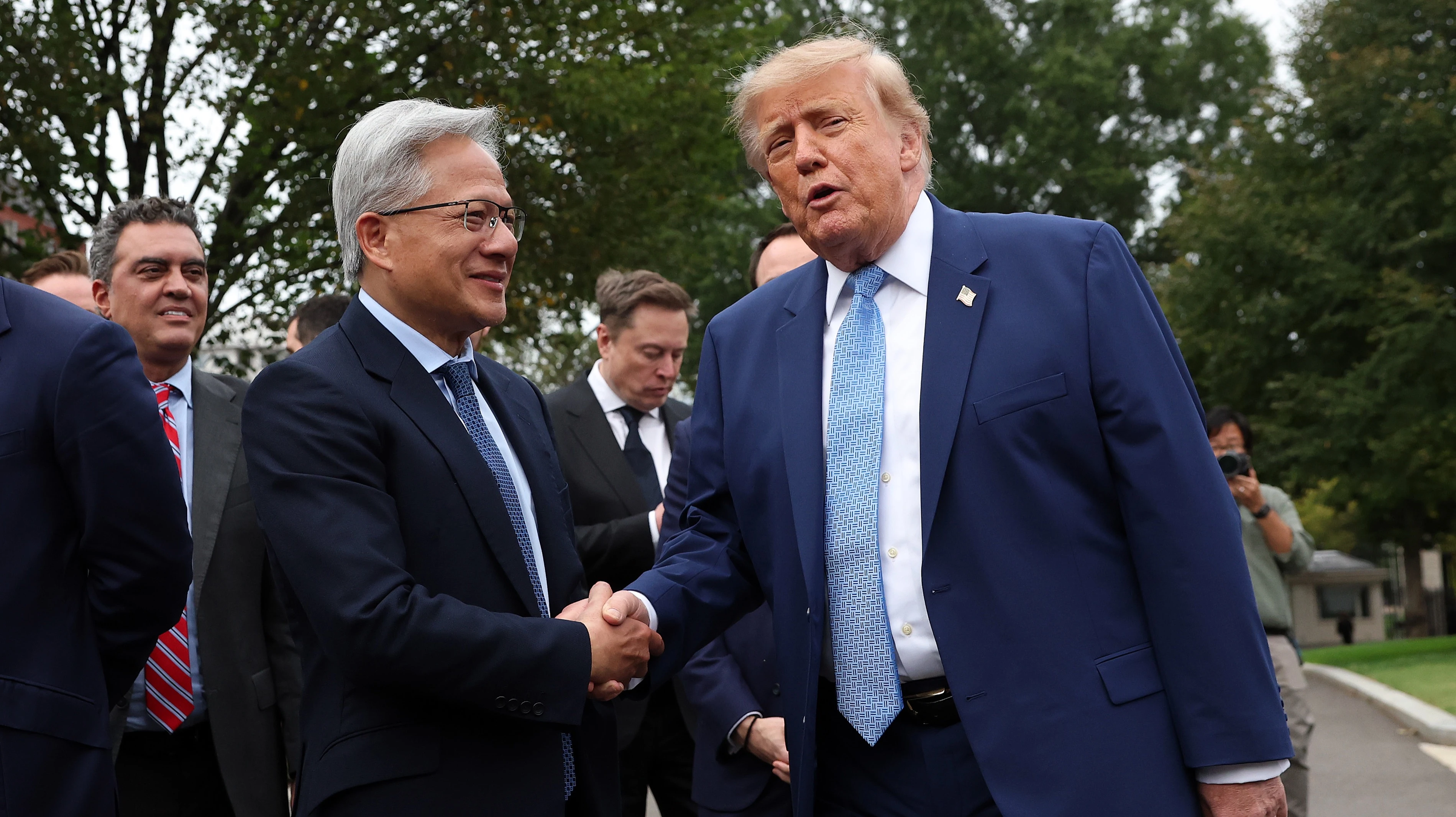
Before the espionage scandal, Nvidia CEO Jensen Huang actively promoted the company's interests, including at the White House. Photo: Kevin Dietsch / Getty Images
The scandal surrounding Nvidia CEO Jensen Huang has created new risks for the company’s stock. What developments should investors watch for in the coming weeks, and how might this ultimately play out for the company? Yegor Tolmachev, senior analyst at Freedom Broker, answers these questions.
Three Important Dates in the History of Espionage
Nvidia CEO Jensen Huang has found himself at the center of a spy scandal due to an affair with Alice Huang, the former head of the Singapore-based company Megaspeed, which purchased Nvidia chips. U.S. authorities suspect her of having ties to Chinese intelligence. The Nvidia CEO himself has admitted to the affair but, according to U.S. President Donald Trump, claims he was unaware of the woman’s alleged ties to intelligence agencies.
The FBI and a special committee of Nvidia's board of directors are investigating the matter. Members of Congress are also seeking explanations from Jensen Huang.
In addition, shareholders have filed a class-action lawsuit against the company and its CEO, accusing them of concealing information about Huang’s alleged ties to a woman suspected of espionage, which, in their view, misled investors. According to Yegor Tolmachev, such a lawsuit will not affect the company’s operations or financial performance, as it does not require a halt to production or the imposition of restrictions, nor does it alter demand for Nvidia’s products.
What should investors be watching right now?
By November 11, the head of Nvidia must respond to a request from the chairs of three House committees—Foreign Affairs, China, and Intelligence—to participate in a closed-door briefing on November 18. Lawmakers expect him to answer questions at the briefing about his contacts with Alice Huang and about Nvidia’s security protocols for protecting against foreign espionage. And on November 17, Nvidia will release its quarterly earnings report. This is always a major event for the market, accompanied by heightened volatility. But this time, it’s also accompanied by a scandal.
According to Tolmachev, the key factor right now is the rhetoric and tone of the statements made by Huang and his team. It’s also worth keeping an eye out for any comments made during the company’s management call with analysts on November 17, following the release of the financial results. However, Tolmachev does not rule out the possibility that Nvidia representatives may not say anything substantial on this sensitive topic: in the expert’s opinion, management will respond to such questions cautiously and in general terms, as the company will not want to give any unnecessary cause for discussion.
Three Scenarios for Nvidia
On Monday, November 9, alone, the company’s stock fell by more than 4%, and Huang’s net worth dropped by nearly $6.5 billion to $148 billion, according to Bloomberg. Wells Fargo, Citigroup, and Mizuho have already lowered their price targets for Nvidia shares while maintaining a “buy” rating.
However, according to Yegor Tolmachev, the current situation does not justify selling the company’s shares, which are already extremely cheap given the expected growth rates and profitability levels.
The baseline scenario for how the situation will unfold assumes that the company’s internal investigation will not uncover any violations, that Huang will provide explanations to Congress, and that he will avoid charges. In that case, Nvidia’s stock price will gradually recover, “and the whole story will fade into the background by early 2027,” Tolmachev said. However, he does not rule out that Nvidia will likely continue to tighten its scrutiny of its cloud service partners.
A negative scenario suggests that the investigation will drag on, new reports or leaks will surface in the media, and audits of Megaspeed and other Asian partners of Nvidia will follow. U.S. authorities may require stricter vetting of the chips’ end users and restrict access to cloud services for Chinese companies. This would put additional pressure on sales in Southeast Asia and, possibly, the Middle East, and would also limit the stock’s growth potential.
Tolmachev clarifies that this refers to the stock underperforming other stocks amid growth across the entire AI sector. A further decline in the stock price is also possible, but not to the extent of the crash depicted in the stress scenario.
Finally, a stressful but unlikely scenario involves the leak of sensitive information being confirmed, Huang stepping down from his position, and U.S. authorities imposing restrictive measures against Nvidia itself. Depending on the circumstances, the identity of the successor, and the severity of the restrictions, the stock could fall by 10–30%. But even in that case, the company’s business will not collapse; however, investors will factor a higher risk premium into its valuation.
What Will Happen to Huang?
Jensen Huang is Nvidia's most important intangible asset, the face of the company, its founder, and one of the most influential business leaders in the world—including in politics, Tolmachev said.
According to his employees, he is open and straightforward: it’s not uncommon for him to publicly address an employee’s mistakes. And while some may find this harsh, it fosters a team atmosphere focused on achieving outstanding results.

If Huang steps down from his position, it will deal a painful blow to Nvidia’s stock price, but its operations will not suffer, Tolmachev is convinced: Nvidia itself employs some of the best specialists in the world, so there is no reason to doubt the strength of the team.
He adds: It won't matter whether the businessman leaves on his own or is asked to step down.
Who can take Huang's place?
It is not yet clear whether Nvidia's CEO will step down, but the market is already speculating about who—even in theory—might take his place.
“Right now, headhunters are likely actively calling around the semiconductor industry, trying to figure out who they can propose to Nvidia’s board of directors as a potential successor to Jensen Huang—in case the board decides it’s time for him to step down,” writes Martin Pierce, an editor at The Information.
At the same time, they note that the board of directors may not be considering his resignation at all at this point, but they do not rule out the possibility that some people in the businessman’s inner circle are considering alternative options.
The Information has named several unexpected candidates for the position of Nvidia CEO: AMD CEO Lisa Su and René Haas, CEO of the British chipmaker Arm.

The Information reports that Lisa Su heads a company that is “Nvidia’s only real competitor.” She has managed to drive rapid revenue growth for the company after several years of stagnation. Of course, the competition between the two chipmakers could complicate such an appointment. Furthermore, Su is Huang’s cousin, which is another obstacle. Therefore, René Haas may prove to be a more suitable candidate. He knows the industry inside and out and even worked at Nvidia for seven years early in his career, according to The Information.
Pierce writes that the potential consequences of this scandal extend far beyond the day-to-day management of the company. The reputation of Nvidia’s CEO as the AI industry’s leading public figure has been “seriously damaged,” and even if Nvidia’s board of directors allows Huang to remain at the helm, it is difficult to imagine that his reputation will be fully restored.
“Moreover, even if the board does clear him of all charges, the market may still have doubts: Was this decision driven by the lack of an obvious successor?” — according to a newsletter from The Information.
Yegor Tolmachev is convinced that if Nvidia has to look for a successor, the person will most likely come from within the company. One of the candidates, in his opinion, is the company’s CFO, Colette Kress. She has held the position since 2013, and prior to that worked at Cisco, Microsoft, and Texas Instruments.
However, Kress is more likely to be an interim leader: she is an experienced financier, but she lacks the technical background that Huang has, the analyst continues. Therefore, Tolmachev names Ian Buck, vice president of hyperscalers and high-performance computing, as another candidate for the CEO position. He has been with Nvidia since 2004 and is considered the creator of CUDA—the company’s key software platform.
This article was AI-translated and verified by a human editor