AI will destroy 34 million U.S. jobs by 2030. What to prepare children for?

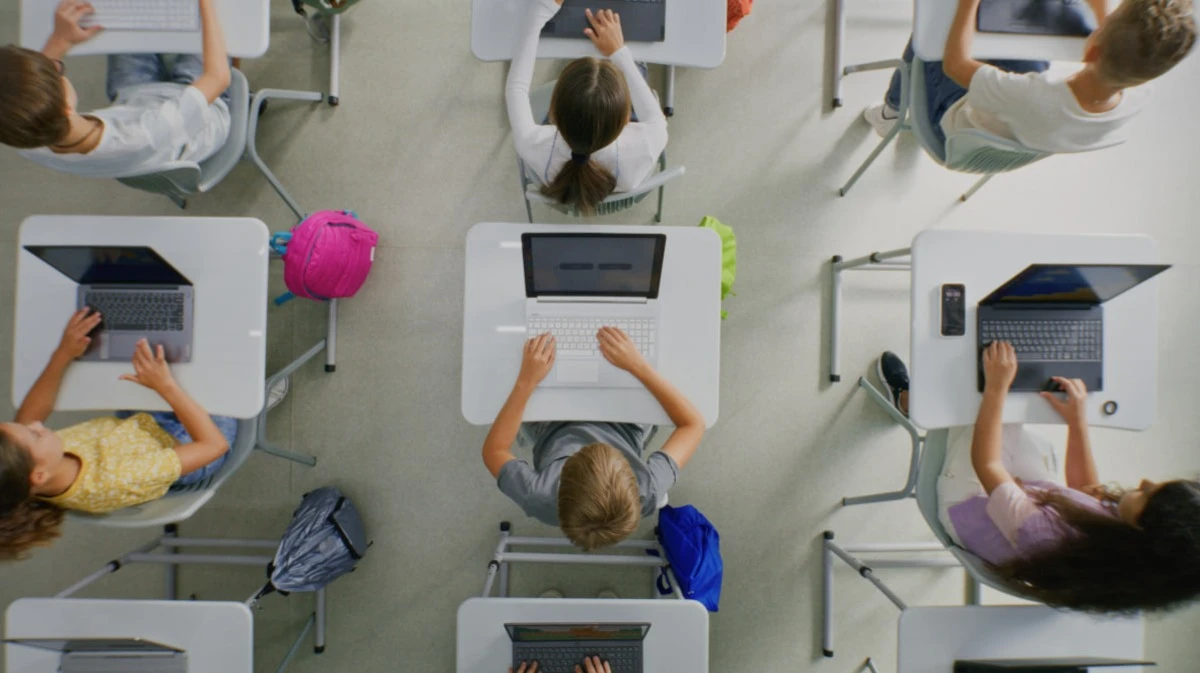
In the U.S., AI will destroy 34 million jobs by 2030 / Photo: Frame Stock Footage / Shutterstock.com
AI is primarily threatening fields that employ women, workers with higher education and high incomes, according to Anthropic research. But the first signs of change are appearing not in layoffs, but in the slowdown in hiring of young employees. By 2030, the net job loss in the U.S. alone will be 6%, Forrester's prediction of AI's impact on the labor market. Half of that will be destroyed by generative AI, the rest by automation, robots, and non-generative AI applications. Sergey Kuznetsov, writer and co-founder of Le Sallay Academy and Le Sallay Dialogue schools, reflects on what to teach children in the AI era.
AI-Sustainable Occupations
The list of skills in which humans will be more competitive than AI is quite long. I'm sure it will be many years before robots will be able to replace those who work with their hands, such as plumbers.
People who work where live emotional contact is needed are also out of the primary risk zone. Yes, some people use AI for psychotherapy, but there will always be those for whom contact with a live person is important. Another example is sales professionals. With face-to-face contact, such as in a store or in complex negotiations, it's still easier for a human to convince a customer to make a purchase - AI at its best can sell well online. This also includes high-performing teachers. Even if all schools switched to automated learning, upper middle and high school students would prefer a live teacher, tutor and tutor.
Those who can compose a book, write a screenplay, or paint a picture that is unlike anything done before. Still AI is not able to generate truly new ideas.Or ethicists, including those able to adjust AI decisions. People who can write a complex prompt or, better yet, come up with an interesting new problem for the AI to solve.
(To see if you're teaching your child the right thing, check out this visualizer from the U.S. Department of Labor's Bureau of Labor Statistics - here you can see who AI is already displacing. By 2030, AI will destroy 34 million jobs in the US. The good news is that almost three times as many will be created - Oninvest).
How to compete with AI
People will be needed where emotional intelligence, high creativity, critical thinking and the ability to solve complex ethical problems are required. Well, or the ability to work with their hands, which the famous Finnish school system emphasizes. This point most private schools will have to cross out: parents do not want us to teach their children the sought-after profession of a plumber. But good schools have been teaching children everything else since before generative models existed.
Creativity
Creativity is not directly related to the so-called "creative professions". Firstly, any profession can become creative, and secondly, the ability to invent new things and generate ideas is a much more important part of creativity than the ability to draw a picture or sing a song. The kind of creativity we are talking about occurs when a child is not afraid to speak up or to suggest something new, that is, where he knows that he will not be laughed at if he says something wrong. Interesting thoughts come to everyone's mind, but if a person is afraid to speak out, the brain stops generating them. This is why children need to know that they have the right to make mistakes. Whether it is physics or literature, a pupil should always be sure that he can express his thought, that he will be listened to respectfully and as a result of the conversation he will get new material for thinking.
Emotional intelligence
We teach to analyze one's own emotions and to recognize others' emotions, both in the classroom and in the student's everyday interactions with others. The educator's task is to discover such a task by inviting the child to participate in a complex process of reflection instead of an imposed decision from above, at the end of which the child may have to make a personal choice in an ethically ambiguous situation.
Critical thinking and multidisciplinarity
Traditionally, mathematics is thought to pump logic, while physics and chemistry teach you to analyze the results of experiments and notice the interrelationships of phenomena. Of course, STEM is necessary to develop critical thinking, but history and literature should not be left out. The skill of analyzing documents, the ability to set the right context, the ability to anticipate consequences and evaluate different strategies are all part of critical thinking, and this is where teaching humanities subjects helps students a lot. We would agree that today the ability to distinguish fake news from real news is an important marker of critical thinking, and physics and math are of little help in this task.
In a way, it is a return to classical education: when rhetoric, logic, literature and math were not separated, but worked together as thinking tools. Only now AI has been added to them. For example, Anna Vlasova-Mrdulyash, a literature teacher at our school, gave an assignment to write a bot that would speak like the hero of Kazuo Ishiguro's novel The Rest of the Day. To do this, students had to identify the main features of his speech and describe them to the selected AI. Of course, it took quite a lot of time, but the result was worth it: now we have several chatbots that speak to you like an English butler of the mid-20th century. Some students even managed to convey passive aggression well - and analyzing this behavioral strategy is also an important part of developing emotional intelligence.
The problem isn't the AI
You may have noticed by now that I hardly talk about what was once considered the main thing in education - the acquisition of knowledge. They say that AI devalues knowledge, but in fact knowledge was devalued earlier. Job interviews have long asked not "what you know" but "what you can do".
Since ChatGPT's launch in 2022, job seekers aged 22-25 in the most AI-vulnerable occupations have seen their likelihood of finding a job within a month drop by around 14%
In other words, skills have long been more important than knowledge - and their role will grow in the future.
This does not mean, of course, that school will not deal with knowledge. Many skills are formed in the process of learning: as the old joke goes, "You may not need school knowledge, but you will need the neural connections formed in the process.
The very ability to learn new things is one of the most important skills. It is almost certain that your children will change careers in the future, perhaps more than once. Therefore, they will need the skill of learning very much.
Even where human contact will remain - in psychotherapy or sales - the market will shrink. That means there will only be room for the best. It is no longer enough to be "good" - you have to be stronger than the majority.
In the past, it might have been a wish - today it is becoming a categorical requirement. The same is true for education. Those who already focus on critical thinking, emotional intelligence and creativity will win. The rest will have to change - otherwise schools risk becoming a place where children are simply "put on hold".
This article was AI-translated and verified by a human editor