Airlines in Europe have faced a second wave of bomb threats
At least 17 flights were disrupted by false bomb threats

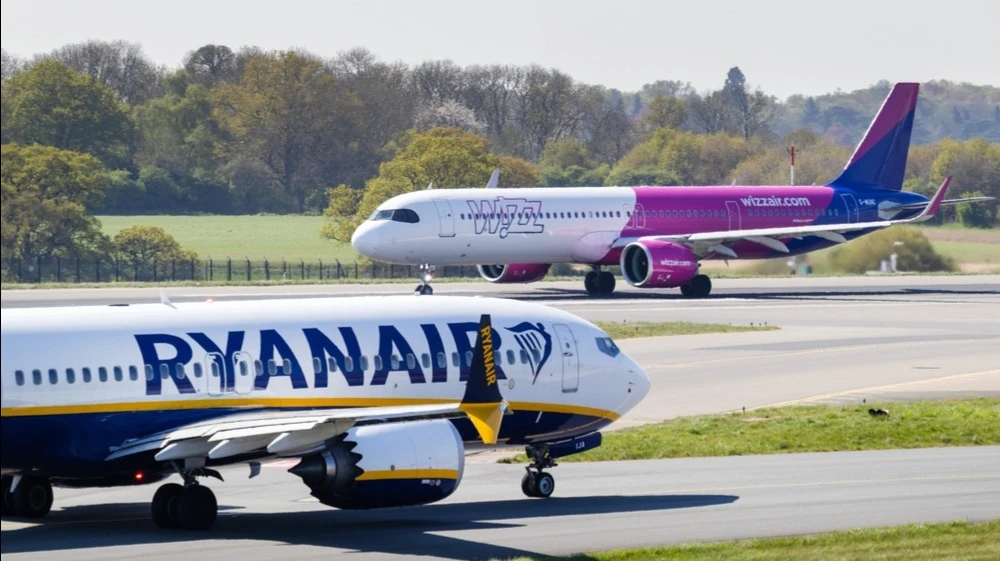
Reports of bombs on planes have affected Wizz Air, Ryanair, Aer Lingus, Finnair, and LOT Polish Airlines / Photo: Airlinephoto / Shutterstock.com
European airlines have faced a second wave of bomb threats against aircraft this week. According to the Financial Times, police and counterterrorism agencies were called in to search at least 17 planes in Italy, Poland, France, Austria, Bulgaria, Romania, and the Czech Republic. The threats affected Ryanair, easyJet, Wizz Air, Aer Lingus, Aegean, Finnair, and Poland’s LOT. In some cases, fighter jets escorted the planes after the threats were received, Bloomberg reports.
The Finnish state-owned airline Finnair reported that two of its flights—from Helsinki to Rome and to Vienna—received threats that later turned out to be false. According to the FT, a Finnair flight from Helsinki to Rome was escorted by Italian fighter jets after receiving the threat.
Among the flights affected was Aer Lingus flight EI402 from Dublin to Rome, which made an emergency landing at a military airfield in northern France after receiving a threat.
The threats also affected the Polish airline LOT Polish Airlines and the Hungarian low-cost carrier Wizz Air, which had already received several similar messages earlier this week. On Thursday, a Wizz Air flight from Milan to Warsaw was diverted to Vienna after receiving a report of a bomb threat during the flight. Meanwhile, at the Bucharest airport, another Wizz Air flight, WMT3064 from Milan, carrying 182 passengers, was searched.
Czech police reported threats against four planes bound for Prague; the planes were searched after landing. The low-cost carrier easyJet later stated that it operated two of those flights.
Threats targeting four flights were also received by Vienna's main airport, according to the Austrian broadcaster ORF.
Threats were also made against three Ryanair flights heading to Sofia from Madrid, Copenhagen, and London, according to a spokesperson for the Bulgarian Ministry of Transport. According to the country’s Ministry of Defense, Bulgarian MiG-29 fighter jets escorted the planes through Bulgarian airspace, and one of the flights was diverted to land in Plovdiv. Ryanair did not respond to a request for comment from Bloomberg.
Context
Earlier this week, on November 2 and 3, bomb threats affected a total of eight flights, the FT reports. Hundreds of passengers were rerouted, some flights were escorted by fighter jets, and no explosives were found on the planes at that time, according to Bloomberg. British authorities called these incidents “malicious hoaxes.”
Air France-KLM executives, whose flights have not yet been affected by the threats, highlighted the coordinated nature of the actions during a conference call with journalists following the release of their quarterly results. “We haven’t seen anything like this level of coordination before, as far as I can tell. It’s unfortunate, and we hope it won’t cause our customers to scale back their travel plans,” said Air France-KLM CEO Ben Smith.
Bloomberg reports that no pattern has been identified in the wave of threats, either in terms of the airlines affected or the routes involved. Bomb threats on airplanes are rare, and such reports almost always turn out to be false or the result of copycat incidents, the agency notes. On average, more than 30,000 flights take place in European airspace every day. However, the surge in threats coincided with a period of heightened geopolitical tension in Europe, which was also marked by hacker attacks on supermarket refrigeration systems and drone incursions into the region’s airspace, the agency notes.
Eurocontrol, the European air traffic management organization, stated that it is monitoring the situation and coordinating with airlines, airports, and air navigation service providers.
This article was AI-translated and verified by a human editor