Are European banks a profitable investment in 2026?

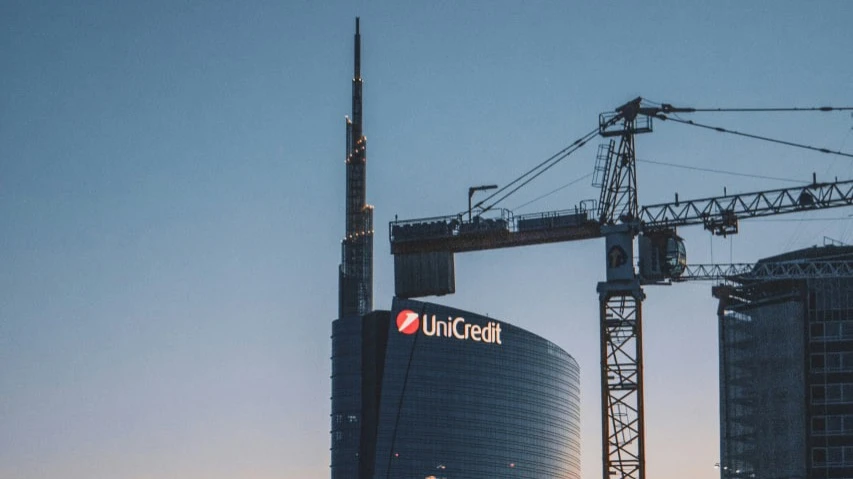
Unicredit is waiting for the ECB rate hike, which will have a positive impact on its earnings. Other European banks may also benefit from this. Photo: Andrea Ferrario / Unsplash.com
Italian banking group UniCredit on Ma 5 reported its "best quarter ever" and raised its profit forecast for this year. Its top management said that the ECB rate hike is a positive for profits. This thesis can be applied to the entire banking sector in Europe. Is it worth an investor's attention?
UniCredit records
Italian banking group UniCredit earned €3.2 billion in net profit in the first quarter of 2026, 16.1% more than the same period a year ago. The figure was 20.2% higher than the bank's own forecast. Earnings per share rose 19.7% to €2.15. Revenue rose 4.9% to €6.9 billion and return on equity reached 25.8%.
The bank raised its full-year 2026 net profit forecast to "at or above" €11 billion from around €11 billion.
The French AlphaValue notes that UniCredit's record quarterly profit was largely due to the trading business: almost 60% of the excess of forecasted revenue came from trading revenues (bonds, currencies, derivatives, etc.). Therefore, the dynamics of the first quarter should not be automatically transferred to all the following quarters. It follows from the statements that the volume of commissions grew by 8% year-on-year, their share in net revenue reached 38%.
In Russia, the bank's revenue fell by almost 41% to €232 million year-on-year, while net profit fell by 47.1% to €145 million. Net interest and fee and commission income fell significantly.
UniCredit has been systematically reducing operations in the country amid sanctions and geopolitical tensions. In a conference call on Ma 5, UniCredit CEO Andrea Orchel said that the bank expects to generate less than €400 million in net profit in Russia in 2026 (vs. about €800 million last year), and about €100 million by 2028. UniCredit plans to maintain only a minimal operating structure in Russia for euro and dollar payments for corporate clients.
Ma 7 UniCredit announced that it expects to sell part of its Russian assets to a private investor from the UAE and signed a preliminary agreement with the buyer. The deal involves the division of the Russian business into two structures - the new bank will remain with UniCredit and will deal with international payments in euros and dollars for corporate clients not under sanctions, and the remaining part will go to the buyer. The deal is planned to close in the first half of 2027 after receiving regulatory approvals. The Russian and Italian bank's statements, as well as the terms of the deal, suggest that the new bank's asset size could be €50-150 million - less than 10% of the group's current Russian business. It may drop from 23rd to 160-200th place in the rating of Russian banks by assets. UniCredit did not answer Oninvest's questions about the UAE investor and the size of the new bank's assets.
What European banks look like: promising and undervalued
UniCredit's top management on the investor call actually articulated one of the current talking points across the EU banking sector: the upside from a possible ECB rate hike.
On April 30, the European Central Bank kept the rate at 2% for the seventh time in a row. But a slowing economy and accelerating inflation may force it to move to tighten the MPC - Bloomberg wrote that investors expect the ECB may raise rates in June and possibly two more times before the end of the year.
Unicredit's base case scenario assumes two rate hikes in 2026 - in June and September, 25 bps each. This would generate €300 million in net interest income for the bank.
Other European banks can also count on additional revenues.
As Deutsche Bank wrote in an April 28 note, a 100 bps increase in the ECB rate gives banks about a 7% increase in pre-tax profits already in the first year.
According to Deutsche Bank, European banks look undervalued: they are trading at a price-to-earnings ratio of 9 for 2027, about a third cheaper than the European equity market as a whole on this multiple. At the same time, banks earn an average 16.2% annualized return on equity and return 8.8% a year to shareholders, of which 5.9% is in dividends.
Barclays, which also expects two ECB rate hikes in 2026, has a similar thesis. In a research note on April 26, he points out that investors still see banks as a hedge against an inflationary shock, but with higher rates and subsequent pressure on loan demand and asset quality.
Barclays articulated what it calls the "relative advantage" of banks over other sectors: it estimates that the average European bank will deliver around 11% total shareholder return per year between 2026 and 2028 - through dividends and capital appreciation. Over three years, this is equivalent to returning about a third of current market capitalization at constant multiples.
Seven securities: investment banks' choice
European bank stocks have shown steady growth over the past year. The Stoxx 600 Banks Index has risen 36% over the past 12 months.
The strongest growth was shown by shares of Spanish CaixaBank: almost 59% over the year, to about €11. Shares of UniCredit rose by almost a third and are now trading around €70 per paper, quotes ING - by 48.2%, and are now at a level just above $ 30 per paper. Shares of French Societe Generale rose in price by 49% (to €69), BNP Paribas by 19% (to €91), and the German Deutsche Bank - by 14.7% (to €27).
- Citi analysts name Société Générale among the favorites from the EU banking sector in their April survey.
For Deutsche Bank, they upgraded the rating to "neutral." European banks have excess capital that they can use for share buybacks, loan growth or mergers and acquisitions, CNBC quoted the note as saying.
- JPMorgan lists UniCredit, ING, Société Générale, BNP Paribas and CaixaBank as European favorites.
- Barclays notes Commerzbank, Switzerland's Julius Baer, and ING.
- Deutsche Bank talks about Commerzbank securities as potentially good investments.
What are the risks to consider?
AlphaValue's caveat that UniCredit's record quarterly earnings were more than half driven by trading revenues essentially applies to other European banks as well.
For example, JPMorgan in its Ma. 1 review wrote about ING's solid operating revenue and good cost control, CaixaBank's improved return on equity outlook, and BNP Paribas' stable capital. At the same time, he focuses on the quality of revenue, the sustainability of fee income and the ability of banks to keep credit risks low.
Expectations for a rate hike cycle have been set, and investors are now assessing whether banks are able to build profits through diversification, not just loan margins, which can decline when the economy slows.
Problems for banks may come from the private lending market, where a potential crisis is now brewing. Barclays analysts wrote that banks do not yet consider it a source of immediate systemic stress, but if the economic situation in the eurozone begins to deteriorate sharply, it is the problems of the private credit market could become one of the main risks already in the second half of this year.
Investor Vladimir Tsuprov names other disadvantages of the banking sector in Europe: it is regulated, inefficiency of traditional banks and slowdown of the EU economy.
Alexey Tretyakov, CEO of AriCapital Management Company, agrees with him.
European banking stocks have been trading at a deep discount to equity for years, have risen 3-7 times in a few years and are now at multi-year highs. I think now is definitely not a good time to buy.

In the dry residue
The investment case for European banks in 2026 is built on three pillars.
The first is the ECB rate. If the regulator raises it, as the market expects, it will support banks' net interest income and help compensate for weaker credit demand.
The second is capital and dividend payments: the European banking sector now yields 11% compound annual return to the shareholder through dividends, share buybacks and capital gains.
The third whale is that European banks are trading at a discount to the broad market.
There are risks here as well. If the shock from the energy price hike hits European GDP growth harder and higher interest rates persist for a long time, this will start to deteriorate the quality of banks' loan portfolios and reduce the demand for new loans. Profit dynamics may then change, as not all players will be able to continue to deliver strong results.
This article was AI-translated and verified by a human editor