Burry did not sell Build-A-Bear after the stock plummeted. What did the company's full financial report reveal?

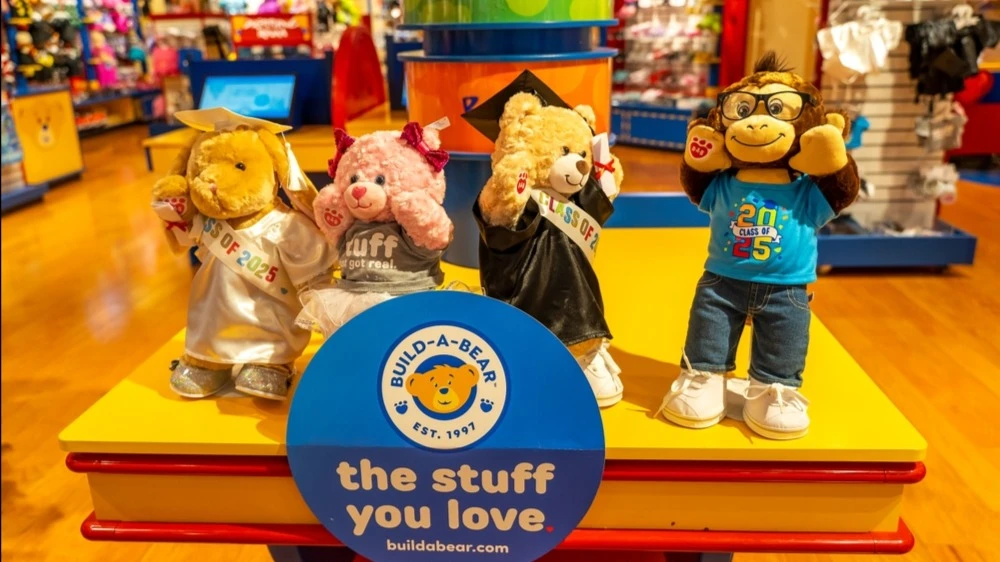
Since the beginning of the year, Build-A-Bear's stock price has fallen by 58.43% / Photo: Iv-olga / Shutterstock.com
Michael Burry bought Build-A-Bear shares in August, shortly before the company’s second-quarter earnings report—and almost immediately took a loss on the stock. Following the weak results, the company’s stock price plummeted 27.3% in a single day, and the investor himself compared Build-A-Bear shares to a “hot potato.” He decided, however, not to sell them until the release of the Form 10-Q, which details the company’s fundamentals. What did the full financial report reveal, and did it change Burry’s investment thesis? Oninvest analyst Aldiyar Anuarbekov took a closer look.
Buying Before the Crash
Michael Burry purchased shares of Build-A-Bear—a small company that offers workshops where participants can create their own stuffed animals from scratch—between August 18 and 20, 2026, about a week before the quarterly earnings report. On August 27, the company reported that its revenue for the second fiscal quarter fell 7.2% to $115.3 million, and pre-tax income dropped 24% to $11.6 million. In addition, the retailer lowered its revenue forecast for the second time this year. On the same day, its stock plummeted by a record 27.3%, to $28.44.
The drop caused Burry to reconsider the idea, but not to abandon it. On August 27, he wrote on his Substack blog that he would wait for the Form 10-Q before reevaluating the company and making a final decision.
The investor was looking for signs of a so-called “kitchen sink quarter.” This term refers to a quarter in which new management addresses a range of accumulated problems all at once—for example, by writing off assets and inventory or implementing a restructuring. This worsens current results but lowers the baseline for future comparisons. This scenario seemed plausible: Christopher Hart took the helm of the company on June 11, so the second-quarter report was the first under the new CEO.
Burry wrote that while there is a sense that this is the case for the quarter, the numbers do not support it: he saw neither write-offs nor inventory write-downs. If the weakness were due to one-time write-offs, the stock’s plunge might have been excessive. If, however, sales and margins had deteriorated without a “cleanup” of the balance sheet, the company would have had to restore its performance through the business itself.
Not a "spring cleaning," but weak sales
The full financial statements seemed to confirm the second scenario. Build-A-Bear reported that it had not recognized any impairment of assets in the form of right-of-use assets under operating leases. Inventories as of August 1 totaled $81.1 million—0.8% less than a year earlier—and management stated that it was satisfied with both the volume and composition of the inventory.
Operating metrics did indeed deteriorate. Same-store sales reduced quarterly revenue by $10.9 million, while digital sales reduced it by an additional $1.1 million. New locations offset only $4.1 million of this decline. The gross retail margin fell by 3.6 percentage points to 54% due to the high proportion of fixed rental expenses amid declining sales and more aggressive promotional activities.
A reduction in administrative expenses (SG&A)—by $5 million, to $51.4 million—helped prevent earnings from falling even further, primarily due to lower bonus payments. Within this line item, stock-based compensation expenses were negative—$800,000, compared with a positive figure of $700,000 a year earlier. As a result, the year-over-year change in these expenses improved quarterly pre-tax profit by approximately $1.5 million.
The 10-Q also states that 70,549 performance shares (shares that management would have received upon achieving revenue and EBITDA targets) for 2024–2026 were canceled, and the estimated number of shares based on results already achieved decreased by an additional 40,494. However, the report does not directly link the negative expenses to a specific group of these securities and does not characterize this as a failure of the 2024–2026 plan. Nevertheless, a portion of the profit was supported by a reduction in variable compensation, and it should not be considered a sustainable source of growth.
Another one-time factor arose as early as the first quarter. Following a Supreme Court ruling, the company was entitled to a refund of approximately $13.2 million in IEEPA duties previously paid, and the company received that amount. Of this amount, $10.4 million was recorded as a reduction in cost of goods sold, including $7 million related to costs from the prior fiscal year. By the end of the second quarter, Build-A-Bear had virtually completed recognizing the impact.
Excluding these $7 million, profit before taxes for the first half of the year totaled $28.5 million—18.5% less than a year earlier. However, on an unadjusted basis, the figure rose by 1.6%.
Stock prices have fallen. Should we wait for a reversal?
The report also includes arguments supporting the view that the stock is undervalued. Build-A-Bear retains a strength uncommon for a small company: as of the end of the quarter, it had not drawn on its revolving credit line and had accelerated its share buyback program. In the first half of the year, the company allocated $17.1 million to repurchase 403,236 shares—at an average price of approximately $42.50 per share. From August 2 to September 8, it repurchased another 129,194 shares for $4.2 million, at approximately $32.50 per share.
However, cash reserves for the year decreased by 64.2%, to $14 million. The company attributed this primarily to share buybacks and its capital expenditure schedule. Capital expenditures rose to $15.4 million from $6.3 million over the first half of the year, and Build-A-Bear plans to spend approximately $25 million for the full year. In other words, the absence of debt reduces financial risk, but there is now less room for aggressive share buybacks.
The number of shares outstanding decreased from 13.16 million as of August 2, 2025, to 12.32 million as of September 8, 2026—a decrease of approximately 6.4%. At a closing price of $25.47 on Thursday, September 17, this corresponds to a market capitalization of about $308 million. During trading that day, the stock price fell to its lowest level in the past 12 months; since the beginning of the year, the price has dropped by 58.43%.
Following the earnings report, analysts sharply lowered their estimates, although they did not change their recommendations. D.A. Davidson lowered its price target from $60 to $37, while maintaining its “Buy” rating. Northland Capital Markets lowered its target price from $60 to $40 and also maintained its “Outperform” rating, valuing the company at a multiple of 6 times its 2027 projected EBITDA, compared to 9.4 for comparable companies (the report is available at the editorial office). The average target price from four analysts is $43, but such a small sample size makes the consensus less indicative.
On September 9, Burry himself reported that he had reduced all his positions and increased his cash holdings. At that time, Build-A-Bear ranked 13th among the 17 long positions he had listed. He did not disclose the extent of the reduction. Later, the investor completely sold his stake in Flutter Entertainment and allocated most of the proceeds to Lululemon, while also increasing his investment in Zoetis. However, he did not publicly announce a complete exit from Build-A-Bear.
The financial statements, therefore, did not provide Burry with a straightforward answer. They did not indicate a large-scale “cleanup” that would automatically improve results from a low base. Instead, it revealed several factors propping up profits—duty refunds and a reduction in variable compensation. Investors should now watch to see if Build-A-Bear can win back customers without constant discounts and boost sales through new stores. The third-quarter report will provide the first indications of these results.
This is not intended as a personalized investment recommendation.