Chinese AI company Zhipu has won the "war of hundreds of models". But what's next for it?

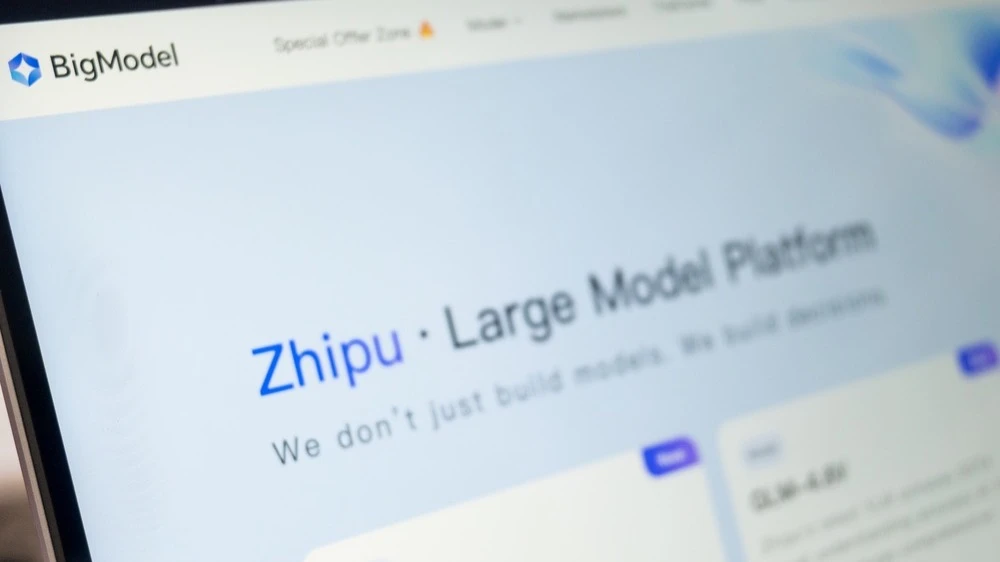
The company Knowledge Atlas, known as Zhipu, is called the Chinese analog of OpenAI. In January, its shares began trading in Hong Kong, now quoting five times the offering price. Photo: agustin.photo / Shutterstock.com
Knowledge Atlas, known as Zhipu, is called the Chinese equivalent of OpenAI. In January 2026, it went public, and its quotations rose more than five times the IPO price. What an investor should know about it, wrote independent analyst Mikhail Zavaraev.
Successful debut
While the next updates to AI models from U.S. developers continue to destroy market capitalization in several industries, releases from Chinese competitors are working to explosively grow their own capitalization.
Thus, after the release of the updated GLM-5 AI model, Zhipu shares soared 30% in one day. In total, after the release for four trading days they rose in price by 130%, reaching the level of 725 Hong Kong dollars on February 20 at the end of trading in Hong Kong. On this platform, in early January, the company held an IPO.
Ma, we would probably see a similar reaction in quotes for American AI developers, but while many of them remain non-public, competing to see who can raise as much money as possible in their development as long as investors are willing to invest in that magic combination of letters - AI. For example, OpenAI recently closed a $100 billion round at a valuation of $850 billion, although lately key players are becoming more cautious about disposing of their available funds, and investors are not ready to invest unconditionally in anything related to artificial intelligence. In any case, so far both OpenAi and Antrophic are keeping their plans for IPO in the foreseeable future.
In turn, Chinese AI developers decided not to test their fate with the potential closure of the window of opportunity and in early January held their initial public offerings. The pioneer was the startup Zhipu, which raised $558 million during its IPO in Hong Kong, offering investors 37.4 million shares at a price of HK$116.2.
It was floated at the same time as its closest competitor, Minimax, which managed to raise $618.6 million by offering 29 million shares at HK$165.
Since then, the quotations of both companies have grown many times - more than five times the offering price (data as of the close of trading on February 24)
Zhipu's capitalization is currently around $33 billion with less than $60 million in revenue over the past 12 months. And it is reasonable to ask how much of this rally is justified and how long it can continue.
A startup from university: how Zhipu's business works
Zhipu has academic roots - this project was established at Tsinghua University and later spun off into a separate company.
Unlike many other players in this segment, Zhipu is exclusively engaged in the development of AI models. In essence, the company operates as a MaaS (Model-as-a-Service) platform, positioning itself as an AI infrastructure provider. The company has historically focused on corporate and institutional customers, rightly relying on the potentially larger market size compared to the consumer market.
In principle, it can already be stated that Zhipu is making serious progress in the AI segment and has won the "war of hundreds of models" in China - in 2023, there were at least 130 large language models in the country, of which only 10 real players remain by now. And all the latest models of the company are in the leaders of the world "table of ranks", albeit noticeably inferior to the leading models in terms of speed, but offering several times lower price for 1 million tokens compared to American competitors. For example, FT writes that Zhipu on its internal platform for developers on GLM-5 set the price at $0.58 per million input tokens and $2.60 per million output tokens. At OpenAI, using the GPT-5.2 model costs about $1.75 per million input tokens and $14 per million output tokens.
However, it should be noted that Zhipu specializes mainly in text models, unlike Minimax, which offers its users a full range of models, albeit slightly inferior in performance to the best models. Which strategy will prove to be the right one, only time will tell. It is possible that both have the right to succeed.
For Zhipu, it is extremely important that the latest model releases demonstrate not only high results and efficiency, but also sustainability - a quality that allows it to commercialize its products more actively. Artificial intelligence has already come to the point where investors want to see not only beautiful presentations, but also real returns on the impressive funds that have already been invested in current projects and continue to be invested in the segment.
Zhipu AI is actively earning money from deploying its models on client companies' own infrastructure as well as through its developer platform.
The first is more marginal and involves project or contract pricing and often includes licensing, customization, system integration and ongoing support. It is mainly an intra-China business targeting companies in regulated industries, which implies a fairly steady but limited volume demand for services. This segment accounts for 85% of Zhipu's revenue.
The second direction, although less marginal, at least for the moment, suggests scalable growth, as well as prospects for expansion internationally - with a much higher potential target market.
Expensive company
Only time will tell how successful the company's business will ultimately turn out to be, but at the moment Zhipu boasts a very high growth rate in its revenues. At the end of 2022, its revenue was only 57.4 million yuan, and in the last 12 months, this figure is already 458.4 million yuan. According to analysts' consensus forecast, the company's revenue could reach 750 million yuan by the end of 2025, which implies a 13-fold increase over the past three years. Yes, one can always reasonably point out that this is growth from a low base. But it's pretty steady: its revenue has more than doubled every year since 2022. In 2026, the company's revenue is forecast to more than double again, to ¥1.64 billion, while current quotes suggest that such growth should continue for quite some time.
However, the impressive revenue growth is accompanied by an equally impressive growth in operating loss. While Zhipu recorded a loss of 143.7 million yuan or 7.3 yuan per share in 2022, over the past 12 months it has already exceeded 4 billion yuan. And the situation is unlikely to change dramatically in the coming years, and the company will start showing profit not earlier than in a few years, and that is provided there are no shocks.
There is nothing extraordinary about this state of affairs, as Zhipu has to seriously invest in technology and further development of its products in order to keep winning or at least not losing the AI model race.
The problem is that there are serious losses now, and potential, albeit perhaps high, profits will come sometime later. And although AI is probably not a case of "winner-take-all", the probability for a particular company to survive and get its share of this huge pie is clearly much further from 1 than from 0.
However, that doesn't stop both Zhipu and Minimax from already trading at extremely high multiples.
Zhipu currently has a Price to Sales ratio, which shows how many times the market is valuing the company relative to its annual revenue, of 426 so far. By comparison, the P/S of Alphabet, which owns the Google search engine, is only 8.17, and the current level for the S&P 500 index is only 3.39. For Zhipu to drop to at least Alphabet's level, the company would need to double its revenue every year for more than five years, assuming the stock remains flat.
By comparison, during the dot-com bubble, Google's hapless competitor Yahoo briefly had a P/S ratio above 200: the company's maximum capitalization at the peak of the Internet bubble in January 2000 was as high as $125 billion, while its 1999 revenue was only $589 million.
The further you go, the harder it gets
Not everyone is destined to become Google, and pioneers don't always become successful companies. Google was not the first search engine and came four years after Yahoo, which was making headlines and trading at mind-boggling multiples.
But then Yahoo lost the competition - in 2016 it reported revenue of $5.2 billion, after it was bought by Verizon and then sold to Apollo Global Management. Google's capitalization reaches $3.8 trillion with revenues of almost $403 billion by the end of 2025.
Zhipu, like Minimax, could go either the way of Yahoo or Google. Although their quotations at the moment are more likely to move along the first trajectory. It is possible that in time these companies will be able to build a global business with multi-billion dollar revenues. However, they will face an incredible number of risks along the way.
AI, despite all the progress made in the last three years, is still a very young segment, and competition is extremely high. To win, you will need very serious investments in research and development. This money not only needs to be attracted, but also used correctly to create a working product. The risk of realization in such projects is always high.
The trillion-dollar target market that AI optimists are painting looks very attractive, but it still needs to be conquered, and it's far from certain that the margins will be exactly what they appear to be now.
AI is an extremely important and sensitive technology for the state, which may be subject to both internal and external constraints. It is important not only to build good AI models, but also to avoid limitations on computing resources, possible power shortages at its suppliers, etc. Zhipu, for example, builds its models on Huawei's Ascend chips, which are not as performant as the latest American Nvidia solutions. In addition, Zhipu is focused solely on models and not on the entire AI value chain, unlike the notional Alphabet or Alibaba, which, among other things, is a shareholder of Zhipu.
Based on all of the above, the probability that Zhipu's capitalization will be much larger in 10 years than it is now does not look very high. At the very least, a lot of "ifs" would have to add up for that to happen.
In the short term, of course, the share price can climb even higher. Optimism after the release of new models, a strong financial report - all this may cause another explosive growth of quotations.
But the company's current high valuations mean that the market has very high expectations regarding Zhipu's further development, and any bad news could lead to a collapse in quotations. At some point, even a 99% year-over-year revenue growth, rather than 100%, could trigger panic selling. And it is impossible to predict when this moment will come - tomorrow, or in a year.
It is also possible to simply run into a situation when, after four trading sessions of rapid growth, the company's quotations will collapse by 23% in one day due to profit taking, as it happened at the trades on February 23. With such volatility of quotations, it is hardly worth allocating more than 1-3% of the portfolio to this security. Rather, it makes sense to focus on less volatile Chinese AI players that operate the entire AI value chain and have a safety net in the form of a working core business. For example, Alibaba.
This article was AI-translated and verified by a human editor