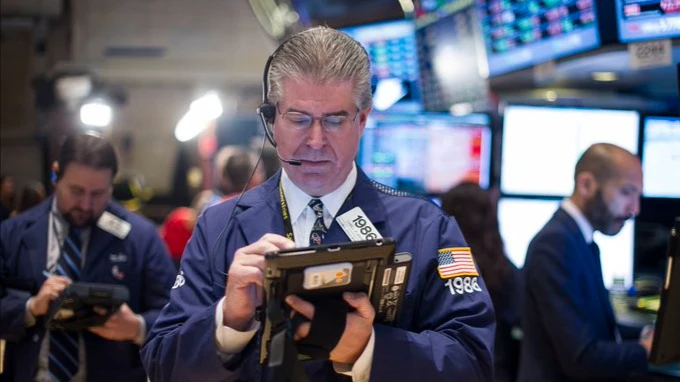
Expensive oil will trigger a "domino effect" and crash the US stock market by 15% - JPMorgan
JPMorgan analysts predict a 15% drop in the S&P 500 if oil prices remain high


Analysts warn about the risk of collapse of the broad market index of American shares, but not all of them change their forecasts for the S&P 500 for the end of the year / Photo: PHOTOCREO Michal Bednarek/Shutterstock
JPMorgan analysts warn about the risk of a "domino effect" in the market, in which high oil prices (above $90 per barrel) can provoke a fall in the S&P 500 index by 15%, follows from the forecast of JPMorgan Private Bank, which is cited by Business Insider. Such pressure on the U.S. stock market, according to analysts, can spread to other platforms, as well as hit the economic growth of the U.S. and the world.
Details
Since the beginning of 2026, the S&P 500 index has declined by 2%, and since the start of the military conflict in the Middle East on February 28, it has lost more than 1%. At the same time, Brent crude oil is showing a sharp rally: since the end of February, it has risen in price by more than 30%, and today, March 16, it is trading above $100 per barrel.
If oil prices remain above $90 for an extended period, it could cause the S&P 500 to decline 10-15% from current levels, according to JPMorgan. As the price of oil approaches or rises above $120 a barrel, the selloff in S&P 500 stocks will only intensify, according to Kriti Gupta, the bank's executive director, and Joe Seidl, senior market economist.
This "domino effect" will also affect the real sector of the US economy through two main channels. On the one hand, there is the rise in fuel prices: according to the American Automobile Association (AAA), the average price per gallon of gasoline in the U.S. has risen to $3.63, which is 21% more than at the beginning of the Iran war. On the other hand, the so-called "wealth effect," where Americans start cutting back on spending as they see their investment portfolios getting cheaper, may be at work. Given that U.S. households own $56.4 trillion in stocks, the market decline directly hits their purchasing power.
Cumulatively, a 10% drop in the S&P 500 could reduce U.S. consumer spending by about 1%, JPMorgan calculated. The combined effect of persistently high oil prices and the S&P 500 entering a bear market will have a serious impact on demand and significantly increase the blow to economic growth, increasing the likelihood of recession, analysts warned.
What other analysts are saying
In parallel with JPMorgan, Goldman Sachs analysts presented their forecasts for the U.S. market. At the moment, the S&P 500 index is about 5% below its historical maximum, but the bank's experts warn about the risk of further decline to 6300 or even 5400 points on the background of growing geopolitical risks, reports MarketWatch.
In a scenario that Goldman Sachs calls a "moderate growth shock," analysts allow the broad market index of American stocks to fall to 6,300 points. This value corresponds to a price/earnings (P/E) ratio for the entire S&P 500 index at 19. However, analysts consider a more pessimistic scenario. In their opinion, if the stock market faces shocks comparable to the most serious oil supply shocks of the last decades, the S&P 500 may collapse by 19% from current levels, to the mark of 5400 points. In that case, the P/E multiple would fall to 16x.
A drop in the S&P 500 to 5,400 points would mean a 23% decline from its recent peak of 7,000 points, which the index reached in January, which would formally confirm the onset of a bear market for U.S. stocks (down more than 20%), according to MarketWatch. However, despite these risks, the Goldman team still maintains its target forecast for the S&P 500 at the end of the year at 7,600 points. The bank's strategists believe that the moderate slowdown in the U.S. economy and the possible reluctance of the Fed to actively reduce rates will be offset by an influx of investment in the artificial intelligence sector, which remains a key market driver.
At the same time, Morgan Stanley believes that the current "correction [in the U.S. stock market] is ripe both in time and price," MarketWatch writes. Despite predicting "strong volatility" in the near term, Morgan Stanley strategists emphasize that their constructive view of the U.S. stock market in the six to twelve month timeframe remains unchanged. At the end of 2025, Morgan Stanley analysts expected the S&P 500 to reach the level of 7800 points by the end of 2026.
This article was AI-translated and verified by a human editor