First quarter small-cap ETF results: who benefited from the energy shock


Projected first-quarter earnings growth for Russell 2000 companies is about 44.9 percent year-over-year, the highest level since mid-2025, according to LSEG consensus / Photo: Shutterstock.com
The escalating conflict in the Middle East has caused the largest disruption in oil supplies in the history of the global market. Against this background, oil prices held near $100 per barrel, and the energy sector in the S&P 500 added about 38% at the end of the first quarter, while the index itself declined by 4.6%.
This gap reflects a large-scale rotation: investors are exiting expensive growth stocks, primarily technology, and reallocating capital to value sectors such as energy, industrials and financials. Small-cap stocks, especially the value segment, have also benefited. For example, Russell 2000 Value was up about 5% for the quarter, while Russell 2000 Growth was down 2.8%. This is the third consecutive quarter that value stocks have outperformed growth stocks in the small-cap segment.
Small-cap ETF leaders in the first quarter of 2026
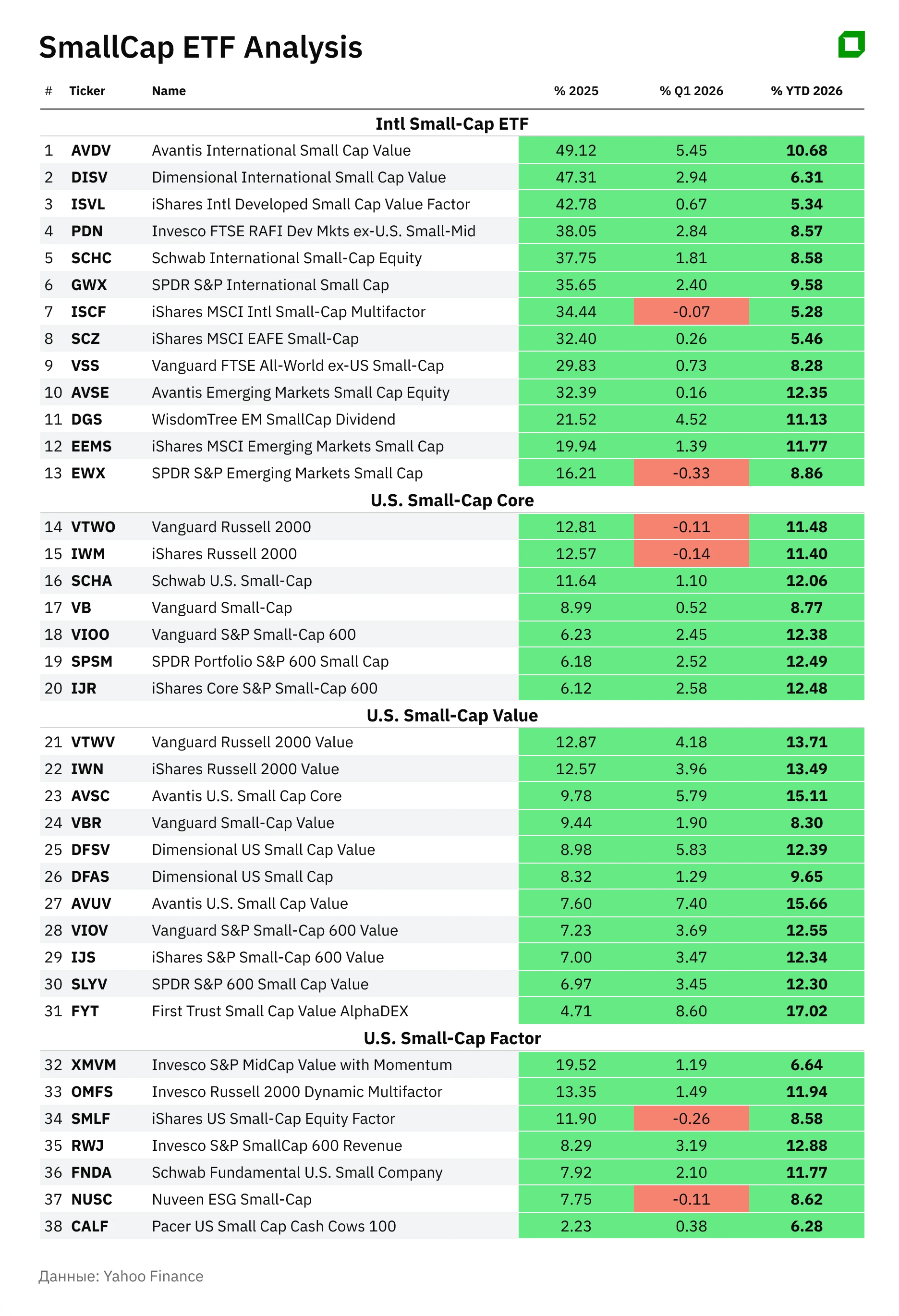
In Oninvest's selection of 38 small-cap ET Fs (see table below), the leader was the First Trust Small Cap Value AlphaDEX ETF (ticker FYT) with a return of 8.6% for the quarter. The fund utilizes AlphaDEX methodology, selecting the most attractive value stocks from the NASDAQ US 700 Small Cap Index and applying an equal-weighted approach. The high proportion of energy (about 18.7%) and financials (19.8%) sectors in the portfolio largely explains its outperformance amid rising oil prices and rotation into value stocks.
The second highest yielding fund is the Avantis U.S. Small Cap Value ETF (AVUV) at 7.4%. It is one of the largest funds in the segment with inflows of about $4.97 billion over the past year, a strategy actively managed with a focus on value stocks and profitability. Avantis reported an 8.55% return on net asset value since the beginning of 2026 (data as of March 31). The fund also has significant exposure to the energy (about 19%) and financials (26%) sectors, which gave the fund an edge in the quarter.
Among the leaders are the Dimensional U.S. Small Cap Value ETF (DFSV), up 5.83%, and the Avantis U.S. Small Cap Core ETF (AVSC), which added 5.79%. Both funds focus on fundamentally sound small-cap companies with low multiples.
Against that backdrop, major benchmarks came under pressure, with the S&P 500 Index down 4.7% for the first quarter, Germany's DAX Index down 7.6%, Hong Kong's main Hang Seng Index down 5.9%, and the MSCI World (iShares MSCI World ETF) losing 3.48%. While broad small-cap ETFs such as the iShares Russell 2000 ETF (-0.14%) and Vanguard Russell 2000 ETF (-0.11%) looked steady, virtually unchanged amid declines in global indices.
International ETFs: resilience amid oil shock
International Small Cap Value ETFs, which had a 30-40% return in 2025, slowed in the first quarter of 2026, but managed to stay in the plus side. The Avantis International Small Cap Value ETF led the way with a 5.45% gain, followed by the Dimensional International Small Cap Value ETF, up 2.94%, and the Invesco FTSE RAFI Developed Markets ex-U.S. Small-Mid ETF, which added 2.84%.
International funds were also supported by the iShares MSCI ACWI ex U.S. (ACWX) index, which ended the quarter with a small but positive result of around 0.5%, while the major U.S. and European indices declined. Despite the energy shock that hit the Asian and European economies harder, small international companies managed to stay in the plus: their cyclical structure and higher share of commodity sectors partially offset rising costs.
Among emerging market funds, the WisdomTree Emerging Markets SmallCap Dividend ETF (DGS) stood out with a 4.52% gain, benefiting from its focus on dividend-paying companies in commodity economies.
Which companies have become growth leaders
For value-oriented small-cap funds such as First Trust Small Cap Value and Avantis U.S. Small Cap Value, rotation was an additional driver. Their portfolios are concentrated in energy, financials and industrials, sectors that are the first to benefit from rising commodity prices and increased credit demand. The valuation differential between value and growth stocks remains wide, which could support further rotation into the market, especially in the event of a protracted conflict in the Middle East, says Morningstar Wealth chief strategist Dominic Pappalardo.
In the First Trust Small Cap Value AlphaDEX ETF portfolio, the largest position is Kosmos Energy with a stake of about 1.44%, a deepwater producer with assets in Ghana, Equatorial Guinea and the Gulf of Mexico. The stock has rallied following a surge in oil prices, with production from Ghana's key Jubilee field topping 70,000 bpd after new wells came online - a record high for the company.
Meanwhile, eight of the fund's ten largest positions, with shares ranging from 1.14% to 0.88%, come from the energy sector: they include drilling platform operator Valaris, refiner Par Pacific Holdings, Permian Basin oil producer SM Energy, oil and gas company Crescent Energy, oilfield services company Liberty Energy and International Seaways, a tanker company that benefits from lengthening oil delivery routes to bypass the Strait of Hormuz.
The Avantis U.S. Small Cap Value ETF has about 775 stocks in its portfolio, and its skew toward financials (25%), consumer discretionary (18%) and energy (20%) explains its outperformance relative to the broad Russell 2000 - these are the segments that have rallied amid the oil rally and rotation out of technology.
The third highest yielding Dimensional US Small Cap Value ETF (DFSV) is an actively managed fund with over 1,000 stocks and a regularly updated structure. As of early 2026, the largest position was Alcoa Corporation (0.87% of assets), one of the world's leading aluminum producers. Amid supply disruptions from the Middle East, inventories of the metal were declining: inventories on the London Stock Exchange fell below 400,000 tons, and prices exceeded $3557 per metric ton - near four-year highs. That supported the company's results: its first-quarter profit rose to $425 million from $213 million a quarter earlier, and the stock has gained nearly 27% since the beginning of the year.
Notably, by April, the fund's largest position was oil producer APA Corporation, whose shares are up about 54% YTD. This change of leader clearly reflects how geopolitics has redistributed growth drivers within the value segment.
What's next
Small-cap companies traded at historically low EV/EBIT multiples relative to large companies in the first quarter, with forecasts for 2026 suggesting faster earnings growth, according to a Royce Investment Partners report.
The LSEG consensus expects first-quarter earnings growth for Russell 2000 companies to be about 44.9% year-over-year, the highest level since mid-2025.
For investors focused on small-caps stocks, the key question is whether support from the oil shock and rotation in value stocks will continue. If the conflict in the Middle East drags on and oil holds above $90 a barrel, value funds with high energy exposure will likely continue to outperform the market. If de-escalation occurs and prices return to pre-crisis levels, the leadership may shift back to growth stocks.
At the same time, the discount of small-caps valuations relative to large companies still remains one of the main arguments in favor of this segment.
Does not constitute individualized investment advice.
