How Silicon Valley Billionaires Learned Not to Worry and Came to Love the Atomic Bomb

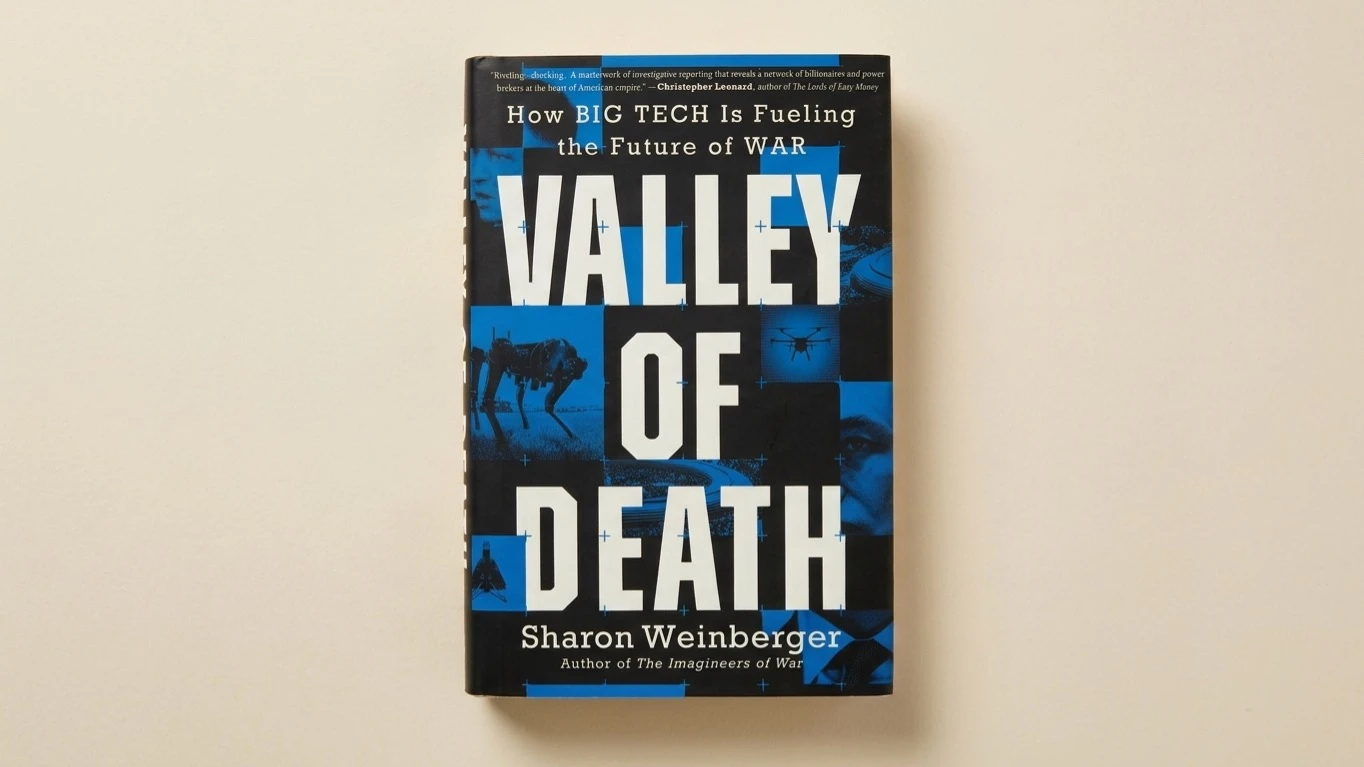
In her book *Valley of Death: How Big Tech Fuels the Future of War*, journalist Sharon Weinberger explores why Silicon Valley’s tech giants have begun actively collaborating with the military-industrial complex. The illustration was created using AI.
The new book by American journalist and author Sharon Weinberger, *Valley of Death: How Big Tech Is Fueling the Future of War*, addresses a topic that has been covered time and again but remains ominously relevant: — how it came to be that the independent tech titans of Silicon Valley not only began collaborating with the military-industrial complex but, in a sense, got ahead of the curve with their latest developments in cutting-edge weaponry. In other words, in true Kubrick fashion, this is a story about how venture capitalists learned not to worry and came to love the atomic bomb.
In this case, the atomic bomb is not a metaphor. The book begins with a private company in Silicon Valley quietly manufacturing nuclear weapons in 2013, secretly purchasing uranium for this purpose from another private company based in Kazakhstan. However, by the second page, it becomes clear that this is nothing more than a reconstruction of a possible scenario (that is, a figurative image after all, but Weinberger describes it so vividly that you can’t help but be drawn in). This scenario was secretly commissioned and funded by the Pentagon in 2013 to gain a clear understanding: what if a private company or an eccentric billionaire decided to build a nuclear weapon? The researchers reached a grim conclusion: a potential nuclear investor could build a first bomb for just one billion dollars within five years, and preventing this would be extremely difficult.
According to Weinberger, this is because gas centrifuges for uranium enrichment have become cheaper and easier to manufacture, which, in turn, makes it easier to join the nuclear club.
The fact is that in 2013, when the study was conducted, the largest tech companies in Silicon Valley—with a few exceptions, the so-called FAANG (Facebook, Amazon, Apple, Netflix, and Google)—had not even considered this possibility and, in any case, were unwilling to address national security issues. Or, at the very least, they didn’t want to admit that they were involved in such matters—especially after a National Security Agency contractor named Edward Snowden revealed Silicon Valley’s collaboration with the U.S. government on surveillance.
But times have changed. The book also quotes promises made by Palmer Lucky, the founder of Anduril: “I would definitely build a nuclear weapon—or, more precisely, a weapon based on thermonuclear fusion.”

"Valley of Death" can be seen as a sort of sequel to Gil Durand's recent book on the "Reich of the Botanists," which we wrote about just the other day. Weinberger herself also cites Alex Karp's "The Technological Republic. "
But that was, after all, purely propaganda literature written by Kamala Harris’s former PR person, whereas Sharon Weinberger is a seasoned science journalist and an experienced expert on defense and national security issues. She worked on the book for ten years, and *Valley of Death* is more reminiscent of a non-fiction novel in the tradition of Tom Wolfe.
The most interesting chapters in Weinberger’s book are those about the past and the future. The most intriguing storyline revolves around Steve Jobs’s relationship with the CIA. In the late 1980s, after being fired from Apple, Jobs agreed to cooperate with the intelligence agency for a very practical reason—despite all his brilliant innovations, his company NeXT was on the verge of bankruptcy. Jobs, ever the perfectionist, fine-tuned the design to perfection, resulting in even the most basic computer model costing a steep $6,500. The CIA signed a contract with the company to supply 20,000 workstations. This didn’t make NeXT a sales leader, but at least it saved the company from financial ruin.
In 1996, Apple announced the acquisition of NeXT, and Jobs returned to his roots, while NeXT’s innovations formed the foundation of Apple’s modern products. So, in a sense, we owe the iPhone to the CIA (I wonder how Apple’s fate would have unfolded if Jobs had struck a deal with the USSR, where he had traveled exactly one year before receiving the offer from the CIA that he couldn’t refuse). Jobs, as a true countercultural figure, initially brushed off the offer to collaborate, but then—again, in the spirit of other countercultural figures—agreed and even gave several lectures at the CIA on the future. In this future, Silicon Valley’s computer technologies began to outpace those used directly by the government—and the intelligence agencies took note.
NeXT computers were used to create an internal network that allowed spies to exchange classified satellite images. That said, not everyone at the CIA was enthusiastic about either Jobs himself or the technology he produced. Weinberger writes that one intelligence officer smashed all the old computers in the office with a baseball bat to force employees to switch to the new machines. This story is almost exactly like Apple’s 1984 commercial.
In fact, ties between the famous region and the military were established long before the alliance with Jobs. In 1928, the U.S. Navy was looking for a site for an airship base and ultimately established it on a plot of land along the border between San Jose and Mountain View, that is, in the very heart of what would become Silicon Valley, amid fields planted with broccoli—a vegetable now so highly prized by the local biohackers.
Weinberger writes that in the early 1970s, the Pentagon provided the bulk of the investment for companies located in what is now Silicon Valley. Even Elizabeth Holmes, the founder of Theranos—who was later sentenced to 11 years in prison—was among those in Silicon Valley who sought to establish ties with the Pentagon.
On the Wars of the Future
Whether it’s Thiel with his mentor René Girard and his lectures on the Antichrist, or Musk with his dream of apple trees blooming on Mars, or the other prominent figures from the “PayPal Mafia,” as Weinberger calls them, — all these people, despite all their quirks and billions, think and act within a familiar paradigm. Roughly speaking, we read more or less the same books as they did and listened to the same music (Musk even lived with a pretty good singer and had three children with her).
It’s also worth noting that Karp and Thiel weren’t techies to begin with—both are more on the philosophical side. But they’re being replaced by truly terrifying automated beings, and it’s impossible to know what to expect from them: whether it’s the aforementioned Palmer Luckey, who literally grew up in the Oculus Rift virtual reality headset he invented and is living the life of a Japanese manga hero named Seto Kaibo, or the infernal Ethan Thornton, a 22-year-old guy with red curls, a forceful way of speaking, and an American flag on his sleeve. At age 19, he dropped out of MIT and founded Mach Industries to realize his childhood dream of building weapons of mass destruction.
Weinberger writes about Thornton as the new Zuckerberg of the military world. In fact, 20 years ago, people like him would have been inventing social networks to get back at exes, but now they’ve bought into Palantir’s utopian vision, according to which war will supposedly become bloodless because it will be waged exclusively by combat robots and AI drones. Thornton’s plan is to bring together the brightest minds and solve all of humanity’s pressing problems in one fell swoop. His company, Mach Industries, plans to sell weapons to the Pentagon just as Walmart sells televisions.
The business models of SpaceX, Anduril, Palantir, and Mach Industries (which, at the time this book was written, had not yet received any government contracts) are broadly similar. Previously, the defense sector had, in essence, only one major customer—the government—and there were virtually no instances of the military acquiring major technological developments from the commercial sector.
Weapons development has traditionally been the preserve of five giants: Lockheed Martin, Raytheon (now known as RTX), Northrop Grumman, Boeing, and General Dynamics. Together, they controlled most of the military market, manufacturing weapons with government funding in accordance with military requirements. It was a long and cumbersome process. That is why, at some point, the military found itself stunned and disheartened by the fact that iPhone apps work more accurately than some of their own guidance systems. As Thiel himself once said, our nuclear bases still run on floppy disks.
Now, instead of waiting for the Pentagon to define requirements and allocate funds for development, these companies intended to develop technologies at their own expense and sell them to the Pentagon—just like cars or televisions. Venture capitalists in Silicon Valley began investing in hundreds of new companies specializing in military technology (from drones to hypersonic missiles). Weinberger writes that in 2025, the total volume of investment amounted to nearly $50 billion.
But the Pentagon seems unable to keep up with these prodigies—it usually used to develop technical specifications first and then award contracts to companies. Thornton, on the other hand, argues that modern warfare has no time for such bureaucratic red tape, and his company’s strength lies in the fact that he doesn’t care about technicalrequirements as longas the technologyis effective. The impending war with China over Taiwan—which Thornton is literally obsessed with—will not wait (incidentally, Musk’s Starlink is not allowed in Taiwan).
Both the situation and the conclusions Weinberger draws from it are disheartening. The book begins like a novel but ends in the style of a manual. From the author’s perspective, the main problem is that modern warfare requires constantly evolving technology, and only private companies can keep up with that pace of innovation. Thus, as one of the book’s characters puts it, they become the very tail that wags the dog—that is, the military-industrial complex. In other words, what should be most alarming is not that tech companies are developing increasingly all-seeing and all-killing technologies, nor even that wars are used as a tool to gain a technological advantage, but rather that the owners of just a handful of companies could seize dominance in the military-industrial complex market and pose a threat to democracy, whereas the U.S. military has traditionally stood as its defender.
But now they’re under threat from a handful of billionaires who will soon be able to declare war on anyone they please—just as Musk has shown that it’s possible to fly into space privately, outside the realm of government authority. Incidentally, in late September, it was announced that Musk and Lucky would become co-leaders of a project to study the wars of the future—literally the title of the book.
But back in 1992, when Musk enrolled at the University of Pennsylvania, Thiel earned his J.D. at Stanford, and Palmer Luckey had just been born, Leonard Cohen released the album *The Future*. The title track prophetically declared that the future belonged to murder. What was perceived in the early ’90s as an Old Testament metaphor from an aging lyricist ultimately turned out to be the most accurate and prescient prediction of the future.
This article was AI-translated and verified by a human editor