Nasdaq 100 in "bear" territory: Anthropic drops 8%, Nvidia has its worst day in two years


Photo: Only background/Shutterstock.com
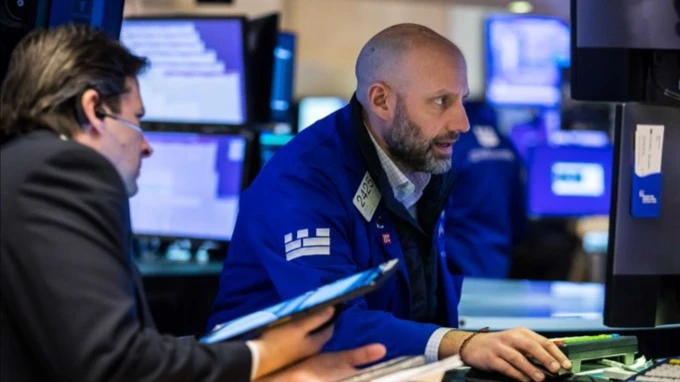
The Nasdaq 100 Index, which includes the 100 largest non-financial companies listed on the Nasdaq, plummeted 5.6% at the close of trading on November 20. It entered “bear” territory, meaning it has fallen 20% from its all-time high set in October, Bloomberg reported. In addition, the index had its worst week since March 2020—the start of the coronavirus lockdowns.
What Was Happening in the Market
All major U.S. stock indices were down sharply on Friday. The broad-market S&P 500 index fell 3.7% and dropped below the 7,000-point mark for the first time since April. The Dow Jones Industrial Average, a blue-chip index, lost 1.9% over the course of the day. Both the S&P 500 and the Dow Jones have entered correction territory, having lost at least 10% from their recent highs. The tech-heavy Nasdaq Composite Index fell 5.3%. It has erased all of its gains for 2026 and is now 2.7% below where it stood in early January.
The S&P 500 fell for the seventh consecutive week—its longest losing streak since February 2020, according to Reuters. Overall, the weekly decline in all three major indices was the sharpest since April 2025.
At the same time, the CBOE Volatility Index (VIX), known as “Wall Street’s fear gauge,” jumped 35% in a single day—to 40 points. The VIX reached its highest level since 2025. In the past, VIX readings above 30 have often coincided with market corrections or declines, explains Investing.com.
Shares of AI developer Anthropic plummeted 8.5% to $88.9 on the first full trading day following its IPO. By comparison, the initial public offering was priced at $83, and at the opening of trading on November 19, the stock rose as high as $115.1.

Nvidia shares plummeted 13.8%, hitting their lowest level since May 2025. Friday’s drop marked the sharpest decline for the company’s stock in nearly two years—since January 27, 2025, according to MarketWatch. Over the course of the week, the stock lost more than 20%: such a plunge hasn’t been seen since at least May 2009, the publication reports. The U.S. Securities and Exchange Commission (SEC) is investigating Nvidia’s accounting practices, Reuters reported on Friday, citing sources. Nvidia has dropped out of the top three on the list of the most valuable U.S. companies: its market capitalization ($3 trillion) has fallen below that of Alphabet, the parent company of Google ($3.19 trillion). Since the start of the year, Nvidia’s stock has fallen by nearly a third. Its market value has nearly halved compared to its October record high.
The Philadelphia Semiconductor Index plummeted nearly 11% over the course of the day. It remains up 17% year-to-date, but as recently as mid-June, it was up 107%, according to Reuters. Shares of the non-cloud company Nebius plummeted 16%, while those of its competitor CoreWeave fell 12%.
Investors were shifting money from the technology sector to more defensive sectors, such as consumer goods and healthcare, Reuters reported.
What They're Saying on Wall Street
"A major blow! The crux of the problem lies in investors' rapidly shifting perceptions regarding technology, particularly the pace and cost of artificial intelligence development," said Steve Sosnik, chief strategist at Interactive Brokers (as quoted by Bloomberg).
Anthropic's IPO and Nvidia's quarterly earnings report failed to allay investors' concerns about the risks associated with AI and the enormous costs of its development, Reuters reports.
“Nvidia reported what may be one of the best quarters in the history of corporate earnings reports. The company did everything right,” said Chuck Carlson, CEO of Horizon Investment Services, in a statement to the agency. “Many people, including myself, had expected to some extent that Anthropic’s IPO would be the event that would dispel the uncertainty in the market. But that didn’t happen.”
Jim Caron, Chief Investment Officer for Portfolio Solutions at Morgan Stanley Investment Management, traces the current sell-off back to the Democrats’ victory in the U.S. midterm elections in early November. “We know that significant capital expenditures on AI have driven economic growth. But won’t political decisions and various investigations—which we expect to be announced after the new Congress takes office in January—lead to a reduction in these expenditures? That is precisely the question the market is currently trying to answer,” the Financial Times quotes Caron as saying.
According to him, “the fundamentals remain strong.” “I still think companies will continue to build data centers. Investment isn’t going anywhere. But right now, the market is trying to figure out: ‘At what price level should I bet on this? What asset valuation would be acceptable to me?’” Caron explained.

On November 20, U.S. President Donald Trump threatened to impose a “huge tax” on companies that build data centers outside the United States. “We won’t let companies build data centers in other countries,” Trump said. “We want them to build them here. And if they don’t want to build in Texas or California, they’ll build them in West Virginia.”
“The stock market is undergoing an AI revaluation, reflecting a slowdown in data center construction, a reduction in funding sources for AI-related projects, and a slower growth trajectory for technology-related earnings,” — said Richard Saperstein, managing director of Treasury Partners (as quoted by Bloomberg).
This article was AI-translated and verified by a human editor