October was the worst month for tech stocks since March 2025: online



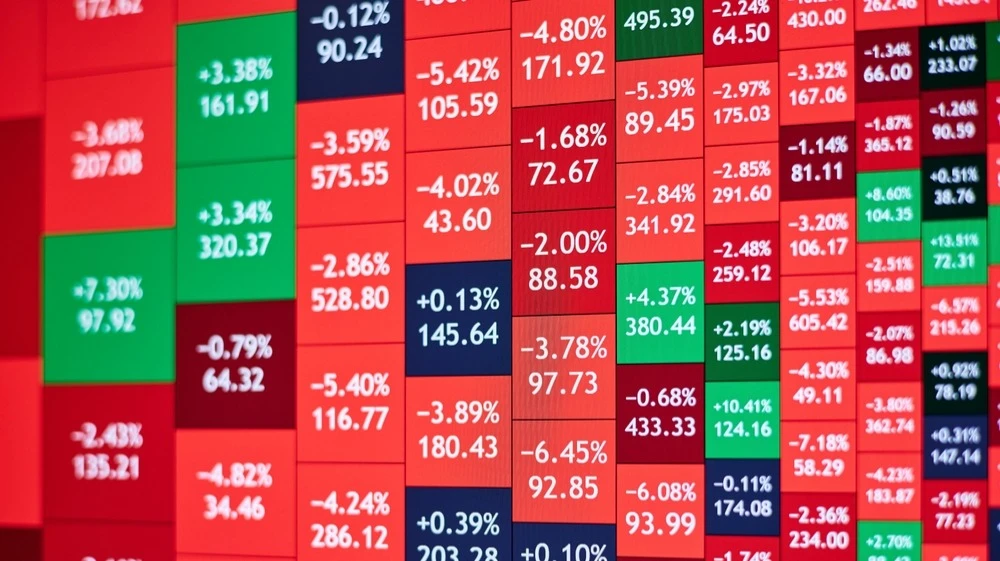
October turned out to be a tough month for AI investors / Photo: Shutterstock.com
Stock market investors ended October with a sharp sell-off in tech stocks following the release of quarterly earnings reports from Big Tech companies, which heightened concerns about the state of the artificial intelligence market. The Nasdaq Composite Index fell 5.3% for the month—its worst performance since March 2025. During Friday’s trading session, the Nasdaq 100 briefly entered a technical correction zone, falling 10% from its peak. Oninvest followed the developments in this live feed.
14:31 CET: Trading opened in New York:
The Nasdaq Composite Index, which is heavily weighted toward technology companies, fell 2.5% at the start of trading on Friday amid disappointing quarterly earnings reports and investor doubts about the return on investment in artificial intelligence;
Shares of chipmaker Intel plummeted 27% after the company’s revenue forecast fell short of market expectations. Amazon’s shares fell by more than 5% due to rising capital expenditures. Together, Amazon and Intel risk losing about $300 billion in combined market capitalization if the decline continues until the market closes, according to Reuters’ calculations.
The S&P 500 broad-market index fell 1.3% at the start of trading;
The Dow Jones Industrial Average, a "blue-chip" index, fell 0.2%;
The sell-off also affected the cryptocurrency market: Bitcoin fell below $77,000 after Binance, the world's largest cryptocurrency exchange, reported a record-breaking hack.
2:45 p.m. CET: Hyperscalers—Amazon, Alphabet, and Meta—were behind the latest wave of tech stock sell-offs, according to Yahoo Finance. The companies that reported earnings this week did not provide Wall Street with clear forecasts on how much they intend to spend on AI infrastructure this year and next, and current spending is turning out to be much higher than expected—and is already beginning to impact the core businesses of these tech giants.

Jefferies analyst Brent Till noted that investors were spooked by financial results that were good but not outstanding. According to him, the market is also increasingly concerned that constraints in physical infrastructure construction are preventing hyperscalers from meeting all the demand. “The tech sector is closed. We’re seeing a massive sell-off; everyone is rushing out right now. We don’t know if the ‘Closed’ sign will stay up for 10 minutes, 20 minutes, or longer,” the FT quotes him as saying.
14:55 CET: Intel’s stock has already fallen 29%—this plunge could be the worst in the company’s history, according to Bloomberg. Following the weak outlook the company issued with its quarterly earnings report yesterday, Bank of America has dropped its “buy” recommendation and now maintains a “neutral” rating, according to CNBC. Analyst Vivek Arya lowered his price target from $145 to $100, which implies upside potential of about 9% relative to Thursday’s closing price.
“The company has not yet demonstrated sufficient progress in attracting third-party customers for contract chip manufacturing. At the same time, the strong performance of the data center division is being offset by an unexpectedly sharp decline in PC shipments,” the analyst wrote.
2:02 p.m. CET: What analysts are saying about the decline in tech stocks:
“I don’t think we’ve reached the moment of truth yet, but investors should seriously consider just how overvalued positions in this sector remain,” said Matt Orton, chief market strategist at Raymond James, on CNBC. “Although what’s happening now may be painful for investors, the fundamentals remain strong overall, especially for companies that are benefiting from capital expenditures on AI.”
"Continued volatility does not make exiting the market an effective way to protect a portfolio from potential drawdowns. We continue to see upside potential for stocks overall and believe investors should build a well-balanced portfolio that includes assets outside the technology sector,” said Ulrike Hoffmann-Burkhardi of the UBS Chief Investment Office (source: Bloomberg).
"The market is much more sensitive right now than usual," said Chris Zaccarelli, chief investment officer at Northlight Asset Management. Investors prefer to sell their stocks and figure things out later—rather than get stuck holding them and watch their losses mount, he noted (Bloomberg).
“The main question remains whether the weakness in the technology sector will spread to the entire market or whether the ‘musical chairs’ game will continue. A sell-off in which all assets fall simultaneously has so far been avoided, but, in our view, the likelihood of such a scenario has increased in November,” wrote Jonathan Krinsky, chief technical analyst at BTIG, in a note (Bloomberg).
15:09 CET: As investors shifted from tech stocks to other sectors, defensive sectors posted gains: shares of consumer staples and healthcare companies, CNBC noted. For example, shares of Procter & Gamble, Walmart, and Coca-Cola each rose by about 2%. Shares of Johnson & Johnson and Merck, in turn, rose by 1.4% and 2.8%, respectively.
15:14 CET: Amid the market’s volatile reaction to Intel’s earnings report, shares of Advanced Micro Devices—which also manufactures central processing units for both PCs and data centers—came under pressure. AMD’s stock price fell 8.7%.
Intel’s business is facing two problems at once: PC sales are declining due to high memory chip prices, and the company cannot produce enough server processors to meet high demand, MarketWatch explains. Investors are trying to determine to what extent these problems are linked to broader industry trends and to what extent they stem from the company’s own missteps. AMD will release its quarterly report on Tuesday, November 3.
15:21 CET: Non-cloud companies—providers of cloud computing power that supply infrastructure for AI data centers—have come under close scrutiny from investors due to their high debt levels. CoreWeave’s stock plummeted 8%, and the company’s market value could drop by 38% in October. Nebius’s stock also plunged 8% and could lose 34% by the end of the month.
3:35 p.m. CET: “The earnings reports from the largest tech companies are starting to resemble a horror movie more than a cause for widespread celebration,” Barron’s concludes in its summary of the latest round of quarterly earnings reports.
On October 29, Amazon reported that its free cash flow for the 12 months ending in September turned negative, coming in at minus $42.4 billion, compared with a positive $14.8 billion a year earlier. Other tech giants are seeing a similar trend: Google’s parent company, Alphabet, and Meta Platforms also reported cash outflows for the third quarter. Among the largest companies to report, only Microsoft posted a positive cash flow—$18.6 billion for the quarter (though it was $25.7 billion for the same period last year).
Previously, massive spending on AI was offset by the high profitability of the tech giants’ core businesses, but now even those businesses are facing their own challenges, leading investors to take a more critical view of large capital expenditures, Barron’s notes.
3:48 p.m. CET: Bonds issued by major tech companies are now more attractive than their own stocks, according to Michael Hartnett of Bank of America. Concerns about large-scale borrowing to develop AI infrastructure have driven up corporate bond prices. Even hyperscalers with investment-grade credit ratings are now offering yields of up to 8%.
“Buy undervalued tech company bonds,” Hartnett wrote, calling these assets “rough diamonds.” Yields on bonds from the “Magnificent Seven” in the 6–8% range look attractive, he noted. According to the strategist, the period during which bonds of AI-related companies underperformed their stocks has come to an end.
4:00 p.m. CET: Amid a stock sell-off, credit default swap (CDS) prices for some tech giants have risen to a new record high, according to Bloomberg. CDSs are contracts that function as insurance against an issuer’s default on its debt securities.
According to ICE Data Services, on Friday, the cost of five-year credit default protection on Intel bonds rose by 22.4 basis points, reaching a record high of 127.9 basis points per year. Amazon’s CDS spread also hit a new high, rising 6.9 basis points to 94 basis points per year. Credit risk indicators for Microsoft, Alphabet, SpaceX, and Intel’s competitor Broadcom also reached record highs. The cost of CDS on Advanced Micro Devices’ debt reached levels last seen in early 2019.
According to Bloomberg, since the beginning of 2026, companies have already borrowed nearly $500 billion for the construction of data centers, the purchase of microchips, and other AI-related projects. By comparison, total borrowing for the entire year of 2025 amounted to about $200 billion.

16:31 CET: The sell-off in the market shows no signs of slowing down. Two hours after the market opened, the Nasdaq Composite Index is down 2.4%, and the S&P 500 Index is down 1.5%. The Dow Jones’ decline has accelerated to 0.6%. Intel shares have been unable to recover their losses and are down more than 28%, while Amazon has limited its decline to 1.3%.
17:15 CET: The Nasdaq 100 index is on track to end October with a loss of more than $2 trillion in market capitalization—slightly more than the total value of SpaceX, according to Reuters. Since the beginning of the month, the index has fallen by more than 5% amid growing investor doubts about whether the billions of dollars invested in artificial intelligence will pay off quickly enough.
5:50 p.m. CET: The WSJ notes that today’s sell-off in tech stocks differs from previous ones—U.S. Treasury bonds did not rise as sharply as on other days of market declines in recent weeks, as investors flocked to safe-haven assets.
According to Tradeweb data, following the release of Intel and Amazon’s earnings reports, the yield on 10-year U.S. Treasury bonds fell by 0.02 percentage points to 4.954%, and during the overnight session, it even dropped to 4.894%, but then recovered most of the loss. By comparison, on October 22, when tech stocks also fell sharply, the yield on 10-year Treasuries dropped by nearly 0.2 percentage points.
Yields on Treasury bonds decline as their prices rise.
The modest rise in bond prices may indicate that yields have bottomed out, the WSJ reports. For investors, this is a mixed signal. The positive aspect is that yields are not falling any further thanks to steady economic growth. Since the Federal Reserve is still seen as more likely to raise rates in the coming months than to lower them, investors are in no hurry to make big bets on bonds. The downside is this: if yields have indeed stabilized at current levels, investors will not be able to use bonds to hedge against losses in the stock market, as they did earlier in October. Persistently high yields will also continue to weigh on stock valuations and fuel concerns about rising borrowing costs for businesses.
In addition to economic growth, yields are being held back by inflation concerns: investors are watching for signs that the U.S. might resume strikes against Iran after the November 3 midterm elections, which could lead to higher energy prices.

6:10 p.m. CET: The Nasdaq Composite Index has extended its decline—it is now down slightly more than 3%. Falling tech stocks are dragging down the entire market—the S&P 500 Index is down 1.9%.
At the same time, concerns about the prospects for AI investments have affected not only the technology sector but also the industrial sector, whose companies are involved in building data centers for AI, Jeff Buchbinder, chief equity strategist at LPL Financial, told MarketWatch. According to FactSet, by midday trading on Friday, the industrial sector of the S&P 500 was down 1.1% and, along with the technology sector, was among the biggest losers.
A report by the Financial Times did little to dispel negative sentiment in the market—the newspaper learned that investment firm Blackstone had warned investors that Anthropic might not receive an investment-grade credit rating following its IPO. Anthropic’s publication of its IPO prospectus gave a boost to investments in the AI sector earlier this week, but pressure on the market resumed as Wall Street analysts assessed the latest financial results from tech companies.

6:40 p.m. CET: It may be time to take profits while the opportunity still exists, according to CNBC. On Friday, nearly all AI-related stocks came under pressure: Intel’s shares plummeted 30%, Micron’s fell 6%, and Nvidia’s dropped nearly 6%. Amazon and Google are down about 2%.
After a week packed with corporate news, investors are questioning the prospects for AI investments, CNBC notes. Alphabet’s weak advertising revenue report and the release of Anthropic’s pre-IPO filings have heightened concerns that returns on capital investments in artificial intelligence are not keeping pace with the scale of those investments.
“You want to make sure the payoff is worth the risk,” says J.J. Kinahan, senior vice president of Cboe Global Markets. “I believe there will be a payoff, but a lot of money is being invested up front right now.” In his view, the AI boom of the past few years is now in question.
"I'm a little concerned about this deal," said Mike Kho, a strategist at YieldMax. "I think we're likely to see some more volatility."

Options specialists are noting a rise in demand for protection against falling prices. “Historically, tech stocks have shown a bias toward call options: people are more willing to buy ‘greed’ in the form of calls than ‘insurance’ in the form of puts. Over the past three days, I’ve seen that the situation has changed,” said Dennis Davitt, co-chief investment officer and co-founder of Millbank Dartmoor Portsmouth.
He noted that investors may be gaining more confidence in the commercial prospects of AI technology itself—in particular, thanks to successful consumer-facing applications like Meta’s Muse. “I believe ChatGPT and other algorithms are taking market share away from companies like Amazon and Google. If you look at the option prices for Muse, there’s less fear factored into Meta’s valuation than into Amazon’s,” Davitt noted.
Macro investors are also taking a more cautious stance. Paul Tudor Jones, founder of Tudor Investment Corporation, suggested earlier this month that the markets may continue to put off addressing the issue. He estimated the probability of approaching a tipping point at 60%. According to him, the volume of AI-related debt issuance relative to GDP is 50% higher than it was for railroads at the time, and three times higher than for highways and telecommunications. Competition between AI infrastructure development and sovereign borrowing could push the market toward this tipping point.
7:30 p.m. CET: The Nasdaq 100 Index, which comprises the 100 largest non-financial companies listed on the Nasdaq exchange, is approaching a technical correction—it has lost 9.4% from the high it reached earlier this month, according to Barron's. Among the index’s biggest decliners are shares of Intel (-31%), SanDisk (-16%), and Astera Labs (-14%).
On Friday, the index fell 4.2% to 28,160.85 points. For the correction to begin, it must close below 28,102.023.
There are about 1.5 hours left until the market closes.
7:40 p.m. CET: Where are investors fleeing to avoid stock market risk?
It's not gold—the metal closed at $3,885.7 on Friday, its lowest level in more than a year. The price of gold has fallen by about 27% from the high it reached nine months ago.
Yields on 10-year U.S. Treasury bonds remained virtually unchanged, while the U.S. Dollar Index edged lower. Bitcoin fell on news of a hack at the Binance cryptocurrency exchange.
It appears that investors are seeking refuge in defensive sectors of the stock market, according to Barron's. The consumer staples sector rose 1.8%. The utilities and healthcare sectors each gained 1%.
20:25 CET: The Nasdaq 100 index has officially entered a technical correction—its decline from its recent high has exceeded 10%, according to Bloomberg. This marks the third technical correction for the tech index since the beginning of 2026.
After many years of confidence that any investments or loans in the AI sector would yield impressive returns, investors have begun to ask sober questions about the profitability of these investments and, in some cases, even about the return of their principal, notes Steve Sosnik, chief strategist at Interactive Brokers. According to him, many technology companies have gone from being “cash flow generators” to becoming major borrowers, which amplifies the volatility in the sector.

May 21, CET: Market Highlights for the Day:
The Nasdaq 100 Index, which entered a technical correction during the trading session, closed approximately 9% below its peak. The decline in tech stocks dragged down the entire market—the S&P 500 Index fell 1.8%. Even the Dow Jones Industrial Average, a “blue-chip” index that is heavily weighted toward cyclical sectors of the economy, fell by more than 1%.
Shares of chipmaker Intel plummeted more than 28%, marking their sharpest decline in more than 40 years, following the company’s disappointing revenue forecast. Amazon’s stock fell 1.4% after the company reported higher-than-expected capital expenditures the previous day, along with a slowdown in e-commerce revenue growth.
21:15 CET: The Nasdaq Composite, an index of technology companies, fell 5.3% in October—its worst monthly performance since March 2025.
At the end of October, the S&P 500 fell 0.9%, while the Dow Jones rose 1.7%, according to FactSet.
For more details on the close of trading, see this article. That concludes our online session. Thank you for your attention.
This article was AI-translated and verified by a human editor