U.S. Elections: What Will Happen to the AI Sector, Oil, Gold, and the Dollar After November 3?

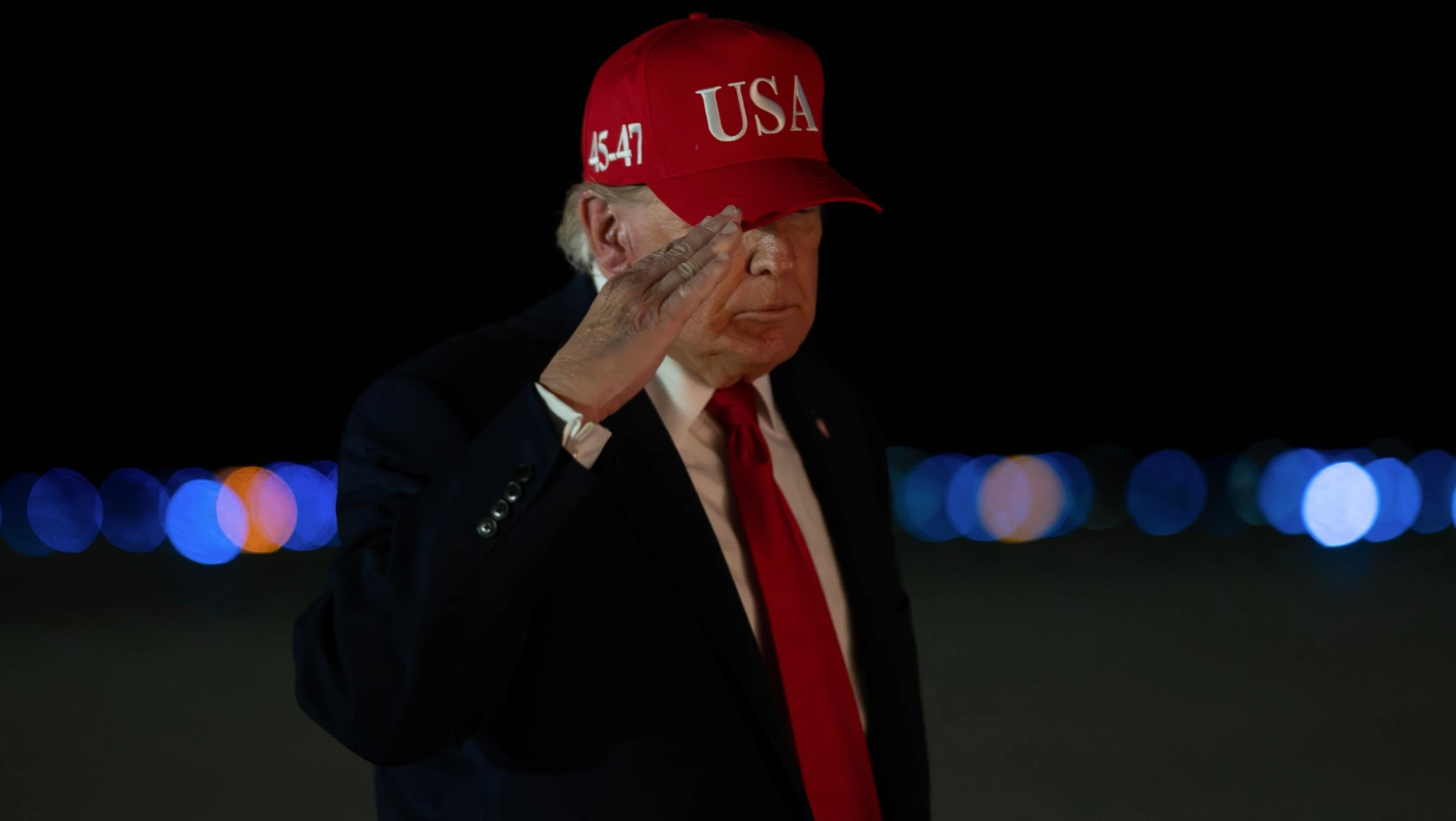
Polls show that U.S. President Donald Trump’s Republican Party is unlikely to retain its majority in Congress in the upcoming elections / Photo: The White House
On November 3, the U.S. will hold midterm elections for the U.S. Congress. The main question surrounding these elections is whether President Donald Trump’s Republican Party will be able to retain its majority in both chambers of Congress. Polls suggest that such an outcome is unlikely. What might the election results mean for the market, and how should investors prepare for them? Alexander Orlov, Managing Director of Arbat Capital, provides insights.
The Magic of the Midterm Elections vs. the Magic of 2026
Midterm elections in the U.S. almost always serve as a kind of referendum on confidence in the president and the party he leads. Statistics on the U.S. stock market (as shown in the chart) indicate that the year leading up to midterm elections is typically the worst for stocks in the entire four-year presidential cycle. On the other hand, the year following the elections has historically seen super rallies!
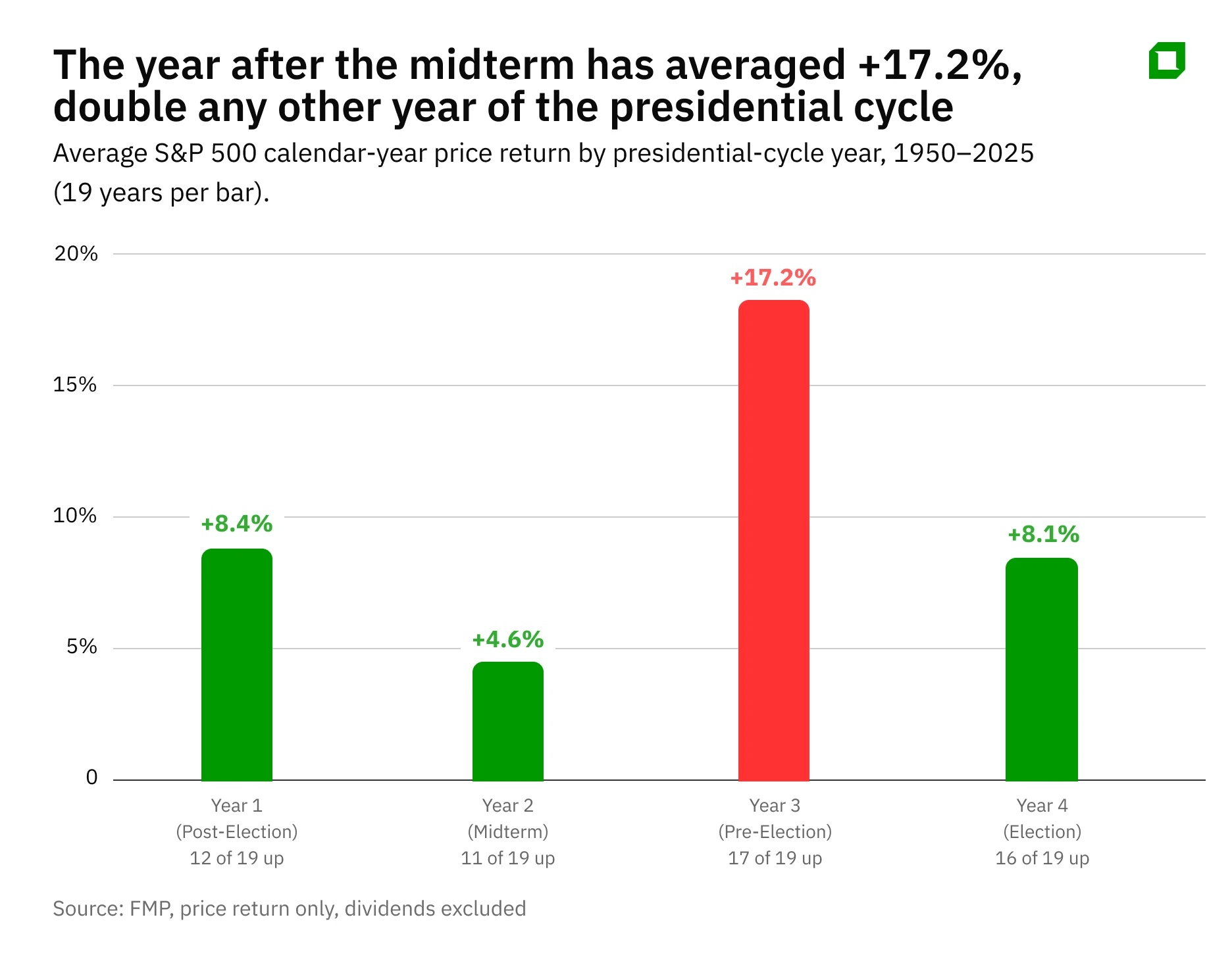
Additional statistics show that in U.S. midterm election years, beginning in 1974, the median return of the S&P 500 index from August 1 through Election Day in November was 0%, as previously calculated by Goldman Sachs; in years when there were no midterm elections, the index’s average return over the same period was 6%, according to BlackRock.
From this, one might draw the seemingly logical conclusion that one should buy stocks during any market dip before, during, and immediately after the November 3 election.
But in 2026, things aren’t going according to plan. Since the start of 2026, the S&P 500 has already risen by 13%, despite the war in the Middle East and high prices for oil and petroleum products. The topic of AI development has proven to be far more important than geopolitics. As a result, the market’s future direction after the election will depend more on the trajectory of tech companies’ spending on chips and semiconductors.
And here, the outcome of the election turns out to be more important than it seems at first glance.
Election Scenarios
According to polls, the baseline scenario assumes that the Democratic Party will regain a majority in the House of Representatives and secure a slim majority in the Senate (60% to 40%, since only 35 of the 100 seats are up for re-election).
But there is also an alternative scenario in which the Republican Party could retain control of the Senate. Currently, Republicans hold 53 seats in the upper chamber of Congress, while Democrats hold 47.
Essentially, both scenarios have the same consequences for the markets: a division of power between Congress and the president is, in fact, good news—especially when dealing with such an unpredictable president.
What does all this mean for the various market sectors?
For the stock market as a whole, there is one major caveat to the Democrats’ victory: their stance on AI, the main driver of the U.S. market.
The election could burst the AI bubble if the victorious Democrats continue to push through legislation opposing Trump’s stance on the unrestricted construction of data centers and the implementation of AI. However, the current U.S. president can always veto these legislative initiatives, and it is unlikely that a two-thirds majority in each chamber could be secured to override the veto.
In any case, such scenarios would be bad news for the AI sector—and, by extension, for the entire market. And this would prompt investors to look for alternative sectors for growth.
The commodities market could change significantly after the election if a decisive Democratic victory manages to end the war in the Gulf. In that case, oil prices would plummet by 25–30%, while gold would rise slightly in price (de-escalation in the region would give the Fed the opportunity to cut rates, which could slightly increase gold’s appeal).
But there is another scenario in which a Democratic-controlled Congress would only be able to limit Trump’s willingness and ability to make concessions to Russia on energy issues. In that case, oil will remain expensive, and agricultural commodities will also continue to rise in price (prices will also rise due to the El Niño climate phenomenon, which has become the strongest in several decades).
Metals, however—and especially precious metals—will react more strongly to the Fed’s interest rate, which is likely to remain high.
A Democratic victory is likely to bring hope to the bond market that the rate of growth in the national debt will slow and that operations in the Middle East will be scaled back. These are the two main conditions for the Fed to refrain from raising interest rates and for the rise in U.S. Treasury yields to come to a halt. A potential burst of the AI bubble in the stock market could also trigger a shift of investor funds from overvalued stocks to undervalued government bonds.
But there is a counterargument to this positive scenario as well—if Donald Trump becomes a “lame duck,” he will be even more inclined to take risky actions in the geopolitical arena in order to “leave his mark on history.” In that case, the bond sell-off will continue.
Foreign exchange market statistics show that elections alone do not change the direction of the dollar’s trend, whatever it may have been prior to November. It is clear that in 2026, even a Democratic victory will not force Fed Chair Kevin Warsh to drastically change his stance and abandon his gradual approach to fighting inflation, which involves minimal communication with the market.
The dollar will likely begin to weaken against a basket of currencies as Trump’s geopolitical adventurism subsides. In addition, investors can expect the Fed to ease monetary policy—following the bursting of the AI bubble and a slowdown in the U.S. economy, potentially leading to a recession in the second half of 2027.
What Investors Should Do
In both the baseline and alternative election outcome scenarios, we see a divided government in the U.S. for the next two years — Trump and the Republicans will most likely lose sole control over the domestic political agenda (though this does not apply to the international agenda, since the president has executive power in that area).
Given the Democrats' propensity for regulation, we can expect negative news for the AI segment of the stock market, the dollar, and oil prices, but positive news for government bonds and gold.
Based on this, here are some suggestions for hedging election-related risks:
— buy U.S. government bonds;
— Reduce holdings in stocks of AI-related companies. There’s no need to close them out entirely: it’s hard to believe that strict regulations will be adopted anytime soon, tech companies’ capital expenditures are approaching $1 trillion, and, moreover, the market is expected to rally ahead of the Anthropic and OpenAI IPOs.
— The oil and gas sector could also be affected by the Democrats' actions—it’s best to sell all shares in companies in this sector;
— In an equity portfolio, you can increase the weighting of the consumer and healthcare sectors;
— The best way to bet on a weaker dollar is through the undervalued Japanese yen, not through European currencies. Europe faces even more problems with its economy and debt market; moreover, a series of elections is also on the horizon there in 2027;
— Buy gold (through an ETF or futures) and establish a protective options position in oil: buy a Brent put option with a strike price of $100 and sell a Brent call option with a strike price of $125.
This is not an investment recommendation.
This article was AI-translated and verified by a human editor