Startups with Russian roots have survived one crisis. But there is a new one ahead

Tougher immigration policies in the US and banking compliance in the EU, as well as Iran's strikes against the UAE, are the new black swans for startups with Russian roots. Photo: Nicolas B82 / Shutterstock.com
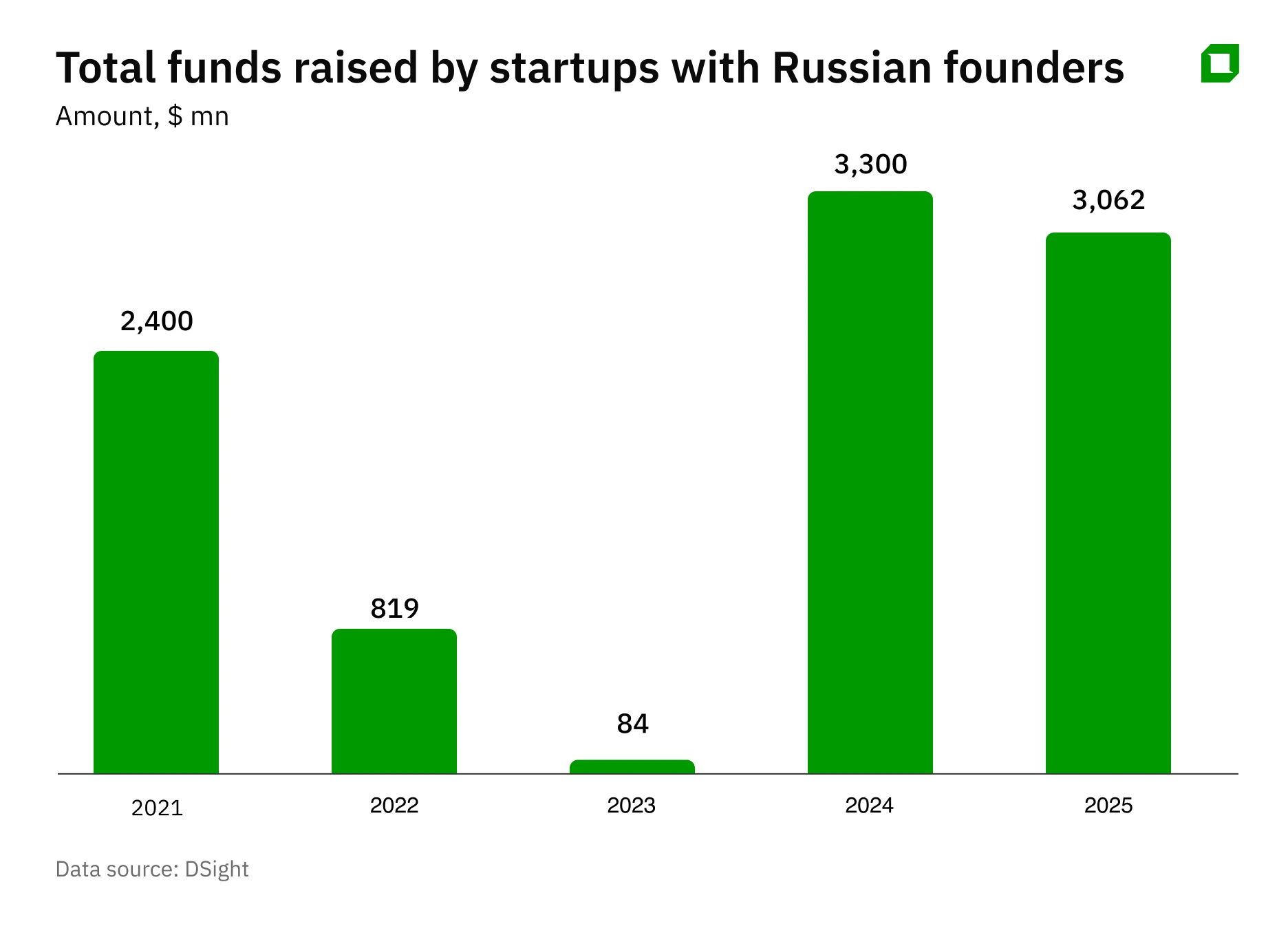
Founders with Russian roots in 2025 attracted just over $3 billion of foreign investment in their projects, which is comparable to the result of 2024. This means that the crisis of 2022-2023, when foreign investors turned away from Russian startups after the outbreak of hostilities in Ukraine, has been overcome. In 2026, Russian founders will have to deal with new serious problems, including tougher US immigration policy and Russia's inclusion in the EU's money laundering blacklist. How will this affect their business?
The last stable year?
At the end of 2025, startups with Russian roots will have attracted just over $3 billion in foreign capital, according to the analytical company DSight. A year earlier, Russian natives managed to raise a comparable amount of investment - $3.3 billion. At the same time, the number of deals in 2025 increased (58 against 46 a year earlier), while the "average check" of a round decreased (from $22.48 million to $22.13 million). That is, the money was distributed over a greater number of projects.
Dsight defines startups with Russian roots as those whose founders were born in Russia or on its territory in the USSR, or were once citizens of one of these countries.
According to DSight founder Arseny Dabbakh, in 2025, startups founded by natives of Russia showed stable results in all indicators.
Especially if we compare it to the crisis of 2022-2023. At that time, the Russian venture capital market collapsed due to the withdrawal of Western capital after the outbreak of hostilities in Ukraine. And then it split into businesses that remained in the country and those that cut ties with Russia. Those companies that chose to develop outside of Russia have already established stable ties with venture capitalists abroad.
Russian-speaking founders have spent four years choosing which system of the world order they want to work in. Only a very small number of entrepreneurs are able to live and work both in Russia and abroad, said Ilya Chernetsky, founder of Coinkeeper and startuper.
Who's in the top?
The leader in terms of capital raised was Nikita Shamgunov's Neon project, which develops a cloud platform. He sold it to the data analytics company Databricks for $1 billion. Shamgunov, an ITMO graduate, moved to the USA at the start of his career, where he built a career as a "global Russian".
Among other startups with Russian roots, the projects associated with Oleg Tinkov and Arkady Volozh were in the top of the list, according to DSight data. Both made their fortunes in Russia, but got rid of their Russian assets after the outbreak of hostilities in Ukraine.
Fintech startup Plata, whose early co-investor was Tinkov, has become a unicorn in 2025 and has become a leader in terms of venture capital raised. The company raised a total of $910 million in three rounds over the year, including $500 million in debt financing from Japan's Nomura Securities International, the largest deal ever for a Mexican financial startup. In an interview with Elizaveta Osetinskaya last June, Tinkov and another Plata investor Michael Calvey said Plata planned to grow to a valuation of $3.3 billion. By the end of last year, the goal was almost achieved, with the company's valuation jumping more than twofold to $3.1 billion.
In 2026, Plata received a banking license from the Bank of Mexico, ahead of other major players in local fintech - Brazil's Nubank and Argentina's Mercado Pago. This will allow the company to add classic credit products to its product line: now the startup can only issue debit and credit cards and installment payments. The fintech has also received a financial institution license in Colombia. In Mexico and Colombia, Plata will compete for market share with Revolut.
In fintech, Russian-speaking entrepreneurs have outstanding expertise, which they are now successfully scaling globally and generating real profits, explains the success of Plata AI startup Islam Midov.
Avride also raised a large investment - $375 million - in 2025 among startups with Russian roots, according to DSight data. This is the former Yandex Self Driving Group, which was taken over by Arkady Volozh and is now part of his Nebius Group. The company develops solutions for unmanned cars and delivery robots. The startup was founded by the parent Nebius Group and Uber Technologies, its strategic partner. The main market for Avride is the US, where it is headquartered. It uses Avride's self-driving cars and delivery robots in its Uber cab and Uber Eats delivery services. The company does not disclose its current valuation. Analysts' estimates diverge markedly from $2.7-2.8 billion to $6 billion.
Like Plata, Avride is looking to expand internationally: its rovers and drones are already operating in Tokyo and Seoul, and partners include Korean auto giant Hyundai and major Japanese e-com Rakuten.
The fourth largest investment round, at $350 million, was raised by another Yandex alumnus, the database management systems developer Clickhouse. It was founded by Alexei Milovidov, Aaron Katz and Yuri Israelievsky. Initially, the technology was created for the needs of "Yandex.Metrics". But in 2021, the project became a separate company, and in 2022, the founders said that it had no operations, infrastructure, and investors left inside Russia.
Volozh's Nebius Group owns about 30% in the company. It also participated in a $350 million round led by US-based Khosla Ventures. In addition to this funding, ClickHouse received a $100 million credit line from Stifel and Goldman Sachs.
Clickhouse, like Avride, does not disclose its current valuation. Bloomberg, citing a source in May 2025, reported that Clickhouse almost tripled its valuation to $6.35 billion in 2025.
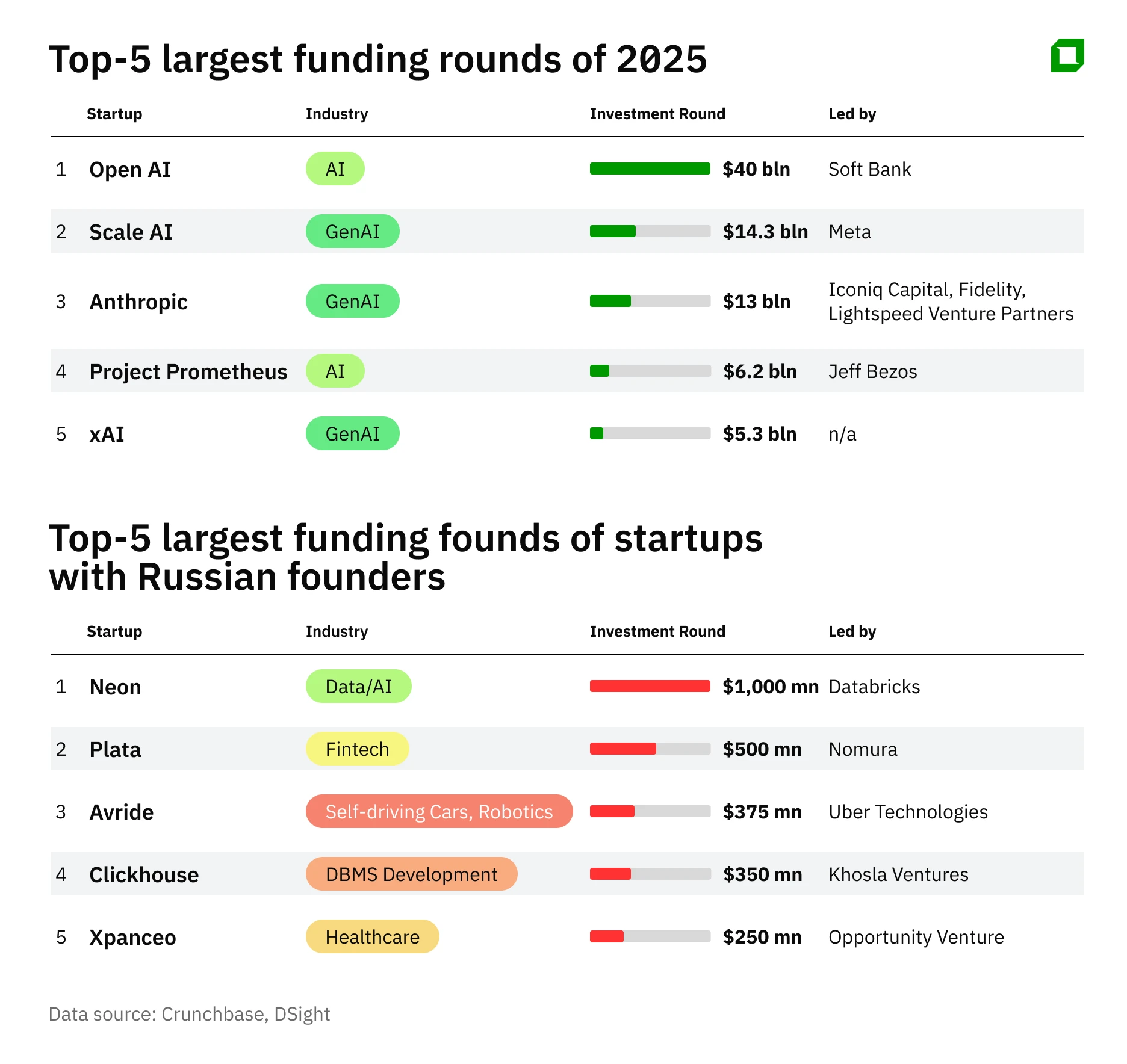
Several other startups from Russia have attracted large rounds: the unicorn-like developer of "smart" lenses Xpanceo ($250 million) from the UAE of Russian entrepreneur Roman Axelrod and Ukrainian scientist Valentin Volkov, a platform for creating chatbots in social networks ManyChat ($140) by Mikael Jan, and the European fintech project Finom by Russian Modulbank founders Andrei Petrov, Oleg Laguta and Yakov Novikov ($134 million).
Fintech and infrastructure are areas where natives of Russia are historically strong, where they have established competencies and professional networks, and Xpanceo is in principle a completely new product that has no analogues in the market, explains Sergey Bogdanov, managing partner of Yellow Rocks.
What will be the focus of the venture?
Globally, about 50% of all venture capital investments in 2025 will be in AI-related projects, says Arseny Dabbah. The bias in this direction is even more evident with the projects of Russian natives. According to Dabbakh, all the startups that have become leaders in terms of the amount of venture capital raised in 2025 either have AI as a key technology within their product, or provide infrastructure for AI. For example, Avride is directly tied to the use of AI, while Clickhouse is simply "a blockbuster in this field," notes Dabbah.
"In general, the main fever now is around AI: applications, infrastructure, even fundamental models are being invested in," says Sergey Toporov.
Many people are now also talking about the robotics segment, suggesting a future boom in the software segment for robots: for example, application marketplaces and the applications themselves, which change the robot's functionality and improve its hardware, says venture capitalist Pavel Miasnikov. According to him, fintech will also remain a promising area: sanctions, compliance requirements, trade wars, macroeconomic volatility and changing consumer patterns are creating demand and a window of opportunity for payment and credit projects.
In addition to AI, the largest funds closely follow projects in cybersecurity, defense and dual-use technologies, energy, industrial solutions, as well as data-, devtools- and fintech-infrastructure, Sergey Bogdanov lists.
2026: a new challenge for Russian founders
However, Russian founders have a risk that the main topic of 2026 will not be AI transformation, but new tightening measures. First, it is about Russia's inclusion in the EU's money laundering blacklist, which has tightened compliance against Russians many times over.
The EU decision may increase the timing and complexity of transactions, especially in cross-border investments, concludes Pavel Miasnikov.
Sergey Bogdanov suggests that some European investors are likely to become more cautious due to stricter compliance and the risk of regulatory blockages. The key factor for startups with Russian roots will be a transparent ownership model, a proven source of funds, the absence of Russian cash flows and control, as well as a clear jurisdiction and the status of the founders, he says.
Practically speaking, startups with Russian founders will have to prove even more thoroughly that they have no operational connection with Russia, agrees Sergey Toporov.
The second difficulty is the tightening of US migration policy. The most painful thing for startups was the increase in the fee for an H-1B work visa to $100,000 for each invited specialist. In addition, the USA has suspended the acceptance of applications for immigrant visas for citizens of 75 countries, including Russia.
Russian founders have not yet been radically affected, as most of them move on O-1 talent visas, says Islam Midov. The tougher regulations are hitting salaried employees and freelancers to a greater extent.
Immigration risk has actually become an additional cost factor for founders, says Sergey Bogdanov. According to him, in the long term, the US will retain its capital leadership, but companies will increasingly create distributed teams and move headquarters to jurisdictions with more predictable visa regimes.
Under such conditions, Latin America looks promising, where technology transfer is already taking place and Russian-speaking founders are building large businesses thanks to the absence of serious barriers to entry, a large market, specific venture capital and quite adequate competition, Miasnikov believes.
The local market in the UAE is quite specific and small, but Xpanceo's successful case study proves that the right institutions and environment are there so that global scale projects can be grown, he adds.
The UAE has long been a "safe haven" and a "tax haven" for millionaires and businesses. But now the country is experiencing the "arrival of a black swan" - its territory is being bombarded by Iran. In an interview with the Daily Mail, US President Donald Trump said that coordinated US-Israeli military action in Iran will last about 4 weeks. If they drag on, the consequences for the Emirates, whose economy depends on tourism, finance, air travel and shipping, could be catastrophic, former JPMorgan chief strategist Marko Kolanovic warned in X.
This article was AI-translated and verified by a human editor