The Fed has cut rates for the third time in a row. What happens next?
Fed committee members expect only one round of monetary policy easing in 2026

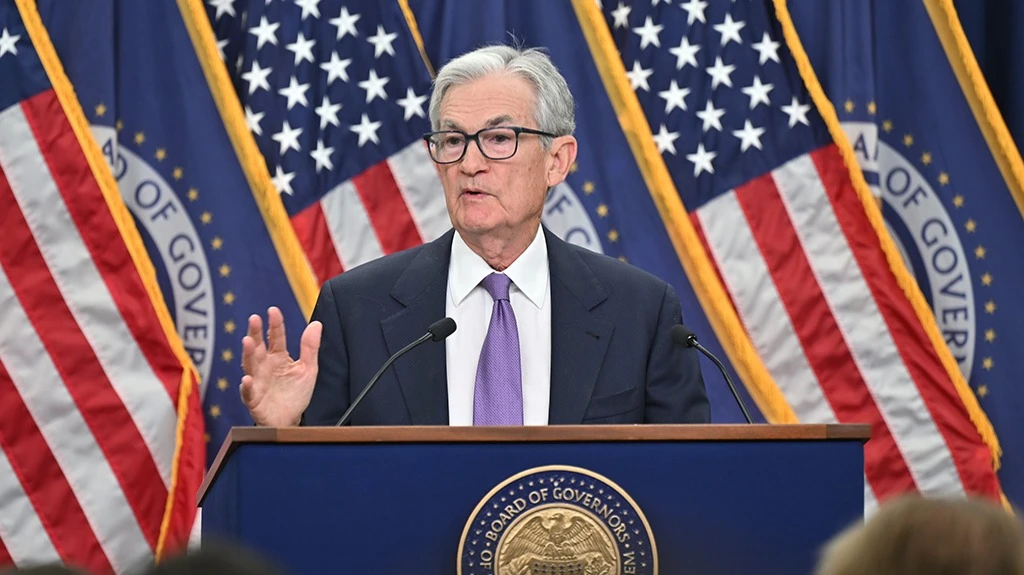
The U.S. Federal Reserve lowered its key rate by 0.25 percentage points to a range of 3.5% to 3.75%. This was the third consecutive round of monetary policy easing this year after a similar decision in September and October.
Details
The Federal Open Market Committee of the US Federal Reserve System (FOMC) reduced the key rate by 25 basis points. It now stands at 3.5-3.75%, follows from the message on the regulator's website. This decision was made following a two-day meeting on December 9-10. The reduction fully coincided with the expectations of economists and market participants.
"Economic activity is growing at a moderate pace. Job gains have slowed this year, and the unemployment rate has risen slightly since September. (...) Inflation has risen from earlier in the year and remains somewhat elevated," the Fed said in a press release. "The Committee seeks to keep employment and inflation at 2 percent as high as possible over the longer term. Uncertainty about the economic outlook remains elevated. The Committee is attentive to risks on both sides of its dual mandate and believes that downside risks to employment have increased in recent months."
CNBC notes that in the Fed's statement, the text of which often largely repeats the previous release, this time the unemployment rate is not called low, as it was at the end of the meeting in October. And Bloomberg noted that the statement includes new language about "the scope and timing of further adjustments to the target range." Previously, the Fed used this phrase to signal a pause in policy easing, the agency points out. In his speech after the meeting, the head of the regulator Jerome Powell said that the Fed is in a "good position" to wait for more clarity on further movement of the labor market and inflation.
The so-called dot plot, which reflects committee members' expectations for the regulator's future decisions, still assumes only one rate cut in 2026 - in similar 25 basis point increments - and only one in 2027.
What else the Fed is predicting
The median estimate of U.S. GDP growth in 2026 has significantly increased from 1.8%, which was assumed in the previous September forecast, to 2.3%. In 2027, according to the Fed's calculations, the economy will add 2% - instead of the previously expected 1.9%. At the same time, inflation next year should be 2.4%, not 2.6%.
Powell said that if the impact of US President Donald Trump's duties is excluded, inflation is already close to the 2% target. He said the effect of trade restrictions should peak in the first quarter of 2026, after which it should subside. The duties will likely prove to be a one-time price increase, the Fed chief said. "Our challenge is to ensure that this is the case," he added.
Fed discord and data shortages
The Dec. 10 decision was the result of a tense balance within the Fed: some heads of regional reserve banks (many of whom do not have a vote on the rate) pushed for continued easing, while others feared the effect it would have on economic activity given inflation is holding above target, Bloomberg noted. In the end, a quarter-point easing was supported by nine council members, with one voting for a sharper cut and two in favor of keeping the rate unchanged, the release showed.
Commenting on these differences, Powell explained that the Fed's twin goals of lowering inflation and maintaining the labor market are now at odds, and called such a situation rare.
The Fed also made its decision in the absence of fresh economic data, a consequence of the government shutdown that lasted all of October and much of November. Official labor market data for November will not be released until December 16. Powell's estimate of employment growth is likely negative.
How the market reacted
Major US stock indices reacted positively to the decision: immediately after the release, the S&P 500 added about 0.2%, the tech-heavy Nasdaq Composite trimmed its morning decline, remaining down 0.2%, and the Dow Jones blue-chip index rose 0.5%. As Powell spoke, all three benchmarks accelerated sharply.
The Russell 2000 index of small-capitalization companies jumped 1.8% to a record.
The dollar index from Bloomberg updated the daily lows, down about 0.4%, the agency reports . The yield of two-year government bonds also approached the lowest levels for the session and is about 3.55%. The yield of ten-year securities fell to 4.14%.
The market now estimates the probability of the next rate cut at the next Fed meeting in January at about 26%, according to the FedWatch trader expectations monitoring tool. 40% expect the continuation of easing in March.
What are the analysts saying?
Fed leaders are likely to find it more difficult to share their plans for monetary policy, given the upcoming change of chairman (Jerome Powell's term will end in May) and the split in views within the regulator, Standard Chartered economists Steve Englander and John Davis noted before the meeting. Their opinion was published by Reuters.
"How markets perceive December's signals regarding future policy is complicated by divided views within the FOMC, inconsistent Fed communication, the impact of the government shutdown on data, the approaching end of Powell's term, uncertainty about the credibility of his successor, and likely changes in the composition of the committee," they wrote. - We believe markets are justifiably skeptical of any announcement given the uncertainty over who will occupy the chairmanship in the coming months."
Context
In October, the Fed also made a rate decision amid the government shutdown. Because of the shutdown, the central bank was left without a full set of statistics on employment and consumer spending, on which it usually relies, including its favorite inflation indicator, the PCE (personal consumption expenditures) index.
PCE data for September were published only in early December. They were below analysts' expectations. The core index, which excludes volatile food and energy prices, rose 0.2% month-on-month and 2.8% year-on-year. The previous index, which was published in September, was 2.9%.
Federal Reserve officials use the Personal Consumption Expenditures (PCE) price index as their primary inflation policy tool.
This article was AI-translated and verified by a human editor