The psychology of the "empty tank": why do gasoline prices scare us more than nuclear war?

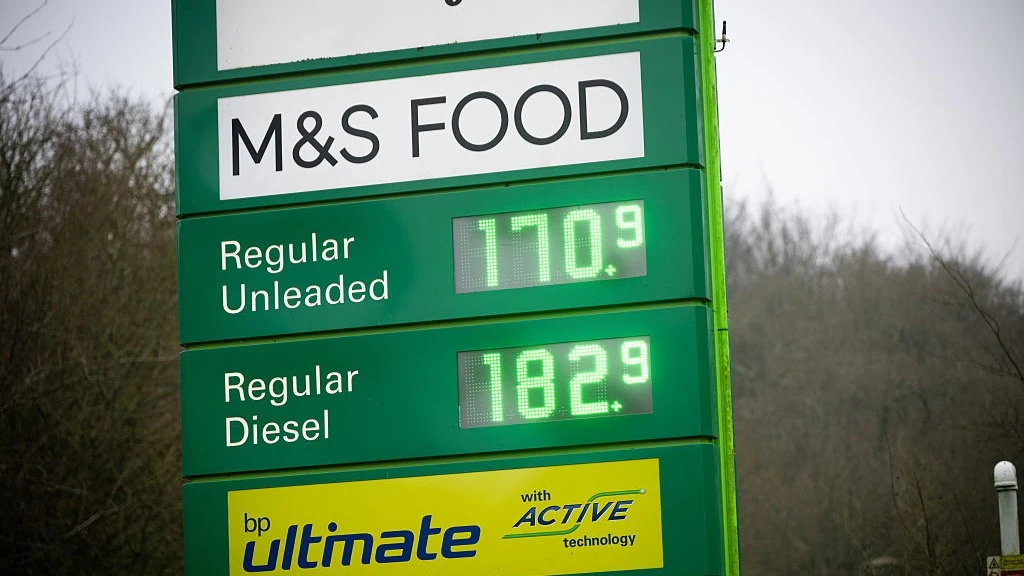
The cost of a liter of 95 petrol in the UK has risen by a quarter since the start of the war. Photo: Finnbarr Webster/Getty Images
Due to the soaring cost of oil in Europe and the United States, prices at gas stations have risen sharply. In particular, the cost of a liter of diesel has risen by about 16% in France since the last pre-war day on February 27. Psychologist Mikhail Tegin explains why, when the cost of a barrel of Brent oil reaches almost $120, our emotions turn on inside in addition to analysis and calculations: we are ready to sell promising tech sector stocks just because it has become 30% more expensive to fill up the car.
Maslow vs. indices: attacking the base
Psychologist Abraham Maslow's pyramid is a hierarchical model of human needs; at its base are basic physiological needs: safety, food, sleep, warmth, and at the top is self-actualization. The essence of the idea is that unless a person has a sense of security and a minimum level for calm survival at the lower levels, his brain will not be able to fully focus on higher-order goals. This is usually not only self-actualization, but any kind of creation at all, including long-term investment.
That is, the need for security and resources is the foundation. In modern society, fuel is freedom of movement, warmth and access to food. When the price of gasoline rises, the brain reads this as a threat to survival. The brain turns on the fear system - the limbic system. It's located in the very center of the brain and evolved in humans a long time ago. It also suppresses the logic system - the prefrontal cortex - during stress and fear. The investor begins to perceive his portfolio as an "excess" that must be sacrificed to save the "base".
Here we enter the territory of meanings, where oil and gas provide not just mobility, but are generally associated with possibilities. Having a full tank gives the illusion of control over one's life in an unstable world. Therefore, in this case we sell assets not because they have become bad, but because the subconscious calls to protect the tank, not the deposit - so the investor is trying to buy peace of mind.
Here we are also entering the territory of subjective value, where we can substitute concepts: we confuse "price" and "value". If the price of gasoline has increased by a dollar, but its subjective value for a panicked brain has increased many times over. Because of this, we can literally feel the "itch" of discomfort in our bodies, and sell shares in large companies for the opportunity not to feel it.
"The Focus Effect": the trap of narrow focus
This is also where the focusing illusion, described by the famous Nobel laureate Daniel Kahneman, comes into play. The Ma of this phenomenon is simple: nothing in life matters as much as it seems to us at the moment we think about it. So right now, the price of gasoline is what we see in the media headlines, on the scoreboard on the way to work or the store, so we unwittingly focus on those numbers. At that same moment, the cost of filling up a tank overshadows all other real economic indicators: companies' earnings growth, dividend payments, other asset prices, and long-term trends. We have already exaggerated the impact of one factor on our entire well-being.
This effect is confirmed by data from the University of Michigan Surveys of Consumers. Their long-term studies show a very strong direct correlation between consumers' expectations of inflation and stock market dynamics precisely through rising gasoline prices, not through real Fed reports. In other words, for the average investor, gas station prices are the "people's indicator" of inflation. If it rises, the person subconsciously "devalues" their portfolio in their mind, even if oil stocks rise in the process. So they are given a dependence on oil prices.
Learned helplessness and aggression
Soaring fuel prices is a situation in which, as we noted just above, control is completely lost. Or is felt to be lost. Lost control is a feeling of helplessness, almost as powerful as fear or panic.
If, however, the investor is faced time after time, as in recent months, with negative external factors that he or she cannot influence, such as the AI crisis, now the war in Iran and rising fuel prices, he or she may develop learned helplessness. This is Martin Seligman's concept, according to which, a person under prolonged stress falls into decision-making paralysis, i.e. cannot make decisions. In our case we can talk about investment paralysis. The brain concludes: "No matter what I do, external forces will take away my money anyway".
In order to regain a sense of power over the situation and the market, the investor begins to "clean up" wherever he or she can - for example, by randomly recording losses just to do something. Inaction in such situations seems to only further reinforce the feeling of helplessness and "worsen" the market situation itself.
Psychoanalysis says that helplessness breeds latent rage. But we can't yell at the price of oil or stop a military conflict - that anger energy shifts to another available object. It can be anything or anyone: family members, coworkers, or our own investment portfolio. It is under the influence of this mechanism that chaotic sell-offs occur - it is a self-destructive way to regain our subjectivity: "Let me lose money, but it will be my decision, not someone else's will or the result of external forces beyond my control.
How do you keep an empty gas tank from draining your investment account?
There are many techniques in psychology and therapy that can help you cope with strong feelings of fear, panic and helplessness, and with it, regain a sense of control over at least your life. Here are some of them.
The "math grounding" technique. Try doing an easy calculation: a $1 per gallon increase in gasoline prices at average mileage will cost you an extra $50-80 per month. Selling stocks on emotion could cost you several hundred or thousands in lost profits. Is it worth saving $80 at the cost of thousands...?
Value Sharing. Gasoline is always also a matter of everyday expenses that you incur on a regular basis. That is, you have already experienced previous crises in the energy market. So you already have at least an intuitive understanding of how to deal with difficult situations. Remember this.
Separation of accounts. In continuation of the previous point, you can allocate from your investment funds the amount that you will make an inviolable reserve, and let the second one be spent on emotions and attempts to sell-buy now, just to do at least something. This is essentially creating a "peace of mind buffer," but you don't want to change your entire investment strategy for 10 years.
"Reframing the gas station," or changing your point of view. Remember that you don't actually have to see a check from the gas station only as a "loss." There are always unforeseen costs in business, and from this perspective, rising gasoline prices are a temporary operating cost, meaning you can look at them as a "volatility tax." This moves the event from the category of "catastrophe and safety hazard" to "within normal limits".
In lieu of a conclusion
The most expensive mistake an investor can make is trying to solve a short-term problem (rising fuel prices) with a long-term instrument - stocks or other securities. Therefore, it is important to realize that the fuel tank will be empty one way or another, so it will fill up again dozens of times, as it has in the past. And it may be harder and more expensive to buy assets sold on panic. Until proven otherwise, rising fuel costs are a temporary discomfort and should not dictate the trajectory of your financial freedom.
This article was AI-translated and verified by a human editor