The S&P 500 Index declined for the second week in a row for the first time since June
Despite the political risks of recent weeks, the U.S. stock market remains relatively close to record highs

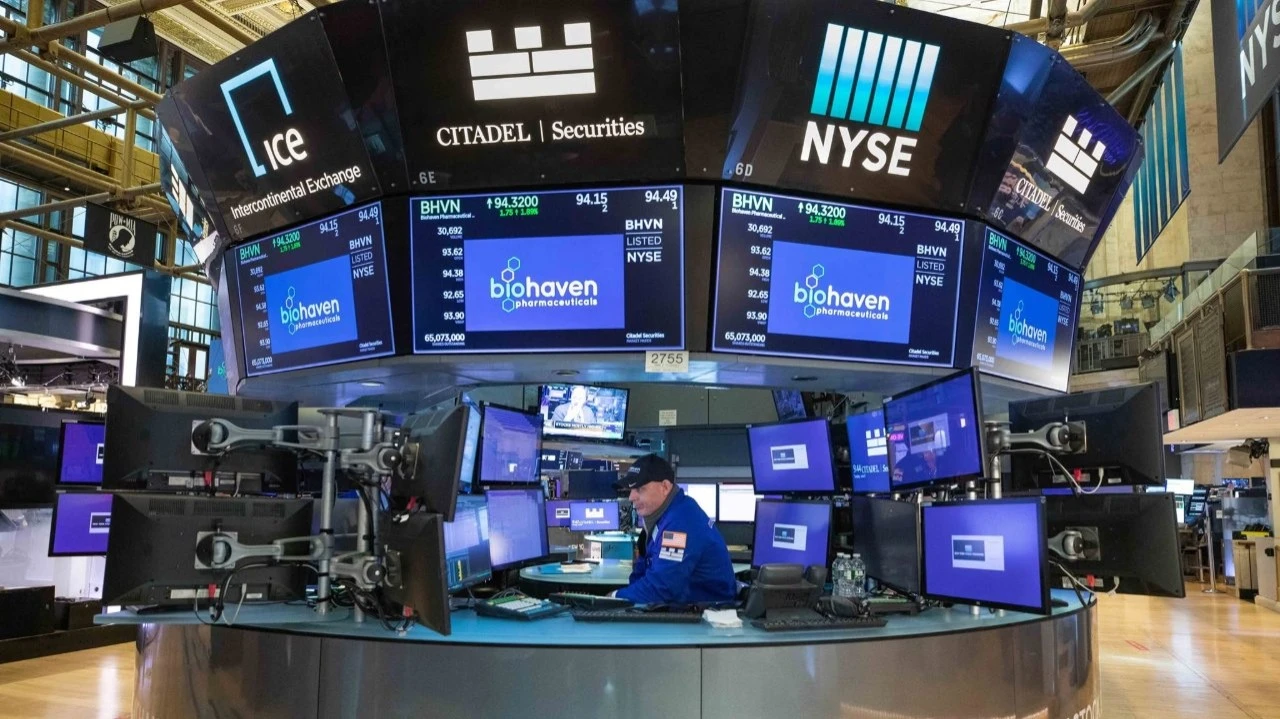
U.S. stocks failed to fully recover after Tuesday's strong drop / Photo: X/NYSE
The broad market index S&P 500 declined for the second week in a row: this happened for the first time in more than six months. At the beginning of the shortened trading week, U.S. stocks fell sharply due to the decision of Donald Trump to impose trade duties against European countries because of Greenland. But already on Wednesday, when the U.S. president changed his decision, the securities turned to growth. This week is a good reminder to investors to ignore political headlines from Washington, some analysts say.
Details
- The S&P 500 broad market index rose a slight 0.03% on January 23, closing at 6915.6 points, but ended the week down about 0.4%. The index posted negative results for two consecutive weeks for the first time since June, Bloomberg noted.
- The index of the technology sector Nasdaq Composite added 0.28% on Friday, reaching 23,501.24 points. The growth of the index was supported by shares of Microsoft, Nvidia and AMD. Nevertheless, at the end of the week, the Nasdaq lost less than 0.1%, also showing a decline for the second week in a row.
- The blue-chip index Dow Jones Industrial Average fell 0.58% on the day, closing at 49,098.71 points. The index was under pressure due to the fall of Goldman Sachs by 3.7% and Intel, whose securities collapsed by 17% after a weak forecast. For the week, the Dow fell by 0.5%.
- Mark Brent crude oil jumped 2.8% to $65.9 a barrel and WTI jumped 2.9% to $61.07. Prices rose as traders considered the possibility of U.S. military action in Iran and a strong winter storm in the U.S., Bloomberg writes.
- Gold reached historic highs, reaching $4990 per ounce. Silver exceeded $100 for the first time.
What influenced the stock
U.S. stocks have rallied since Wednesday - after U.S. President Donald Trump slapped duties on imports from eight European countries scheduled to begin Feb. 1 and announced that he had reached a "framework agreement on Greenland" with NATO Secretary General Mark Rutte. At the beginning of the week, the threat of duties provoked the flight of investors from U.S. assets and the launch of sentiment "sell American" - it was especially noticeable on Tuesday, writes CNBC (on Monday there was no trading due to the holidays).
On Friday, shares of Nvidia and Advanced Micro Devices rose 1.5% and 2.3%, respectively, after CNBC reported that Nvidia CEO Jensen Huang is preparing for a visit to China. This supported investors' optimism. At the same time, Intel shares collapsed by 17%: the company published a weak forecast for the first quarter.
Consumer sentiment in the United States rose to a five-month high in January as Americans became more optimistic about the economy and their financial situation. According to the University of Michigan, the final value of the consumer sentiment index for January totaled 56.4 points, up 3.5 points from December and exceeding the preliminary estimate. The index was above all forecasts in a Bloomberg survey of economists.
What the analysts are saying
"This week's market dynamics are an important reminder for investors not to let political headlines out of Washington influence a portfolio, and should use moments of news-driven weakness as an opportunity," Alexander Giuliano of Resonate Wealth Partners told Bloomberg.
Despite the political risks of recent weeks, the U.S. stock market remains relatively close to record highs, Daniel Scally, head of market research and strategy at Morgan Stanley Wealth Management, noted in an interview with Bloomberg. "If these clouds dissipate, positive expectations for key themes of the year, such as the effect of AI, deregulation and other market-friendly measures ahead of the midterm elections, could come to the fore again," he added.
"The stock market is consolidating," Louis Navellier of Navellier & Associates told the agency. - Outsiders are starting to catch up with the market, and leaders are partially losing ground".
This article was AI-translated and verified by a human editor