Three ingredients for revolution: will Iran's protests lead to regime change?

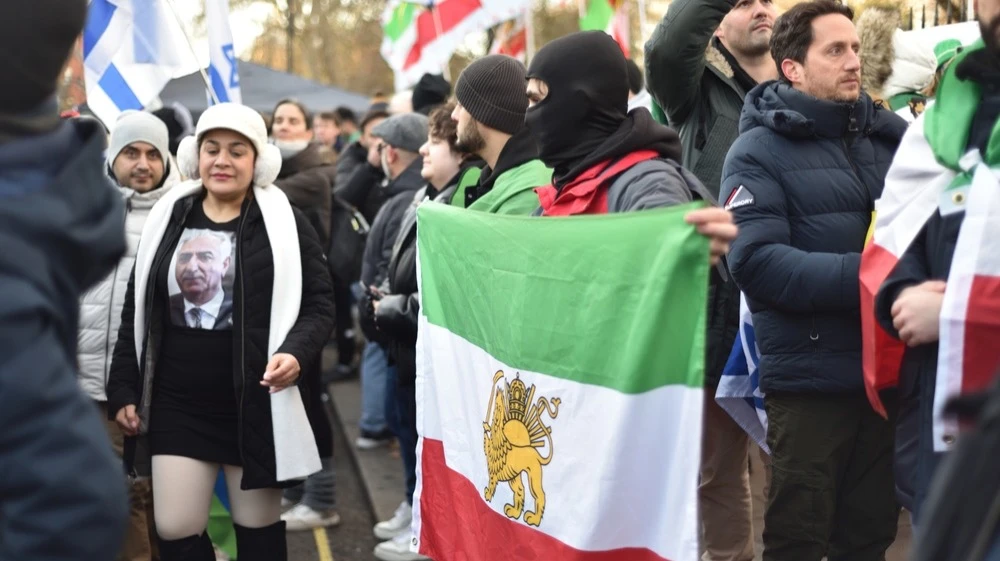
Anti-government protests have been going on in Iran for several weeks. Demonstrations are also held near Iranian embassies in other countries. Photo: Donovan Elmes / Shutterstock.com
The protests in Iran, now in their third week, are among the largest in the history of the Islamic Republic. But is the current wave of discontent capable of leading to regime change? Ruslan Suleymanov, an orientalist, discusses this issue.
A new scale
A distinctive feature of the current demonstrations is the unprecedented violence with which the authorities are suppressing the protest. According to the Norwegian-based human rights organization Iran Human Rights, as of January 14, at least 3,428 people have become victims of the protests, and thousands have been injured. At the same time, the London-based international television channel Iran International reported that at least 12,000 people were killed in the demonstrations, the majority on January 8-9.
Iran has never before faced such huge numbers. For example, 72 people were killed during multimillion-dollar rallies to overturn the results of the 2009-2010 presidential election, and 72 people were killed during protests under the slogan "Woman. Life. Freedom" protests against state interference in private life between September and December 2022 killed 476 demonstrators.
Since January 8, the authorities of the Islamic Republic have been applying a total information blockade. Neither the Internet nor telephone communications are working in Iran, making it difficult to get reliable information about what is actually happening in the country. Individual state agencies, such as Tasnim or Fars, have been broadcasting official narratives that the country's "fight against terrorism continues."
In addition, state media occasionally report mass rallies in support of the current regime, where participants condemn the policies of the United States and Israel. These two countries are portrayed as the main instigators of the unrest. And the Iranian authorities present the fight against the protests as a fight against external enemies.
As in all previous instances where large-scale protests have engulfed Iran, the question inevitably arises as to how sustainable the current regime in power in the Islamic Republic is and how likely the protesters are to win.
This time, talk of the end of the regime has become especially relevant due to the very broad composition of the participants in the demonstrations. Unlike previous unrest, now people of all generations, women, middle-aged men, small and medium-sized business owners, are taking to the streets. The latter have been particularly affected by the sharp collapse of the national currency, the Iranian rial: its price against the U.S. dollar has fallen by half in six months. By the end of December, the dollar was worth 1,470,000 rials on the black market. At the same time, other problems in the economy are accumulating - inflation in December exceeded 42%. At the same time, the authorities do not know how to respond to the requests of protesters to improve living conditions in the country. "There is nothing I can do," Iranian President Massoud Pezeshkian admitted in December, shortly before the protests began, commenting on the situation in the country's economy.
After large-scale unrest in 2019 due to rising gasoline prices, Iran's leadership was able to adjust pricing policy, after the demonstrations of 2022 removed the vice police from the streets. But how to overcome the collapse of the national currency and high inflation is still an open question.
So far, the only thing the Iranian government has offered is targeted payments of up to 10 million rials (that's $7-8) per person. This is not "real" money, but checks that can only be used at selected grocery stores. And this is clearly not something that will solve people's problems and satisfy the protesters.
The Shah's heir: does he have a plan?
Meanwhile, the key problem of mass demonstrations in Iran, as in all previous years, can be called the lack of a clear leader, a coordinated program of action and clear demands of the protesters.
The protests are spontaneous, and everyone who takes to the streets has a different vision of what Iran should be like in the future. For some, economic reforms are enough; for others, competitive elections are enough; others want a complete change of power and the elimination of the theocratic regime.
The current protests, as before, have no leader. But in recent weeks, protesters have begun to "raise the banner" of Reza Pahlavi, the heir to the last Shah of Iran. He himself has been publicly calling for demonstrations on the X network.
However, to say that all of Iran took to the streets for the return of the Shah's monarchy would be a great exaggeration. Many people were disappointed in Pahlavi last year, when he supported the Israeli bombing of Iran, which, according to the Islamic Republic's authorities, killed 1,100 people.
In addition, the Crown Prince has no real influence on the situation in the country. The maximum he can do at the moment is to call on protesters to take to the streets and seize administrative buildings. But Pahlavi has not formulated what to do next.
And the leadership of the Islamic Republic is taking advantage of this, suppressing the protest and presenting it as a counter-terrorist operation. Thus, Iranian Foreign Minister Abbas Araghchi said on Wednesday that "terrorists shot people" because they wanted to "drag him(US President Donald Trump - ed.) into this conflict." As such, any intervention by the US or Israel would allow Iranian authorities to further marginalize the protest.
Will the U.S. intervene?
However, it is still unclear to what extent US President Donald Trump intends to get involved in the situation inside the Islamic Republic. Even earlier this week, it seemed that the impending intervention of the states was obvious. Trump addressed protesters in Iran on January 13, urging them to seize government offices. "I have canceled all meetings with Iranian officials until the senseless killing of protesters stops. Help is on the way," he wrote on the Truth Social network.
And the next day, Reuters reported, citing two European officials, that the United States could launch an operation against Iran in the next 24 hours. But nothing happened, and Trump claimed the killings of protesters in the Islamic Republic had "stopped". And earlier he claimed that Tehran had requested the resumption of talks on the nuclear program.
All this clearly indicates his doubts about the need to intervene in the situation. The current White House master, known for his rapid demonstrative actions, is unlikely to go for a full-scale ground operation now.
But without a ground invasion, Washington is unlikely to achieve any tangible results in Iran. Last year's 12-day Iran-Israel war showed that air strikes alone are not enough for regime change. Moreover, it may cause a backlash - a rallying around the flag, when the country's population perceives an external invasion not just as a threat to the regime, but to the whole of Iran.
In parallel, the countries of the region, mainly the Arab monarchies of the Persian Gulf, are clearly not enthusiastic about the idea of a new regional war. Last year's events, when the territory of Qatar, where the U.S. military base El Udeid is located, was subjected to an Iranian attack, were a serious test for the Arab world.
Now, as the AFP news agency reported, citing sources, Saudi Arabia, Qatar and Oman have managed to convince Trump to "give Iran a chance."
From protest to protest
The experience of the 1979 Islamic Revolution has clearly demonstrated that overthrowing the regime in Iran requires the unity of at least three key components: the clergy, the bazaar (the traditional commercial and business layer of society), and the political Xi.
Today's clergy in the Islamic Republic, although not united on a number of issues, are not ready to renounce the 1979 principle of velayat-e faqih ("rule of the lawgiver", which implies that power is concentrated in the hands of the spiritual leader) and swear allegiance to someone else.
The Iranian bazaar, which under the Shah's rule was almost an autonomy of numerous merchants, is now under the serious control of the Islamic Revolutionary Guard Corps.
Finally, all political forces inside Iran that criticize the authorities (usually referred to by the generic term "reformists"), demand economic liberalization or, for example, rapprochement with the West, operate in one way or another within the framework of the Islamic Republic and do not advocate its liquidation.
Thus, without a unifying figure, which was Ayatollah Ruhollah Khomeini in 1979, and without consolidation of Xi forces inside Iran, we cannot expect a new revolution in the country.
In any case, mass protests, even if suppressed now, could erupt at any moment with renewed vigor and become even larger than they are today. Without sweeping political and economic reforms, the Islamic Republic will be in a permanent state of turbulence from one wave of violence to the next.
But it is unlikely to spell the end of the regime.
This article was AI-translated and verified by a human editor