Alta Banka, a bank popular among Russians in Serbia, has had its license revoked. Where can they open an account?
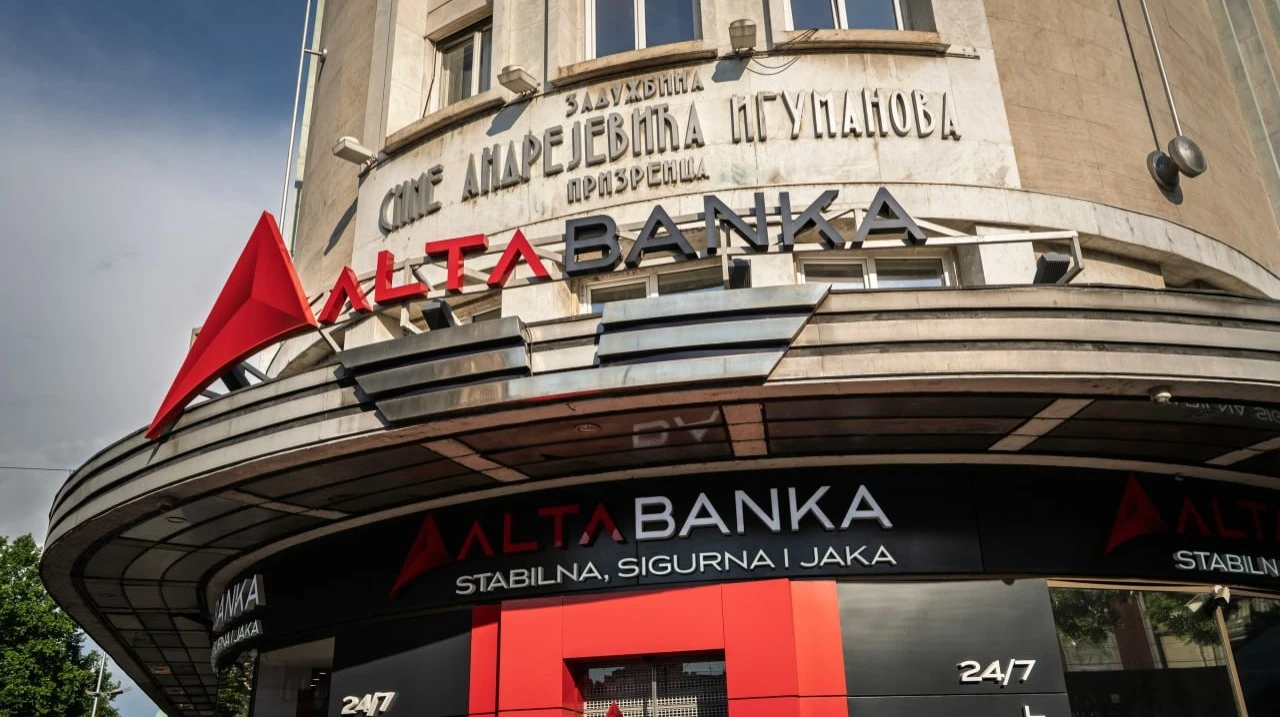
Russians made up the majority of Alta banka’s individual customers, according to the Serbian publication Nova Ekonomija. After the bank’s license was revoked, many customers lost access to their personal funds, which they had planned to use for everyday needs. Photo: BalkansCat / Shutterstock.com
Alta banka, one of Serbia’s largest and fastest-growing banks, had its license revoked on October 30. It was popular among Russians who had moved to Serbia. Oninvest explores what might have led to the revocation of the license and what the consequences will be for customers.
Why was the license revoked?
Alta Banka ranked ninth among banks operating in Serbia in terms of net assets. In 2025, it moved from the small-bank category to the medium-bank category after exceeding the 2% threshold of the banking sector’s total assets. As of the end of July 2026, its market share stood at 2.9% in terms of net assets, according to Forbes Srbija. The publication noted that the bank handled payment processing for state-owned enterprises and institutions, including the Serbian Ministry of the Interior, EPS, Air Serbia, and Parking Servis.
The National Bank of Serbia stated in an official announcement that it had taken measures to improve Alta banka’s liquidity situation. However, during an audit, it found that the bank’s financial position had deteriorated over the “previous period” and that there is a likelihood of further deterioration.
"This has posed a threat to the interests of the bank's depositors," the statement said.
As a result, the regulator decided to revoke the license.
What was happening with the bank?
The regulator's statement does not provide details on what exactly prompted its concerns.
According to the bank’s financial statements reviewed by Oninvest, the main sources of funding for the bank’s operations were deposits and other financial obligations to customers. These accounted for nearly 80% of liabilities as of the end of 2025—154.4 billion dinars ($1.55 billion). Over the first nine months of this year, this figure rose further—by 11.4%, to 172 billion dinars—and exceeded 80%.
It is interesting to note how Alta banka’s asset structure has changed over the past year. As of the end of 2025, they totaled 194.1 billion dinars (approximately $1.95 billion), of which 90.5 billion—that is, nearly 47%—consisted of cash and balances with the central bank.
In the first nine months of 2026, assets grew by 10.5 percent, to 214.5 billion dinars. But the changes in their structure were more significant.
Cash and balances with the central bank fell to 88.3 billion dinars, now accounting for just over 40% of total assets.
Meanwhile, the volume of loans and receivables from customers has increased by 39% since the beginning of the year, to 105.9 billion dinars. They now account for nearly half of Alta banka's assets.
At the same time, the share of liquid assets in the bank's liability coverage fell from 65.7% to 55.5%.
In May of this year, Forbes Srbija magazine noted that Alta had shown the highest growth rate in the number of corporate accounts opened in the country’s banking sector over the past few years. From 2020 through the end of 2024, the number of such accounts at Alta banka grew by a staggering 1,223%, reaching 15,552. By the end of April 2026, their number had reached 25,538. Thus, in less than a year and a half, growth totaled 64.2%.
The bank itself reported a 29% increase in the number of retail customers and a 19% increase in the number of corporate customers in 2025.
Alta Banka actively attracted funds from individuals—at rates above the Serbian market average. In May 2026, the bank raised interest rates on time deposits from 5% to 5.5% in dinars and from 3.8% to 4.2% in euros. At the time, this was one of the most attractive deposit offers in Serbia. In October, as part of a promotional campaign, the bank offered to deposit funds at 6.1% per annum in dinars for 12 months and at 4.2% in euros for six months. According to data from the National Bank of Serbia, the weighted average interest rate on new dinar deposits for individuals in September 2026 was 5.1%, and for foreign currency deposits, it was 3.4%.
At the same time, however, the bank’s financial performance deteriorated. In the first half of 2026, the bank’s net profit fell by approximately 80% to 244.4 million dinars. In the first nine months of the year, however, it increased to 542 million dinars. This is 61.2% less than a year earlier.
It is also noteworthy that Alta banka had planned to expand as recently as this past spring. In April, Austria’s Raiffeisen announced that it intended to enter into an agreement with Alta Group (the bank’s parent company) to sell it four Addiko subsidiary banks—in Serbia, Montenegro, and Bosnia and Herzegovina. On November 1, Raiffeisen announced that it now expects to retain all of Addiko’s subsidiary banks, including the one in Serbia, following the revocation of Alta banka’s license.
Judging by the financial statements, the bank’s problems did not begin last year. Liquidity ratios at the end of 2025 exceeded the National Bank’s requirements: the Liquidity Coverage Ratio (LCR) stood at 150%, and the Net Stable Funding Ratio (NSFR) at 190%. By June 30, 2026, they had fallen to 140.37% and 185.03%, respectively. The LCR indicates the extent to which a bank can cover expected net outflows of funds over a 30-day period under a stress scenario, while the NSFR reflects the availability of stable sources of funding. In any case, however, both ratios significantly exceeded the required threshold.
The bank disclosed this information publicly twice a year, which is why it was not included in the third-quarter financial statements. Under reporting requirements, Alta banka was required to submit figures for these two ratios to the National Bank by October 20, 2026. A little more than a week after that deadline passed, the regulator announced the revocation of the bank’s license.
What will happen to customers' deposits?
The Deposit Insurance Agency will serve as the bank’s insolvency administrator. It is required to ensure the repayment of insured deposits—up to €50,000 per depositor at a single bank, regardless of the number of accounts or the currency of the deposit—within seven days.
Why is the news about the revocation of Alta Banka's license important for Russians living in Serbia?
Russians made up the majority of the bank’s individual customers, according to Alta banka employees quoted by the Serbian publication Nova Ekonomija. According to the publication Nedeljnik, Alta banka had 66,481 active clients in 2025: 56,390 individuals and 10,091 legal entities.
Alta Banka's banking operations have been suspended. Some customers are unable to withdraw money from their accounts. As a result, many expats have found themselves unable to access their personal funds, which they had planned to use for everyday needs—such as buying food and paying bills, Olga A., a resident of Serbia, told Oninvest.
“Almost all of my Russian acquaintances (in Serbia) had accounts and cards at Alta Banka, because that bank was practically the only one that opened accounts for Russians without a residence permit or permanent residency,” she says, adding that some Russians also used the bank as their primary bank for their businesses.
“Many people used Alta Banka to transfer money from the sale of real estate in Russia to Serbia. That’s why many of them had more than the state-insured amount sitting in their accounts there,” explains Oninvest’s source.
Depositors will be able to recover larger amounts only through Alta Bank’s bankruptcy proceedings. To do so, the law requires them to file a claim to have their claim as a depositor-creditor included in the registry of claims against the financial institution.
What alternatives do Russians have?
Under Serbian law, a person legally residing in the country who does not have another payment account is entitled to open a basic payment account. Every bank must make a decision regarding each potential customer within 10 business days. The bank must issue a debit card for such an account and conduct basic payment transactions in dinars through it. The maximum monthly service fee is 150 dinars (about €1.30).
Following the announcement that Alta banka’s license had been revoked, some of its Russian clients are already trying to open accounts at other Serbian banks.
According to data from the “Bank Accounts in Serbia” project, as of November 1, the most promising option for people without a residence permit is API Bank. The project’s database records 25 applications to this bank from Russians: in 13 cases, the bank opened an account, while three applicants were denied. Nine applications are currently under review.
The bank itself confirms that it is possible to open an account without a residence permit, using only a passport and proof of entry into the country; however, it may additionally request a document showing your residential address and proof of the source of funds.
Another option is Poštanska štedionica, one of Serbia’s largest banks. However, it is more difficult for a non-resident to open an account there: overall statistics from the “Bank Accounts in Serbia” project show that out of 74 applications from Russian citizens without a residence permit, the bank opened accounts for only 21, 12 more are pending review, and 40 applications were rejected, according to data from the “Bank Accounts in Serbia” project.
Russians with residence permits are turning their attention to Adriatic Bank. According to users of the “Bank Accounts in Serbia” group, out of three applications submitted to the bank, only one has resulted in an account being opened so far, and one was denied. Another application is still under review.
UniCredit Bank Srbija also allows non-residents to open accounts. According to data from “Bank Accounts in Serbia,” Russian citizens currently living in Serbia are submitting applications to this bank. However, there are no results of the application review yet.
Who owns the bank?
Its owner is Davor Matsura, a Serbian businessman. The publication Nova.rs reported that he was detained on the morning of November 2. According to Klix.ba, Serbian police carried out the detention at his home, where a search was also conducted.
The businessman's career began in 2008 with a small currency exchange office in the Zemun district of Belgrade. Later, he expanded his business interests to include banking and payment services, real estate, and retail.
Alta Banka is known to be close to the Serbian Progressive Party of former President Aleksandar Vučić, according to the publication Danas. The party was in power for more than 14 years and lost the parliamentary elections in October 2026. Vucic himself resigned from the presidency on September 27.
According to a BIRN investigation, Macura Danica Park, a company owned by Davor Matsura, held land parcels that were subsequently transferred to Nikola Petrović, who is said to be a close friend of former President Vučić. In addition, Matsura invested in the Vista Rica fund, co-founded by Tatjana Vukić, a member of the Presidium of the Serbian Progressive Party. BIRN claims that she is in a relationship with the younger brother of former Serbian President Andrej Vučić. According to the publication, he also invested in the fund, as did other businesspeople associated with the ruling party.
The Financial Times reported that after the defeat of Vucic's Serbian Progressive Party in the parliamentary elections, Matsura tried to flee to Moscow. But he denied this.
He also commented on the revocation of Alta Bank’s license. “What happened this weekend was not a bank failure,” the businessman told the FT. “It was a failure on the part of the regulator and the political class—both the outgoing and the incoming administrations. They had the legal tools, the time, and the responsibility to stabilize a systemically important bank, but instead they chose the most destructive measure possible—in the midst of a deposit run that they themselves had allowed to begin.”
This article was AI-translated and verified by a human editor