Axios: AI executives clash over surrendering human free will
Leaders of major AI labs disagree over whether to entrust AI systems with critical decisions in the future

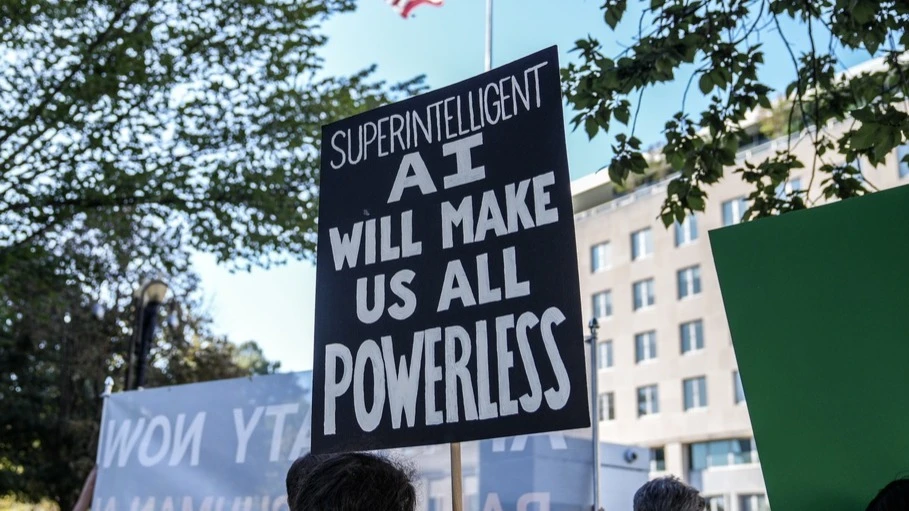
Critics say ceding control to superintelligence would gradually erode human free will / Photo: HASAN AKBAS / Shutterstock.com
Executives at leading AI developers are increasingly pushing back against the idea that humanity should gradually cede some decision-making power to “superintelligence,” Axios reports. The view is common inside Anthropic and is seen as a reflection of CEO Dario Amodei’s worldview, Axios notes.
Details
The debate has intensified as leading AI labs develop models that even some of their own employees consider too powerful to release publicly, Axios reports. People in the industry expect Anthropic to confront these questions first because it is at the forefront of AI development, according to Axios.
Some Anthropic employees have coalesced around the view that humanity will safely hand over authority to superintelligent systems and, in many cases, should do so instead of fighting to retain control, people familiar with internal discussions told Axios. Proponents point to self-driving cars. Once the data shows that autonomous vehicles are safer than those driven by people, they argue, it makes sense for people to drive much less or stop driving altogether.
Executives at rival companies, meanwhile, are increasingly rejecting the idea that people will give up their free will, Axios writes.
“I notice a particular form of lazy thinking within the AI industry, which is that ASI is inevitable and the only problem to solve is how to do it safely, but there is much more at stake,” Meta AI chief Alexandr Wang wrote on X on Sunday. “We should not be okay with a ‘handover’ of society to AI. We should endeavor ourselves to build a technology which delivers a positive future for humanity, where all humans have greater agency and empowerment.”
“People should always be in control of the future. OpenAI is against the notion that it would be acceptable for people to be relegated to a role of doing things that ‘AI systems think makes sense to reward in humans,'” OpenAI CEO Sam Altman wrote on November 4. He stressed that the requirement to keep people in control “should ultimately constrain AI progress.”
Elon Musk recently reiterated a view he has held for more than a decade. Once superintelligence arrives, humans will be “like pet Labradors.” He has also backed technology that would augment the human brain with computing power to help people retain a competitive edge.
Background
Neither Wang nor Altman named any company advocating for a transfer of control. Anthropic founder Dario Amodei, however, has said repeatedly that once AI systems far surpass human intelligence, it will be preferable to hand over decision-making to them in situations where lives are at stake, Axios notes.
In “life-critical, safety-critical cases, we really want to turn it over” to AI, Amodei said in a February interview with the New York Times. He added that society would simply need time to adapt.
In an interview with CBS that same month, Amodei said adversaries might eventually acquire fully autonomous weapons and that such weapons “may at some point be needed for the defense of democracy.”
In November 2024, Anthropic’s CEO said the traditional arrangement in which a professor supervises graduate students could disappear. “The AI systems will be the PIs, will be the leaders, and they’ll be ordering humans or other AI systems around,” he said.
In his 2024 essay “Machines of Loving Grace,” Amodei described one possible future economy in which superintelligent AI distributes resources based on “what the AI systems think makes sense to reward in humans.”
An Anthropic product vision slide from several years ago, made public in litigation, described the company’s “vision for a better world” as a “utopia ruled by god in a box.”
At the heart of Anthropic’s corporate culture is the belief that the company and Amodei himself know what is best for the world, the Washington Post reported earlier in November, citing sources.
In podcasts, interviews, and articles, Amodei has also stressed that there will be many situations in which people will want to stay in control, even if they make worse decisions than machines, Axios notes. In September, the Anthropic CEO publicly called on the industry to slow the development of its most powerful AI models to reduce the risk of “catastrophic harm.”
An Anthropic spokesperson told Axios that Amodei has repeatedly advocated publicly for keeping people in control of AI and that the company trains its Claude chatbot to respect human oversight.