Crypto companies want to capitalize on the gold market. What are the risks of these "digital mines"?

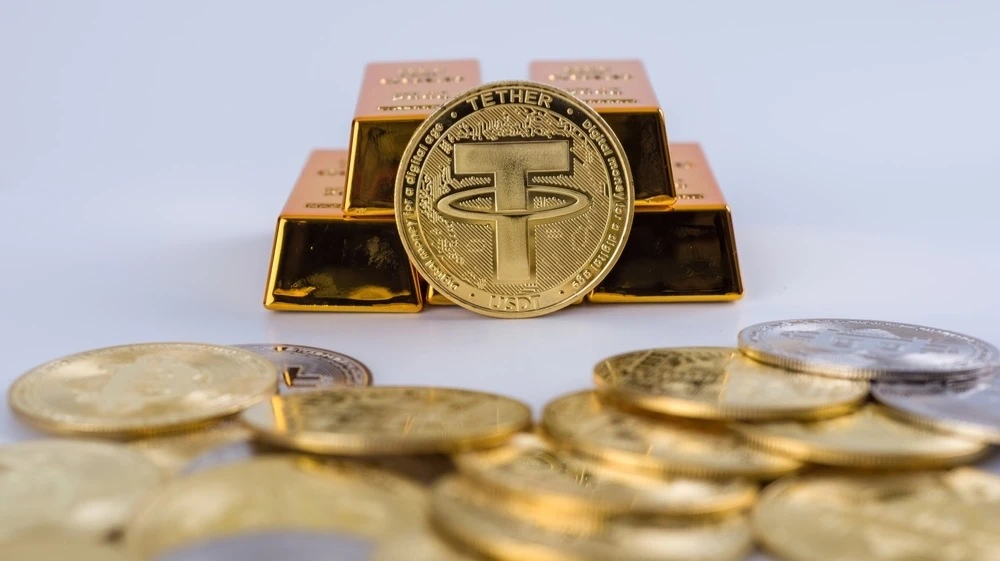
The price of gold has risen by about 60% this year, and such a high result has attracted many players to the market - from ordinary investors to inventors of clever schemes trying to capitalize on the gold boom. The cryptocurrency market, which has been going through difficult times in recent weeks, has also decided to capitalize on the most real and valuable asset in the world's history.
Cryptogold
One of the top buyers of physical gold this year has been Tether, a company that issues the USDT stablecoin, which is pegged to the dollar and has a capitalization of nearly $185 billion, according to CoinMarketCap.
Its CEO Paolo Ardoino in May called gold a "natural bitcoin," thus inverting the phrase "digital gold," which is sometimes used to refer to bitcoin. In recent months, Tether has been in talks to invest in gold mining companies, the Financial Times reported in September.
USDT is backed by U.S. Treasury bonds. But Tether has another cryptocurrency, Tether Gold (XAUT), issued in 2020. The token is equal to one troy ounce of gold and, according to Tether, is backed by bullion that is stored in Switzerland. The tokens can be exchanged for them.
Assuming that Tether reported 116 tons of gold in its reserves at the end of September, the company is "the largest holder of it besides central banks," the FT quotes a report by analysts at Jefferies. It has about as much gold as smaller central banks, for example, South Korea, Hungary and Greece.
It was able to accumulate such reserves, among other things, due to large-scale buying of gold this year. This has added a source of demand that did not exist before and, apparently, contributed to the rise in the price of the precious metal.
According to Jefferies estimates, in Q2 and Q3 Tether bought more gold than any other central bank individually - 24 and 26 tons, respectively. By comparison, the second place in these two periods was taken by the central banks of Poland (with 19 tons in Q2) and Kazakhstan (with 18 tons in Q3), according to the World Gold Council.
In Q3, Tether's gold purchases accounted for nearly 2% of total demand and were equivalent to nearly 12% of central bank purchases. In the last two months, Tether's aggressive purchases likely led to a short-term supply contraction and "influenced market sentiment, which in turn may have attracted speculative cash flows," according to Jefferies.
The price of an ounce of gold reached an all-time high of $4381.5 in trading on October 20.
The amount of gold in Tether's reserves at the closing price on Friday, November 28 - $4239.4 per ounce - should be valued at $15.8 billion.
Jefferies suggests that by hoarding physical gold, Tether plans to make it popular to trade crypto-tokens for it.
Ordinary investors who do not want to get involved with physical metal or futures can now invest in exchange-traded funds backed by it. But those have a management fee, albeit small (for example, 0.4% per annum of net asset value for SPDR Gold Shares, the largest gold ETF), minimum investment thresholds and time restrictions - they are traded during the trading day. Tokens, on the other hand, will be able to trade around the clock, with instant settlement and no extra costs.
But with XAUT's $1.6 billion capitalization , that market is too small.
The only thing left to do, the FT ironically summarizes, is to convince risk-averse investors that the best way to express their fears is to buy blockchain tokens from a private cryptocurrency company licensed in El Salvador that claims to have more than 100 tons of gold bullion in a warehouse somewhere in Switzerland, but no [supporting] audit report."
Tokenize the deposits
The mass entry of non-core investors into the market and the emergence of exotic ways to make money is a standard story after a strong growth, which has already been written about in all the newspapers, says Jon Treacy, publisher of investment newsletter Fuller Treacy Money. As an example, he cites NatBridge Resources, which, instead of mining gold, decided to simply tokenize the deposits.
"NatBridge... unlocks digital wealth without touching a gram of land. Without mining. Without delaying permitting and production. No resettlement. Tokenized underground resources - and NatBridge's mission to turn them into shareholder value"
NatBridge Resources announced Nov. 17 that it has entered into an agreement with NatGold Digital to tokenize mining rights on two of its properties in California. "Digital mining can provide a complementary alternative to traditional mining, strengthening the industry while reducing the burden on the environment," proclaimed Michelle Ash, executive chair of NatBridge's board of directors.
The company calculates that its properties have 122,211 ounces of gold in the ground with a value of $507 million, notes Treacy.
"In this regard, I am reminded of a joke often attributed to Mark Twain: 'A gold mine is a hole in the ground with a liar standing next to it.' Until you work the ore, you never know how productive the mining will be. Until then, everything is just guesswork."
The company, with a market capitalization of 10 million Canadian dollars ($7.2 million), has raised $205 million in token bids for land it doesn't even intend to develop, notes Treacy: "This is a 'give the people what they want' story. I have no doubt it's going to end badly, but at first the value of the tokens might even go up."
Real asset
"The main allure of gold is the fact that it's protected from all kinds of crap. It's real, durable, heavy, rare, and it's just there [in the vaults]. If the worst-case scenario comes to pass (hopefully it never does), gold will be the only form of money that is accepted everywhere," writes Treacy.
Such a characterization is supported by financial and historical analysis. Economists at Deutsche Bank released a study on long-term investments in October, estimating real returns on various assets over 200 years. Gold's average annualized return was 0.4%. This is higher than that of non-income producing "money under the mattress" (-2% in terms of dollars and -2.8% in local currency, 56 countries were considered), but lower than that of all financial assets. In other words, gold has fulfilled its purpose, for which it is valued - it has retained its value (adjusted for inflation) for a very long time.
The price of gold was fixed for a long time, which did not allow it to bring real income, but for the period from the beginning of the XXI century to 2024 it became the most profitable asset, said Deutsche Bank. The real average annual return over this period amounted to 7.45% - more than, for example, U.S. stocks (5.8%), Germany (3.9%), the UK (3.3%) and government bonds of these countries (0.9, 0.8 and 0.6%, respectively).
The gold price behaves best when central banks fail to take the necessary steps to fight inflation, notes Treacy. The Personal Consumer Expenditure (PCE) index tracked by the Federal Reserve is at 2.9% and the target is 2%.
"Inflation has been hovering around 3% for a year and a half. During that time, the value of gold has doubled as investors don't believe the monetary authorities are serious about beating it," and U.S. President Donald Trump's attempts to influence the Fed are only making matters worse, Treacy writes.
This article was AI-translated and verified by a human editor