Is gold's record fall a possibility? Deutsche Bank allowed the price to rise to $8000
The collapse of precious metal quotations in March-April became the deepest in history

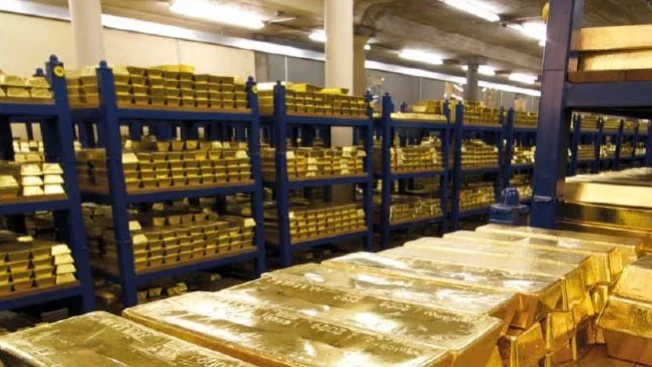
The correlation between gold and equities remains persistently low, according to the World Gold Council / Photo: Bank of England
The collapse in gold prices in March-April was the deepest in history. However, if the central banks of developing countries accelerate the abandonment of the dollar, quotes of the precious metal in the next five years could almost double, said Deutsche Bank. Despite the drawdown, gold can significantly reduce portfolio volatility in the current environment, almost without increasing investment risks, according to the World Gold Council.
What's up with gold prices
Gold futures with the nearest date of execution fell in price last month by 0.7%, ending trading on the last day of April at $4614.7 per troy ounce. According to Dow Jones data, for March-April quotations collapsed by $616, losing 11.77%. This is the largest two-month collapse in the history of observations.
Despite this record slump, the precious metal is up 7% since the start of 2026 and has added 39.5% to its value over the past 12 months, MarketWatch points out.
On Ma 1, June contracts are correcting down about 0.7% after rising the day before.
What Deutsche predicts
Gold could rise to $8,000 if emerging market countries bring the share of the metal in reserves to 40%, MarketWatch writes, citing the head of macroeconomic research at Deutsche Bank, Jim Reed. According to him, such a scenario is possible even with a reduction in their total foreign exchange reserves. Now gold accounts for only 16% of the reserves of developing countries, although since 2008 they have been providing the entire net demand of states for this metal, Reed stated.
He warned that gold purchases could accelerate with the collapse of the post-Cold War world order. The era that political scientist Francis Fukuyama called "the end of history" in 1989 was based on the idea of the triumph of liberal democracy and American leadership. At that time, the dominance of the dollar in the global system of reserves seemed undeniable: in the 1990s and 2000s, central banks of developing countries were actively accumulating dollars, while developed countries were selling off gold reserves, recalled the Deutsche Bank economist.
Today, this familiar balance of power is changing dramatically, forcing states to reconsider their savings patterns. As Reed puts it, now "the very end of history has come to an end." "The world has returned to a struggle of superpowers; the US is retreating from the principles of free trade, alliances and security, and the dollar system has been turned into a weapon," the expert noted.
Gold reduces risks
Despite spikes in volatility, gold remains a strategic asset in investors' portfolios, Juan Carlos Artigas, head of research at the World Gold Council, said in mid-April. Inflationary shocks traditionally hit stocks and bonds, and the recent rise in oil prices due to the war in Iran will only increase price volatility. Under these conditions, gold maintains a low or negative correlation with risky assets and plays the role of a protective instrument, the expert emphasized.
Because of gold's weak correlation to stock performance, adding it to a diversified portfolio helps reduce overall risk, Artigas said. While the precious metal may temporarily decline during periods of market stress as investors sell it for liquidity, it quickly recovers and outperforms other assets in times of prolonged uncertainty. Therefore, gold almost does not increase risks, while the stability of the portfolio is noticeably growing, summarized the analyst.
This article was AI-translated and verified by a human editor