Oninvest Index: 10 small-caps that are winning in the robotics market


Canada's MDA Space participates in the development of the next-generation lunar rover together with Lockheed Martin and General Motors / Photo: X / MDA Space
The robotics market is demonstrating outstripping growth rates and has the potential for multiple expansion in the coming decades, Morgan Stanley noted in The Robot Almanac review, published at the end of 2025. The bank's strategists estimate that the industry's total addressable market (TAM) will grow to $500 billion by 2030. In 2040, its volume may reach about $9 trillion, and by 2050 - to increase to $25 trillion - and this is only the segment of sales of robotic devices themselves, Morgan Stanley believes.
The bank's strategists estimate that the number of robots in operation will increase to 6.5 billion by 2050, up from about 340 million in 2030. This implies not just quantitative growth, but a profound transformation of entire industries, from industry to services and logistics. And analysts separately single out China as the key beneficiary of this trend: robotics and "physical AI" are already among the strategic priorities in the country, and the technological gap with other countries continues to widen.
Oninvest Index: How the robotics sector will grow in 2025
The equal-weighted Robotics Index USD EW, calculated specifically for Oninvest, added 27.6% by the end of 2025, while its version calculated by the size of companies' capitalization - Robotics Index USD CapW - soared by 149%. The Oninvest index includes 52 small-cap companies from the robotics industry. By comparison, the S&P 500 broad market index rose 16.4% over the same period, while the Russell 2000 Index, a benchmark for small-cap stocks, rose 11.3%.
Such a gap in the dynamics of the two versions of the Robotics Index USD industry index can be explained by the high concentration of growth in a narrow circle of leaders. Only about half of the companies in the robotics index ended the year in the plus, but they were the main contributors to the final result.
What is important for an investor
The rapid growth of robotics companies' shares in 2025 and early 2026 noticeably raised their valuations, although by March 30 the market had partially corrected amid a general decline in interest in risky assets. According to our calculations, the average P/E (price-to-earnings) for the Small Cap Robotics Index EW is around 21.5 - that is, the market on average values companies in the industry at almost 21 times annualized earnings. This is comparable to the multiples of the largest IT companies and directly indicates the high expectations already built into prices. Nevertheless, a significant part of small-caps from the robotics sector is still at an early stage of development, which means that such valuations require a careful approach and lay down increased risks in case of a slowdown in growth.
The industry still has bottlenecks: a shortage of rare earth metals, largely controlled by China, limited production capacity, a lack of quality training data for complex AI models (especially in the segment of humanoid robots), as well as issues of safety, regulation and public perception of new technologies.
It is important for investors to look not only at the end manufacturers of robots, but also at the supply chain. The potential robotization boom is creating demand for components - motors, drives, bearings, sensors, optics, cameras, AI computing modules and batteries. These are the segments that could be the "silent beneficiaries" of growth.
Market leaders in 2026
The robotics sector continues to outperform the broad market in 2026. As of March 30, the capitalization-weighted Small Cap Robotics Index is up 8.6% YTD, while the equal-weighted version is down 2.3%. Notably, the USD CapW Robotics Index prior to the Iran War was showing gains of up to 60% YTD. In comparison, the S&P 500 is down 7.1% over the same period and the Russell 2000 is down 3.7%.
Investors are attracted to companies with a proven ability to scale. There is also continued interest in component suppliers, such as IPG Photonics, Cognex, and developers of specialized solutions in the field of autonomous systems, including Exail Technologies and Rainbow Robotics.
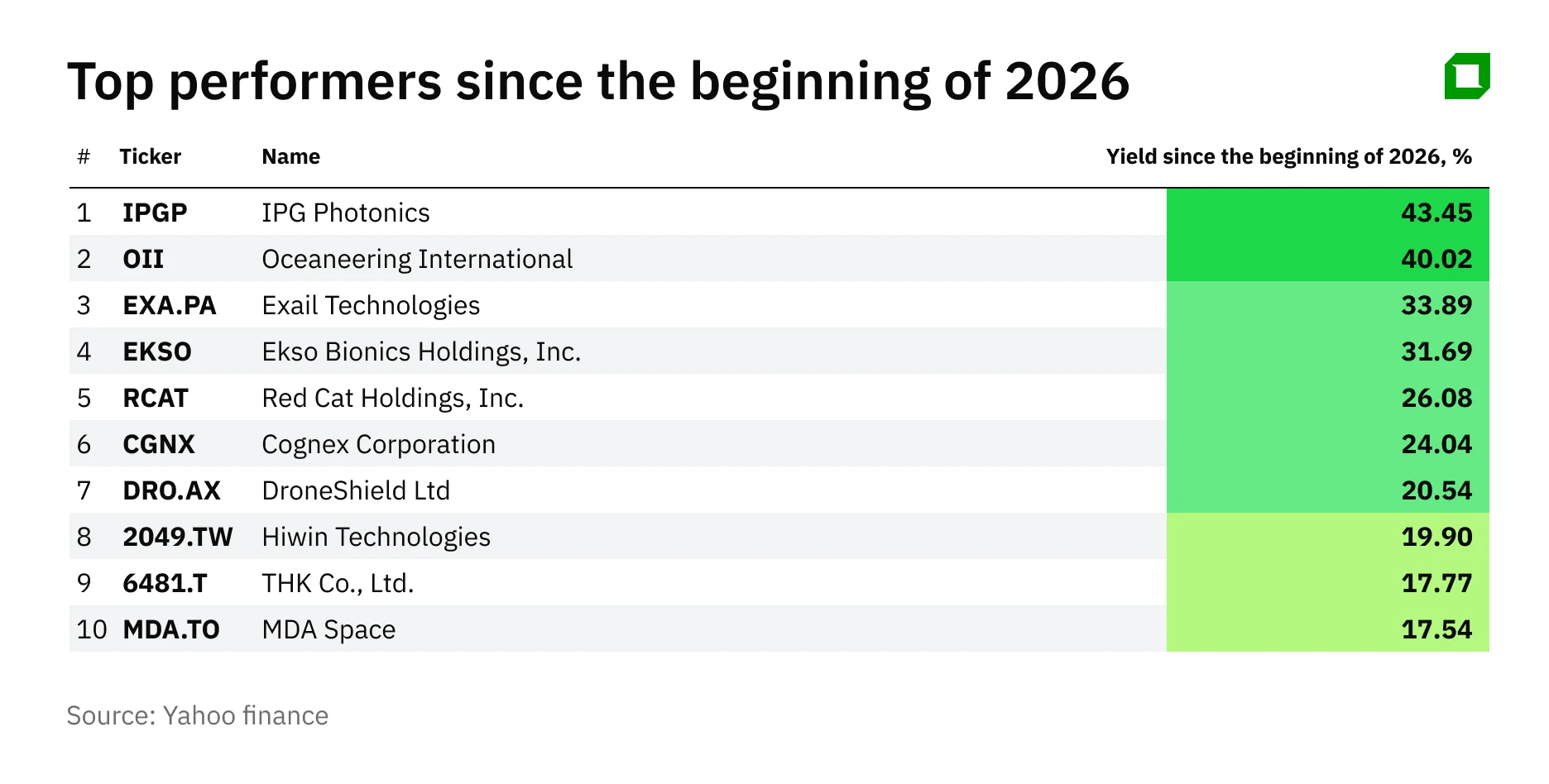
The sector remains highly differentiated: the spread of results between companies is significant, which increases risks for investors. Nevertheless, the overall trend looks consistently positive - investments in "physical AI", including robotics, continue to gain momentum and attract more attention from both strategic players and financial investors.
We have selected three companies from the Oninvest index that investors should pay attention to:
Exail Technologies
French high-tech group Exail Technologies, specializing in marine robotics and inertial navigation, has become one of the brightest beneficiaries of the industry rally. By the end of 2025, its capitalization has grown more than fivefold.
The rapid rise in quotations was underpinned by strong operational performance, with revenues up 28% year-on-year to over €479 million in 2025 and new orders up 87% to €844 million.
Analysts at Kepler Cheuvreux reiterated a Buy rating for the company's stock in a report on February 18, 2026, citing strong competitive advantages and strong demand for Exail's solutions. The company's stock has six Buy ratings and two Hold ratings, Market Screener shows. The average target is $155, meaning the stock could rise 30% by the closing price on March 31.
MDA Space
Canada's MDA Space is a manufacturer of space satellite systems and robotics. MDA Space benefits from several key trends: the increasing share of local contractors in military procurement, the growing Canadian military budget, and the active development of commercial space programs where MDA acts as a contractor.
Financial momentum also remains strong overall. In the third quarter of 2025, the company's revenue grew 45% year-over-year to CAD 409.8 million ($296.2 million), while its order book increased to CAD 4.4 billion ($3.2 billion). Net income increased by 33% to 46 million Canadian dollars.
Morgan Stanley estimates that rising defense spending and the convergence of space and military technologies are creating a sustainable long-term growth driver for MDA Space. The company's stock has eight "buy" ratings, according to MarketWatch. The average target of $53.6 suggests the stock could rise to more than double its current price on the NYSE.
Ekso Bionics
US-based Ekso Bionics, a developer of exoskeletons for medical and industrial applications. In December, Ekso Bionics obtained exclusive distribution rights in the US for the BalanceTutor rehabilitation system and is simultaneously considering strategic options, including a possible deal with Applied Digital to develop the ChronoScale GPU platform and even the sale of part of its exoskeleton business.
In the third quarter of 2025, revenue increased 2% year-over-year to $4.2 million, while net loss decreased 31% year-over-year to about $1.4 million. In January 2026, the company raised an additional $5.9 million, which strengthened liquidity and provided additional resource for business development.
Nevertheless, SADIF analysts assessed Ekso Bionics' financial profile with increased operational risks, so investing in the company's shares requires a careful approach and controlling the share in the portfolio. According to MarketWatch, the company has a single rating of "hold," with a target price of $90. It assumes growth of quotations almost nine times of the current value.
Does not constitute individualized investment advice.
