The OpenAI phone: can it kill mobile apps?

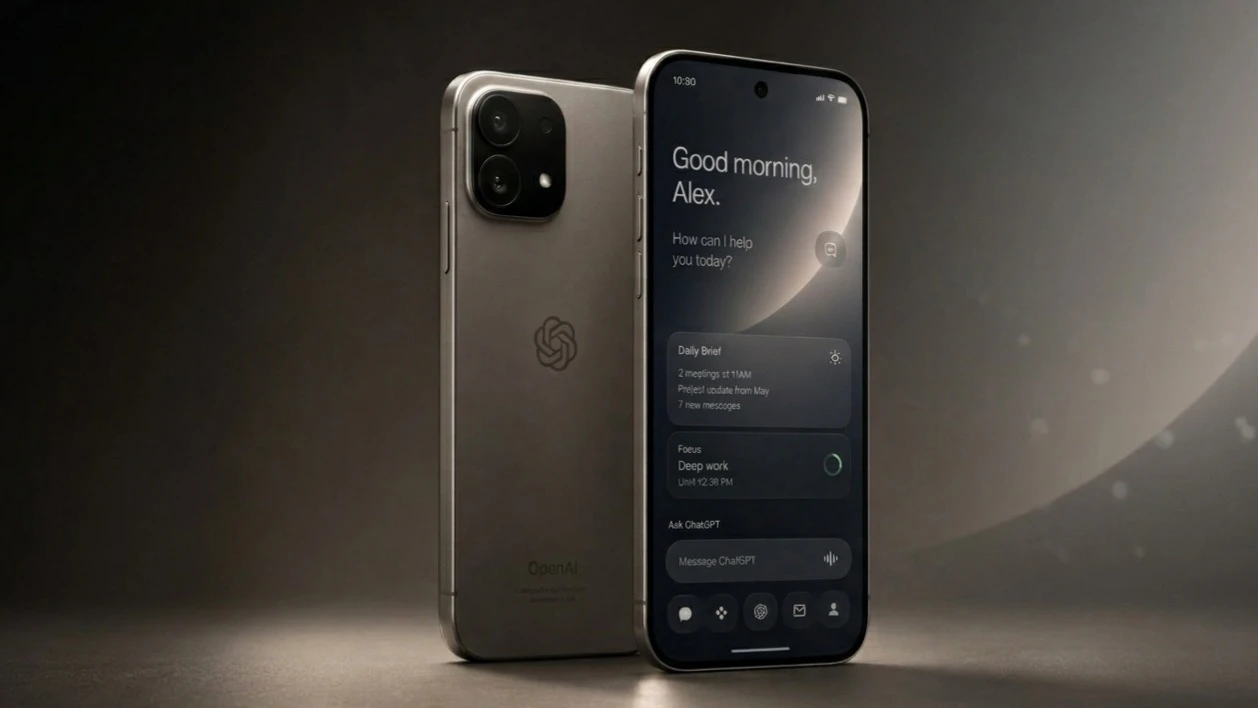
OpenAI could start producing its own smartphone in 2027. Here's how GPT Image 2 sees it
The first hardware device from OpenAI could be a smartphone with an AI agent. It is possible that the company will start its mass production early next year, and the phone will run on a new powerful chip from MediaTek, finalized specifically for the needs of OpenAI. This was written about in X in early May by well-known industry analyst Ming-Chi Kuo. He's been following OpenAI's plans to release its own gadget since the company announced last May that it was partnering with the legendary Jony Ive, Apple's former vice president of industrial design.
Cumulative smartphone shipments from OpenAI between 2027 and 2028 could reach 30 million units, roughly on par with a typical Samsung flagship model, The Verge wrote .
There has been no official comment on this information from OpenAI.
Ilya Chernetsky, the creator of the CoinKeeper personal finance accounting application, discusses what a new smartphone from an AI developer should be like in his Telegram channel. Oninvest publishes a slightly edited version of his post.
***
It's weird that for almost three weeks now everyone has been ignoring the news that OpenAI is planning to release its own phone next year. And no, it's not what Sam Altman bought Jony "our Apple" Ive's companyfor (OpenAI bought io, a startup that develops AI-powered devices, for $6.5 billion in May 2025. It is co-founded by Ive. At the same time, the parties announced that Ive would develop gadgets for OpenAI - ed. note).
And amazingly, no one has yet posted in Threads that the end of mobile apps has come, even though even the T3 edition article explicitly states that it will be a post-app device.
"The idea is," writes T3, "to have agent AI do everything, instead of the user switching between apps to accomplish their tasks.
I think the idea is different. On the one hand, OpenAI needs to avoid the mistake of the Facebook Phone, which was just Android "with a strapped on top" of a buggy Facebook. It needs to offer a whole new experience. And it shouldn't be something like "ChatGPT, calculate my finances" or "ChatGPT, tell me about the weather." In other words, you can't just use chat, you need a visually rich interface.
But even this is not enough, we need services that people are used to: banking, TikTok and Instagram, messengers. Building another developer ecosystem is hard (OpenAI has already tried, remember GPTs and all this). But here's the question: why do we need developers in 2026 if there is Codex.
I think the idea that OpenAI is pursuing is that they will collect all the open APIs (and agree on enough closed ones), and then offer the user the opportunity to "build" their own set of applications, and let people customize them.
This is a kind of next step after AI-builders like Rork and Replit(platforms for building applications with AI - ed.), but with a reliance on API/MCP(interfaces for connecting and interacting with external services and tools - ed. ).
Let's start with a simple one. The four most important and frequently used applications on your phone: mail, messenger, browser and caller. "Build me a Gmail client that shows me only private emails and collects all newsletters into a daily digest." "Make me a client that chats WhatsApp, Telegram and iMessage with SMS together." "Make me a mobile Chrome, just so it has convenient automatic tab grouping." "Make a caller with buttons that don't piss me off, make no mistake."
The most difficult thing will be securitized infrastructure(security systems, protected services and access control mechanisms), such as banking, but most likely they will agree. Maybe they will even make some kind of internal appstore for this, but so that everything can be customized for the user.
Most likely, they'll make some sort of upgrade tool to hook up an old phone, pull all the apps from it, and recreate it on a new device. Basically, there's a lot of stuff that will have to be done to make this thing take off. And most likely, it might not work the first time (but maybe 3.5 times it will?).
It seems we need to recognize that when the cost of writing code is rapidly rolling towards zero, the interface and even partially backend layers will be left to the users. And the value will remain in models and tokens, in closed data and platforms. But mobile applications, like SaaS services as we know them, will cease to exist.
This article was AI-translated and verified by a human editor