Apple vs. Samsung: How Their Battle Will Change the Foldable Smartphone Market

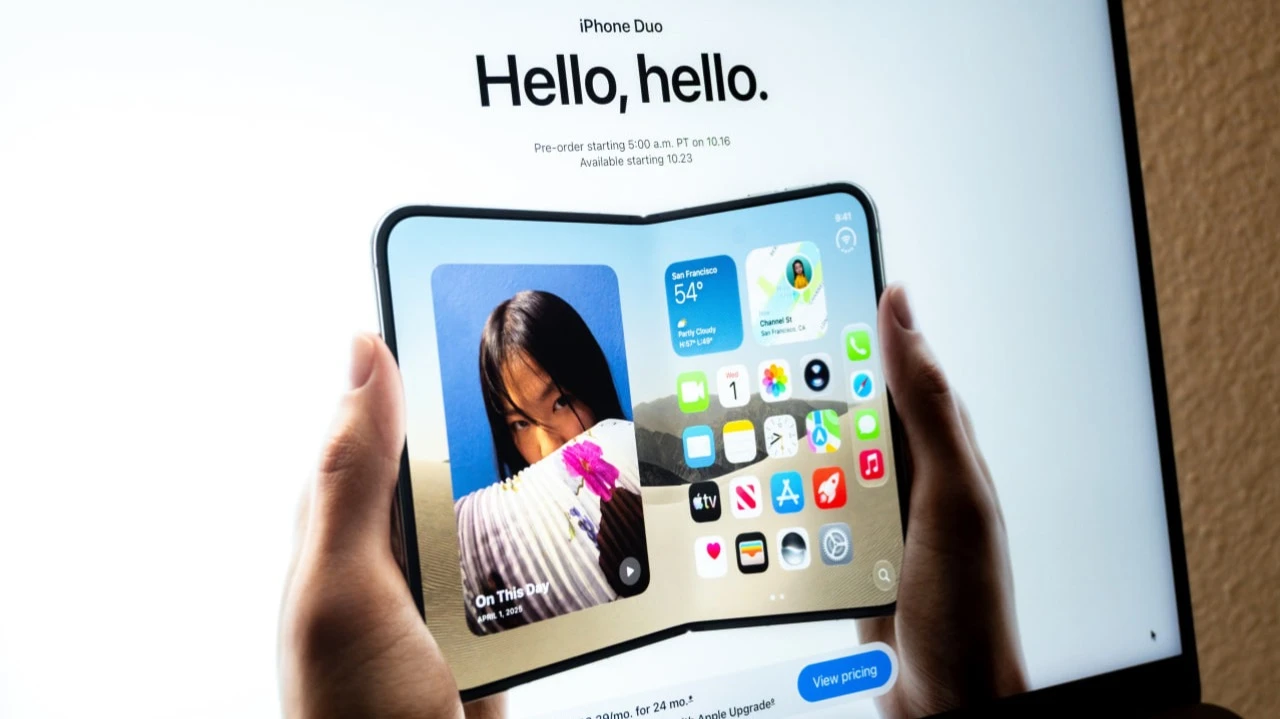
Following the release of the iPhone Duo, the main battle in the foldable smartphone market will be between Apple and Samsung. Photo: agustin.photo / Shutterstock.com
On September 9, 2026, a presentation titled “Amaze and Shine” took place at Apple’s headquarters in Cupertino—the first in 15 years to be led not by Tim Cook, but by the new CEO, John Turnus. The highlight of the event was the debut of the iPhone Duo, the first foldable iPhone. CNN called it nothing less than “the most significant change in the history of the iPhone.” But wait a minute—Samsung and other companies have been making foldable smartphones for quite some time now. How will the market change now?
New Captain
For 51-year-old Turnus, this was his debut. He had been with the company for 25 years (just think about it—half his life!) and took over the reins from Tim Cook on September 1.

Ternus began his career at Apple in 2001 as part of the product design team; by 2013, he had become vice president of hardware engineering, and in 2021, he was promoted to senior vice president. He played a key role in the development of the iPhone, iPad, MacBook, and Apple Watch—virtually all the hardware that has made Apple one of the most valuable companies in the world.
Ternus took the helm of the company at a challenging time. Due to a shortage and rising prices of memory chips, global smartphone shipments in the second quarter of 2026 fell by 11%, to a 13-year low, and Apple lost its global market share leadership to Samsung—20% versus 24% during the reporting period, according to Counterpoint Research.
And then, right at the very end of the presentation, just when it seemed that everything important had already been shown, Ternus said Steve Jobs’s famous “one more thing.” The audience erupted in applause. The iPhone Duo appeared on the screen, folded in half, and then slowly opened like a book.
What Is the iPhone Duo?
The iPhone Duo is a foldable smartphone with two screens. When folded, it has a 5.4-inch external display; when unfolded, it has a 7.6-inch internal display, which is comparable in size to a small tablet. The Grade 5 aluminum hinge contains more than 100 specially designed components. It features a 48-megapixel camera, an A20 Pro chip (the same as in the iPhone 18 Pro), and a battery that provides up to 31 hours of video playback on the inner screen. Prices start at $1,999 for the 256 GB model, with shipments scheduled to begin on October 23.
Apple suggests using the iPhone Duo as a smartphone, tablet, and video player—a convenient way to watch videos without having to hold the device in your hands.
The new form factor also lets you take selfies with a powerful rear-facing camera (selfies are important in today’s world). In addition, during the presentation, Craig Federighi, senior vice president of software, showed the iPhone Duo folded into a “house” shape on a nightstand. “It’s adelightful bedside clock, ”he said.
A bedside clock for almost $2,000? Well, if you're an Apple fan, maybe. However, the American Academy of Sleep Medicine advises against keeping a smartphone in the bedroom to avoid the temptation to "check your feed and notifications one last time," as Mashable points out.
But that's not even the main issue. Actually, foldable smartphones have been on the market for quite some time.
"You're reheating our leftovers"
Samsung's first commercial foldable smartphone, the Galaxy Fold, was released in 2019, and its launch wasn't exactly a success. Journalists who received review units reported cracked screens, dust under the display, and hinge issues. Samsung had to postpone the launch, refine the design, and apologize to customers.
But the company didn’t give up and has now released eight generations of foldable devices: the Galaxy Z Fold and Z Flip. On its website, it has described in detail the improvements to the hinges, the elimination of the crease on the screen, and the reduction in weight. The battle was literally fought over every thousandth of a gram. As a result, the latest Galaxy Z Fold 8, which went on sale in August of this year, weighs just 201 grams—lighter than many conventional smartphones. Overall, sales of Galaxy foldable phones grew by 30% in 2026, Dave Das, executive vice president of Samsung Electronics America, said in an interview with Fortune magazine.
Of course, Samsung couldn’t let an event like the launch of the foldable iPhone pass by unnoticed. As soon as Apple began its presentation, the official Samsung Mobile US account on X posted: “Same old, same old” (with the hashtag “It’sTimeToSwitch” #ItsTimeToSwitch). When the iPhone 18 Pro was shown, Samsung quipped: “Looks very familiar. Is this a sequel to The Sims?” When Turnus kept the audience waiting for the foldable iPhone announcement, Samsung wrote: “Making us wait? Fine. We’ll just fold ours in three for now” (a nod to the latest foldable Galaxy Z TriFold).
And when the iPhone Duo was finally unveiled, Samsung came out with the most-quoted line of the evening: “Let us know when you’re done reheating our leftovers.” Samsung’s most scathing posts garnered over 10 million views.
What difference does that make?
Jokes aside, the iPhone Duo could seriously change the foldable smartphone market. Today, it’s a fairly niche product, accounting for only about 2% of the total smartphone market. According to Counterpoint Research, by the end of 2026, the total number of foldable smartphones sold worldwide since the introduction of this device category will exceed 100 million. By comparison, more than a billion conventional smartphones are sold each year.
According to research firm Omdia (as cited by Reuters), Apple’s entry into the foldable smartphone market will drive the largest annual increase in shipments of such devices since 2021. Omdia forecasts that the market size will reach 22.3 million devices in 2026.
According to Counterpoint’s forecast, by the end of 2026, the foldable smartphone category will grow by 21% year-over-year, and Apple will immediately capture a quarter of the market. Samsung, meanwhile, will retain its leadership with a 32% market share (down from 40% last year).
In 2027, global shipments of foldable devices will grow by another 37%. The main driver will be the first full year of iPhone Duo sales: shipments are expected to more than double, and Apple’s share of this category will reach 40%, according to a study by Counterpoint Research.
This doesn’t mean, of course, that owners of Korean and Chinese phones will rush out to buy the iPhone Duo. According to a SellCell survey (5,000 respondents), leading brands enjoy high customer loyalty. When asked, “Will you switch brands when you upgrade your smartphone next time?” 96.4% of iPhone users answered “no”—a record high—but Samsung’s figure isn’t much lower at 90.1%.
Most likely, the foldable smartphone market will grow primarily thanks to Apple’s existing user base—many of the more than one billion active iPhone users will probably want to try out the new product.
However, competitors are also developing new models in this format— among them, in addition to Samsung, are companies such as Xiaomi, Motorola, HONOR, Google, vivo, and OPPO. But the main battle will likely unfold between the current leader, Samsung, and the newcomer to the category—Apple.
A Niche or the Future?
Skeptics will say that seven years is enough time for the category to have “taken off,” which hasn’t happened yet. Foldable smartphones remain an expensive ($1,500–2,000) niche segment. Why should anything change?
But, on the other hand, Apple has never been a pioneer. Yes, Samsung, Huawei, and Motorola have been in the foldable smartphone market for a long time, but Apple is famous not for creating fundamentally new technologies, but for its ability to package existing ones in such a way that they deliver a completely new user experience and thereby create new mass-market categories. That’s exactly what the first iPhone, introduced in 2007, was. It was the start of the smartphone revolution.
During the presentation, Ternus had already criticized existing models of foldable smartphones: “They’re like two phones awkwardly glued together.”
It is understood that the iPhone Duo will be completely different, allowing users to take full advantage of the new form factor—this will require not only technical excellence but also a complete software overhaul. And there is no doubt that Apple has done exactly that.
It remains to be seen whether “foldables” will break out of their niche and become truly popular. At the very least, Wall Street analysts are in no hurry to revise their current estimates for Apple. Of 46 analysts, 28 recommend buying the company’s stock, another 13 recommend holding it in portfolios, and only five recommend selling. That said, the company’s current stock price is roughly equal to the average price target set for it.
Who knows—maybe in a few years, we’ll be opening our smartphones just as naturally as we open a book. Although, wait a minute: who reads paper books these days?
This article was AI-translated and verified by a human editor